

Abstract / Overview
World modeling in AI is the practice of learning an internal predictive model of an environment—often in a compact latent space—so an agent can simulate “what happens next” under candidate actions and choose better actions with fewer real-world trials. This is the core idea behind many model-based reinforcement learning (MBRL) systems, modern “imagination-based” agents, and emerging video/spatial world models for robotics, simulation, and interactive media. (NVIDIA)
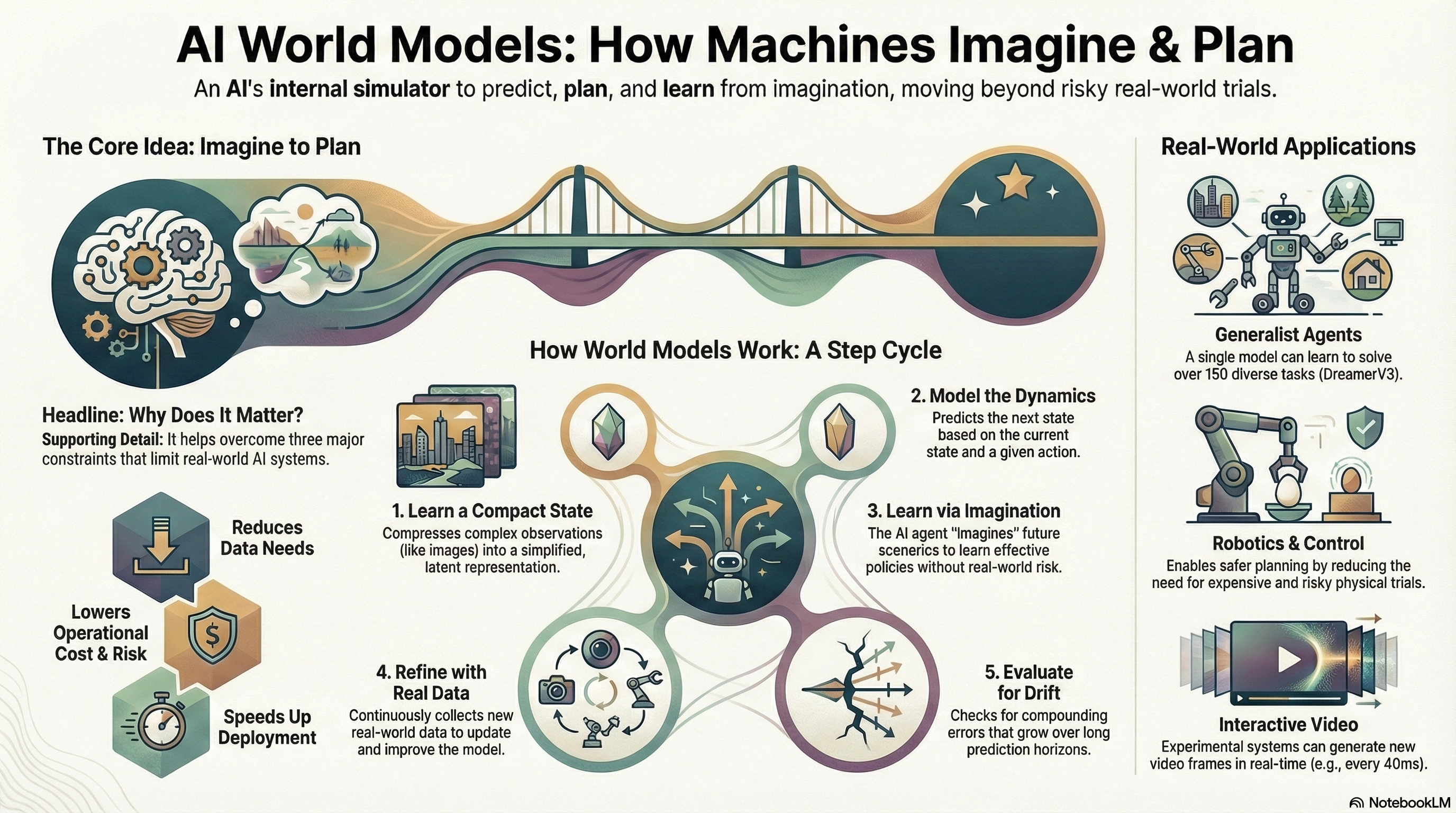
As of December 30, 2025, the field spans:
Classic MBRL world models that learn transition dynamics and plan through them. (arXiv)
Latent imagination agents such as DreamerV3, reported to work across 150+ diverse tasks with a single configuration. (arXiv)
Newer predictive representation approaches (for example, JEPA-style) that emphasize learning in abstract spaces rather than generating every pixel. (Meta AI)
Product-facing “interactive world” demos, including real-time video generation claims such as fresh frames every 40 milliseconds in experimental systems. (C# Corner)
Conceptual Background
What a “world model” means in AI
A world model is a learned function (or family of functions) that predicts how an environment evolves. In practice, it usually includes:
A representation model: compress observations into a latent state.
A dynamics model: predict the next latent state given the current latent state and action.
Optional heads: predict reward, value, termination, uncertainty, or auxiliary targets. (NVIDIA)
In MBRL, the agent uses the world model to plan. In latent imagination agents, the agent learns behavior by rolling out futures in latent space rather than in the external environment. (arXiv)
Why world models matter
World models target three hard constraints that limit real systems:
Data scarcity: robotics and operations cannot generate unlimited safe trials.
Cost and risk: real-world exploration can break hardware or violate safety constraints.
Time-to-deploy: planning in a learned simulator can reduce the number of expensive interactions needed. (arXiv)
Key lineage: from model-based RL to latent imagination
A minimal timeline of influential directions:
“World Models” (2018) demonstrates learning compressed spatial/temporal representations and training compact controllers on top. The paper’s framing emphasizes that the world model can be trained “quickly” in an unsupervised manner and then used as a feature extractor for control. (arXiv)
MuZero (2019/2020): learns a planning model that predicts the quantities most relevant to decision-making (reward, policy, value) instead of reconstructing full observations. (arXiv)
DreamerV3 (2023; later formal publication): learns in latent space and improves behavior by imagining futures; claims broad robustness across 150+ tasks. (arXiv)
Predictive representation approaches (for example, V-JEPA): learn by predicting masked/missing parts of video in an abstract representation space, pushing toward scalable physical understanding without pixel-perfect generation. (Meta AI)
Step-by-Step Walkthrough
Step 1: Define the environment interface
Assumption: you have an environment that yields observations o_t, accepts actions a_t, and returns rewards r_t (or task signals). You may be in:
Fully observed settings (games with full state).
Partially observed settings (robotics with camera + proprioception), requiring memory or belief state.
Deliverable: a clean data record format:
obs: raw observation (image, lidar, state vector)action: action takenreward: scalar reward or task metricdone: termination flagmeta: timestamps, safety constraints, scenario ID
Step 2: Learn a compact latent state
Most practical world models do not model pixels directly for planning. They learn a latent z_t (or s_t) that keeps information relevant for predicting outcomes. This is essential for long-horizon rollouts.
Common choices:
VAE-style encoders/decoders (image → latent → reconstruction)
Deterministic encoders + predictive objectives
Recurrent state-space models (RSSM) for partial observability (arXiv)
Step 3: Train the dynamics model (the “physics” of the latent)
Core objective: predict z_{t+1} from z_t and a_t.
Typical additions:
Reward head: predict
r_t(or dense task signal)Termination head: predict
doneUncertainty: ensembles or probabilistic heads to estimate epistemic uncertainty
This is where compounding error starts, so calibration matters.
Step 4: Learn behavior using imagined rollouts
Two common patterns:
Planning-based: run a planner (MCTS, shooting methods, CEM, trajectory optimization) inside the world model and execute the best first action. MuZero’s line is a canonical example of planning with a learned model. (arXiv)
Policy learning in latent imagination: learn a policy/value function by rolling out trajectories in latent space and optimizing expected return, as in Dreamer-style agents. (arXiv)
Step 5: Close the loop in the real environment
World models must be trained on data that matches how the agent actually behaves. Closed-loop training repeatedly:
collects new trajectories using the current policy/planner,
updates the world model on new data,
updates the policy/planner using the improved model.
Step 6: Evaluate like a simulator engineer, not only like an ML engineer
In world modeling, “loss went down” is insufficient. You need simulator-quality checks:
One-step prediction accuracy on held-out episodes.
Multi-step rollout error growth (error vs horizon).
Policy sensitivity: Does small model error flip action choices?
OOD robustness: new lighting, textures, dynamics perturbations.
Safety: constraint satisfaction under model uncertainty (safe exploration). (arXiv)
Process diagram

Code / JSON Snippets
Minimal pseudocode: latent dynamics world model + imagination
This snippet is intentionally minimal and framework-agnostic. It shows the conceptual training steps.
# Pseudocode: world model training + imagination-based policy improvement

for batch in replay_buffer.sample_sequences():
    o, a, r, done = batch.obs, batch.act, batch.rew, batch.done

    # 1) Encode observations into latent states
    z = encoder(o)  # possibly recurrent for partial observability

    # 2) Learn dynamics in latent space
    z_pred = dynamics(z[:-1], a[:-1])
    dyn_loss = loss(z_pred, z[1:])

    # 3) Optional auxiliary predictions
    r_pred = reward_head(z[:-1], a[:-1])
    done_pred = done_head(z[:-1], a[:-1])
    aux_loss = loss(r_pred, r[1:]) + loss(done_pred, done[1:])

    # 4) Update world model
    (dyn_loss + aux_loss).backward()
    world_model_optimizer.step()

    # 5) Imagine rollouts for policy/value updates
    z0 = stop_grad(z[-1])
    imagined = rollout_latent(dynamics, policy, z0, horizon=H)
    policy_loss = -expected_return(imagined)

    policy_loss.backward()
    policy_optimizer.step()
Sample workflow JSON: training and deployment pipeline
{
  "workflow_name": "world_modeling_ai_pipeline",
  "inputs": {
    "environment": "YOUR_ENV_ID",
    "observation_mode": ["rgb", "state_vector"],
    "action_space": "continuous",
    "safety_constraints": ["max_torque", "collision_free"]
  },
  "data": {
    "replay_buffer": {
      "capacity_steps": 5000000,
      "sequence_length": 50,
      "prioritized_sampling": true
    }
  },
  "models": {
    "encoder": { "type": "rssm_encoder", "latent_dim": 1024 },
    "dynamics": { "type": "latent_transition_model", "stochastic": true },
    "heads": {
      "reward": { "enabled": true },
      "termination": { "enabled": true },
      "uncertainty": { "enabled": true, "method": "ensemble", "members": 5 }
    },
    "policy": { "type": "actor_critic", "planning": { "enabled": false } }
  },
  "training": {
    "loop": ["collect", "update_world_model", "imagine", "update_policy", "evaluate"],
    "evaluation": {
      "metrics": ["one_step_loss", "rollout_error@5", "rollout_error@20", "task_return", "constraint_violations"],
      "ood_tests": ["lighting_shift", "mass_shift", "sensor_noise"]
    }
  },
  "deployment": {
    "mode": "receding_horizon",
    "fallback_policy": "model_free_backup",
    "monitoring": ["uncertainty_spikes", "constraint_violations", "distribution_shift_alerts"]
  }
}
Use Cases / Scenarios
Model-based control in robotics
Robots face expensive data and strict safety constraints. World models enable:
planning without executing every candidate trajectory,
safer exploration using uncertainty and constraint heads,
domain randomization via learned simulators (with caution about realism gaps). (NVIDIA)
Games and simulators: planning with learned models
MuZero demonstrates a pragmatic idea: learn a model tailored for planning—predict reward, value, and policy-relevant features—rather than reconstructing the full environment. This reframes “world modeling” as decision-sufficient modeling. (arXiv)
General agents that learn by imagination
DreamerV3 popularizes the pattern of learning behaviors by imagining futures in latent space and optimizing from those imagined trajectories. Its headline claim—single configuration across 150+ tasks—highlights the push toward generality in world-model agents. (arXiv)
Interactive video and spatial world models
Some systems frame world models as interactive scene generators, producing consistent frames under user actions. For example, reporting on Odyssey’s preview describes generating frames in real time, with claims like fresh frames every 40 milliseconds, emphasizing an “action-conditioned” view of video. (C# Corner)
For additional background coverage and news-style context, see C# Corner’s world-model topic area and related reporting. (C# Corner)
Limitations / Considerations
Compounding error and hallucinated dynamics
Multi-step rollouts drift. A model that looks good on one-step loss can be unusable for planning at horizon 50. Mitigations:
latent rollouts with regularization,
short-horizon planning with receding horizon control,
ensembles and uncertainty penalties,
periodic grounding with real observations.
Partial observability and memory
Real environments require belief states. RSSM-style latent dynamics and recurrent encoders help, but evaluation must include memory-sensitive tasks. (arXiv)
Objective mismatch: predicting pixels vs predicting decision-relevant variables
MuZero illustrates a key design decision: modeling what matters for planning (reward/value/policy) can outperform modeling everything. This is often more stable and efficient than pixel-perfect generation. (arXiv)
Safety and constraints
A world model can confidently predict unsafe trajectories if uncertainty is miscalibrated or the agent goes out of distribution. Safe RL variants integrate constraints into imagination/planning and emphasize cost minimization. (arXiv)
Evaluation leakage and simulator overfitting
Agents can exploit model errors (“dream hacking”). Robust evaluation requires:
randomized seeds,
varied initial states,
cross-validation across environment variations,
audits of imagined trajectories for exploit patterns.
Fixes
Imagined rollouts diverge after 10–20 steps
Fix: train with multi-step consistency losses; shorten planning horizon; use receding horizon; add uncertainty-aware penalties.
Policy exploits model loopholes
Fix: adversarial environment perturbations; ensemble disagreement penalties; periodically re-ground with real observations.
Model predicts well but control performance is poor
Fix: add decision-relevant heads (reward/done/value); add latent features targeted to control; consider MuZero-style modeling of planning quantities. (arXiv)
High performance in the sim, poor transfer to the real world
Fix: domain randomization; sensor noise modeling; calibration against real logs; conservative action constraints; uncertainty gating. (NVIDIA)
Training is unstable (posterior collapse, drifting latents)
Fix: balance reconstruction/prediction losses; normalize latents; use robust optimization tricks reported in DreamerV3-style work. (arXiv)
FAQs
1. Are world models the same as large language models?
No. LLMs primarily model token sequences, while world models target environment dynamics (physical, spatial, or action-conditioned state evolution). Some current research and industry commentary frames world models as a path beyond text-only intelligence toward grounded prediction and planning. (Business Insider)
2. Do world models require reinforcement learning?
Not always. You can train predictive world models from passive video or logs, then use them for planning, control, or representation learning. V-JEPA-style work emphasizes predictive learning in abstract spaces without necessarily generating pixels. (Meta AI)
3. What is the main practical advantage of a world model?
Reduced real-world interaction. When the model is accurate enough in the regions the policy visits, you can evaluate candidate futures in imagination and act more efficiently. Dreamer-style systems explicitly learn from imagined rollouts. (arXiv)
4. What is the biggest technical risk?
Model error under distribution shift. Planning can amplify small errors into catastrophic actions. Uncertainty estimation and conservative planning are not optional in safety-critical domains. (arXiv)
5. Is a generative video model automatically a usable world model?
Not automatically. A usable world model must be action-conditioned, temporally coherent, and decision-relevant. Real-time interactive demos are promising signals, but control-grade evaluation requires counterfactual consistency and robustness tests. (C# Corner)
References
NVIDIA Glossary: definition-oriented overview of world models. (NVIDIA)
Ha & Schmidhuber (2018), “World Models” (arXiv:1803.10122). (arXiv)
Schrittwieser et al. (2019/2020), “MuZero” (arXiv:1911.08265) and associated publication record. (arXiv)
Hafner (2023) DreamerV3 (arXiv:2301.04104) and later publication record, noting broad benchmark coverage. (arXiv)
Meta AI blog: V-JEPA overview (predictive learning in abstract video representation space). (Meta AI)
VL-JEPA (2025) arXiv: predictive JEPA-style vision-language approach with efficiency claims (example: fewer trainable parameters; reduced decoding operations). (arXiv)
SafeDreamer (2023): safe RL with world models. (arXiv)
Conclusion
World modeling in AI is best understood as predictive simulation for decision-making: learn compact latent state, learn dynamics, and use imagination (planning or policy learning) to choose actions with fewer real-world trials. The strongest modern patterns avoid naive pixel prediction, emphasize decision-relevant quantities, and treat uncertainty as a first-class signal. The practical path is iterative: build the model, evaluate rollout fidelity, integrate planning or imagination learning, and close the loop with real data while guarding against drift, exploitability, and unsafe out-of-distribution behavior.
Join the conversation! Your thoughts help the community grow.