

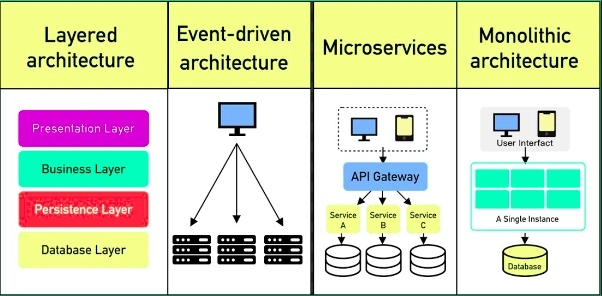
Image source: online
This blog is your definitive guide to eight key software architectures—monolithic, microservices, SOA, event-driven, layered, serverless, hexagonal, and domain-driven design (DDD), crafted for a global audience. With real-world examples, C# code snippets, and costs in US dollars (USD), we’ll dive deep into business cases, use cases, ROI, TCO, manageability, scalability, and costing strategies. Designed to be business-friendly for non-technical leaders and developer-friendly with technical depth, this article progresses from basic to advanced scenarios, making it engaging, actionable, and inspiring.
Let’s unlock the architecture that will propel your business to new heights!
Table of Contents
- Why Software Architecture is Your Business’s Secret Weapon
- Monolithic Architecture: The Simple Start for Startups
- What It Is
- Real-World Global Example
- Business Case
- Use Case
- ROI: Dollars and Sense
- TCO: Keeping Costs in Check
- Manageability: Easy or Overwhelming?
- Scalability: Growing Pains
- Costing Strategy: Budget Smart
- Scenarios: From Local to Global
- C# Code Example
- Microservices Architecture: Scaling Like a Tech Titan
- What It Is
- Real-World Global Example
- Business Case
- Use Case
- ROI: Dollars and Sense
- TCO: Keeping Costs in Check
- Manageability: Easy or Overwhelming?
- Scalability: Sky’s the Limit
- Costing Strategy: Budget Smart
- Scenarios: From Regional to Global
- C# Code Example
- Service-Oriented Architecture (SOA): Connecting Legacy to Modern
- What It Is
- Real-World Global Example
- Business Case
- Use Case
- ROI: Dollars and Sense
- TCO: Keeping Costs in Check
- Manageability: Easy or Overwhelming?
- Scalability: Growing with Limits
- Costing Strategy: Budget Smart
- Scenarios: From Regional to Enterprise
- C# Code Example
- Event-Driven Architecture: Real-Time Magic for Dynamic Businesses
- What It Is
- Real-World Global Example
- Business Case
- Use Case
- ROI: Dollars and Sense
- TCO: Keeping Costs in Check
- Manageability: Easy or Overwhelming?
- Scalability: Built for Speed
- Costing Strategy: Budget Smart
- Scenarios: From Local to Global
- C# Code Example
- Layered (N-Tier) Architecture: The Organized Enterprise Choice
- What It Is
- Real-World Global Example
- Business Case
- Use Case
- ROI: Dollars and Sense
- TCO: Keeping Costs in Check
- Manageability: Easy or Overwhelming?
- Scalability: Steady but Limited
- Costing Strategy: Budget Smart
- Scenarios: From Small to Enterprise
- C# Code Example
- Serverless Architecture: Pay Only for What You Use
- What It Is
- Real-World Global Example
- Business Case
- Use Case
- ROI: Dollars and Sense
- TCO: Keeping Costs in Check
- Manageability: Easy or Overwhelming?
- Scalability: Effortless Growth
- Costing Strategy: Budget Smart
- Scenarios: From Startup to Global
- C# Code Example
- Hexagonal (Ports and Adapters) Architecture: Flexibility for the Future
- What It Is
- Real-World Global Example
- Business Case
- Use Case
- ROI: Dollars and Sense
- TCO: Keeping Costs in Check
- Manageability: Easy or Overwhelming?
- Scalability: Flexible Growth
- Costing Strategy: Budget Smart
- Scenarios: From Regional to Global
- C# Code Example
- Domain-Driven Design (DDD) Architecture: Mastering Complex Business Needs
- What It Is
- Real-World Global Example
- Business Case
- Use Case
- ROI: Dollars and Sense
- TCO: Keeping Costs in Check
- Manageability: Easy or Overwhelming?
- Scalability: Precision Scaling
- Costing Strategy: Budget Smart
- Scenarios: From Small to Enterprise
- C# Code Example
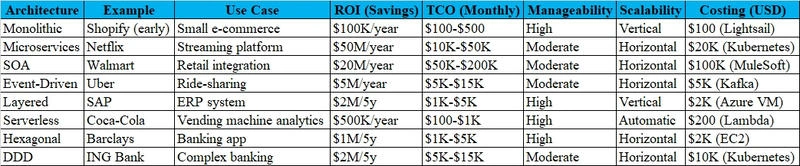
- Comparison Table: Your At-a-Glance Guide
- Choosing the Right Architecture for Your Global Business
- Conclusion: Architecting Your Path to Global Success
1. Why Software Architecture is Your Business’s Secret Weapon
Imagine launching an online store that rivals Amazon or a ride-sharing app as seamless as Uber. The secret? Software architecture—the blueprint that determines how your app is built, scales, and performs. In a digital economy contributing $11.5 trillion to global GDP (projected for 2025), the right architecture can make or break your business. It’s not just tech jargon; it’s a strategic decision that impacts your bottom line, customer experience, and growth potential.
This guide is your roadmap to eight powerful software architectures, designed to be business-friendly for CEOs and entrepreneurs, user-friendly for non-technical readers, and developer-friendly with technical depth. We’ll use real-world examples (e.g., Netflix, Uber), C# code snippets, and costs in USD to explore business cases, use cases, ROI, TCO, manageability, scalability, and costing strategies. From startups to enterprises, we’ll cover basic to advanced scenarios, addressing global challenges like infrastructure reliability, skill availability, and cost sensitivity. Ready to architect your success? Let’s dive in!
2. Monolithic Architecture: The Simple Start for Startups
What It Is
Picture a single, all-in-one shop where everything—sales, inventory, payments—happens under one roof. A monolithic architecture combines all app functions (UI, logic, database) into a single codebase, making it easy to build and deploy but harder to scale.
Real-World Global Example
- Business: Shopify (early days)
- Context: Shopify’s initial e-commerce platform was a monolithic Ruby app, managing stores, payments, and inventory, enabling rapid market entry in 2006.
- Why It Worked: A single app allowed Shopify to launch quickly, serving thousands of merchants with minimal infrastructure.
Business Case
- Problem: Startups need affordable, fast-to-launch solutions to compete in crowded markets.
- Solution: Monolithic apps require minimal setup, ideal for small teams with limited budgets.
- Outcome: Shopify scaled to 1M+ merchants, later adopting microservices as complexity grew.
- Business Impact: Enabled rapid revenue generation ($1M+ in first year) with low initial costs.
Use Case
- Scenario: A startup in New York launching an online marketplace for artisanal goods, handling product listings, Stripe payments, and inventory.
- Why Monolithic?: One app simplifies development and maintenance for a lean team.
ROI: Dollars and Sense
- Benefits
- Fast Time-to-Market: Launch in 3-6 months, driving early revenue.
- Low Initial Costs: Affordable for startups with $50,000-$100,000 budgets.
- Quantifiable ROI: A $50,000 investment could generate $100,000 in sales within a year, yielding 100% ROI.
- Global Context: Monoliths are popular for startups in emerging markets (e.g., India, Brazil) due to cost efficiency.
TCO: Keeping Costs in Check
- Initial Costs: $30,000-$100,000 (global .NET developers charge ~$5,000/month).
- Ongoing Costs: $100-$500/month for hosting (e.g., AWS Lightsail) and maintenance.
- Challenges: Scaling costs rise with traffic (e.g., $1,000/month for high-traffic servers).
- Risks: Large codebases become unwieldy, increasing maintenance costs over time.
Manageability: Easy or Overwhelming?
- Ease: High; single codebase simplifies debugging, updates, and deployment.
- Challenges: As features grow (e.g., adding international shipping), the codebase becomes complex, slowing development.
- Global Context: Ideal for startups with limited DevOps skills, common in regions like Southeast Asia.
Scalability: Growing Pains
- Type: Vertical (add CPU, RAM to servers).
- Limitations: Scaling the entire app is costly and inefficient for high traffic.
- Example: Shopify faced slowdowns during Black Friday sales, requiring expensive server upgrades.
- Global Context: Vertical scaling suits small-to-medium businesses but struggles with global traffic spikes.
Costing Strategy: Budget Smart
- Approach: Use affordable cloud hosting (e.g., AWS Lightsail, Heroku) or local providers in cost-sensitive regions.
- Optimization: Monitor server usage to avoid over-provisioning; start with shared hosting (~$50/month).
- Example Cost: $100/month for a basic AWS Lightsail instance.
Scenarios
- Basic: A local craft store in London selling online.
- Solution: Monolithic .NET app for sales, inventory, and Stripe payments.
- Outcome: Costs $20,000, generates $50,000/year, but struggles with 1,000 daily orders.
- Business Impact: Quick launch enables early revenue, but scaling limits growth.
- Advanced: A regional retailer in Singapore with ERP integration.
- Solution: Monolithic system for sales, inventory, and ERP, but scaling for global orders is costly.
- Outcome: Costs $100,000, saves $200,000/year in manual processes, but maintenance rises to $1,000/month.
- Business Impact: Efficient for regional operations but requires migration for global scale.
C# Code Example
using Microsoft.AspNetCore.Mvc;

namespace ECommerceApp.Controllers
{
    [ApiController]
    [Route("api")]
    public class StoreController : ControllerBase
    {
        private static Dictionary<string, int> inventory = new()
        {
            { "handbag", 100 },
            { "scarf", 50 }
        };

        private static List<string> orders = new();
        private static List<User> users = new();

        [HttpPost("buy")]
        public IActionResult BuyItem([FromBody] OrderRequest request)
        {
            if (inventory.ContainsKey(request.Item) && inventory[request.Item] > 0)
            {
                inventory[request.Item]--;
                orders.Add(request.Item);
                return Ok(new { Message = "Order placed!", OrderId = orders.Count });
            }

            return BadRequest("Out of stock!");
        }

        [HttpGet("stock")]
        public IActionResult CheckStock()
        {
            return Ok(inventory);
        }

        [HttpPost("users")]
        public IActionResult CreateUser([FromBody] User user)
        {
            users.Add(user);
            return Ok(new { Message = "User created", UserId = user.Id });
        }
    }

    public class OrderRequest
    {
        public string Item { get; set; }
    }

    public class User
    {
        public string Id { get; set; }
        public string Name { get; set; }
    }
}
Explanation: This .NET Core app handles sales, inventory, and user management in one codebase, perfect for a startup but challenging to scale for high traffic.
3. Microservices Architecture: Scaling Like a Tech Titan
What It Is
Imagine a shopping mall with independent stores for clothes, electronics, and food, each running its own operations but connected via walkways. Microservices split an app into small, independent services (e.g., payments, inventory) that communicate via APIs, enabling flexibility and scalability.
Real-World Global Example
- Business: Netflix
- Context: Netflix uses microservices to manage streaming, user accounts, and recommendations, serving 200M+ users across 190 countries.
- Why It Worked: Independent services allow Netflix to scale streaming during peak hours and deploy updates daily without downtime.
Business Case
- Problem: Global platforms need to handle millions of users and frequent updates without disruptions.
- Solution: Microservices enable independent scaling and updates for each function, ensuring high availability.
- Outcome: Netflix achieves 99.99% uptime, streaming 250M+ hours daily, boosting revenue to $25B annually.
- Business Impact: High availability and rapid feature rollouts drive user retention and growth.
Use Case
- Scenario: A global video streaming platform managing content delivery, PayPal payments, and personalized recommendations.
- Why Microservices?: Scales recommendation services independently during peak viewing hours, ensuring smooth performance.
ROI: Dollars and Sense
- Benefits:
- High Availability: 1% downtime reduction saves $10M/year for platforms with $1B revenue.
- Rapid Updates: Daily deployments attract users, increasing subscriptions.
- Quantifiable ROI: A $1M investment in microservices could save $50M/year by minimizing downtime and enabling targeted scaling.
- Global Context: Essential for tech giants in the US, Europe, and Asia, where user bases exceed millions.
TCO: Keeping Costs in Check
- Initial Costs: $500,000-$2M for development, DevOps setup (e.g., Kubernetes), and CI/CD pipelines.
- Ongoing Costs: $10,000-$50,000/month for cloud hosting (e.g., AWS EKS), monitoring (e.g., Prometheus), and maintenance.
- Challenges: Distributed systems increase operational complexity, requiring skilled teams.
- Risks: Over-provisioning or poor service design can inflate costs.
Manageability: Easy or Overwhelming?
- Ease: Moderate; requires DevOps expertise and tools like Kubernetes, Docker, and centralized logging (e.g., ELK stack).
- Challenges: Debugging across services is complex; inter-service communication failures can cause outages.
- Global Context: Requires skilled teams, readily available in tech hubs like Silicon Valley but costly in emerging markets.
Scalability: Sky’s the Limit
- Type: Horizontal (add instances of specific services).
- Strengths: Scales only the needed services (e.g., Netflix scales streaming without touching billing).
- Example: Netflix handles 10x traffic spikes during new show releases.
- Global Context: Ideal for global platforms with unpredictable traffic patterns.
Costing Strategy: Budget Smart
- Approach: Use cloud platforms (e.g., AWS EKS, Google Cloud, Azure AKS) for orchestration.
- Optimization: Leverage auto-scaling, spot instances, and serverless components to reduce costs.
- Example Cost: $20,000/month for a mid-sized Kubernetes cluster with 10 services.
Scenarios
- Basic: A mid-sized e-commerce startup in Berlin.
- Solution: Microservices for product catalog, payments, and user management.
- Outcome: Costs $200,000, scales for 10,000 daily users, saving $500,000/year in downtime.
- Business Impact: Enables rapid feature updates, attracting new customers.
- Advanced: A global bank like HSBC integrating mobile banking, ATMs, and online payments.
- Solution: Microservices for each channel ensure scalability and compliance.
- Outcome: Costs $2M, saves $10M/year in operational efficiency.
- Business Impact: Supports global expansion with minimal downtime.
C# Code Example
Two .NET Core microservices for an e-commerce platform:
// Product Service (ProductService.cs)
using Microsoft.AspNetCore.Mvc;

namespace ProductService.Controllers
{
    [ApiController]
    [Route("api/products")]
    public class ProductController : ControllerBase
    {
        private readonly ProductRepository _repo;

        public ProductController(ProductRepository repo)
        {
            _repo = repo;
        }

        [HttpPost]
        public IActionResult AddProduct([FromBody] Product product)
        {
            _repo.Save(product);
            return Ok(new { Message = "Product added", ProductId = product.Id });
        }
    }

    public class ProductRepository
    {
        public void Save(Product product)
        {
            // Save to database (e.g., MongoDB)
            Console.WriteLine($"Saved product: {product.Name}");
        }
    }

    public class Product
    {
        public string Id { get; set; }
        public string Name { get; set; }
        public decimal Price { get; set; }
    }
}

// Payment Service (PaymentService.cs)
using Microsoft.AspNetCore.Mvc;

namespace PaymentService.Controllers
{
    [ApiController]
    [Route("api/payments")]
    public class PaymentController : ControllerBase
    {
        private readonly PaymentProcessor _processor;

        public PaymentController(PaymentProcessor processor)
        {
            _processor = processor;
        }

        [HttpPost]
        public IActionResult ProcessPayment([FromBody] Payment payment)
        {
            _processor.Process(payment);
            return Ok(new { Message = "Payment processed", PaymentId = payment.Id });
        }
    }

    public class PaymentProcessor
    {
        public void Process(Payment payment)
        {
            // Process via PayPal API (simulated)
            Console.WriteLine($"Processed payment: ${payment.Amount}");
        }
    }

    public class Payment
    {
        public string Id { get; set; }
        public decimal Amount { get; set; }
    }
}
Explanation: Each service (product, payment) runs independently, allowing targeted scaling and updates but requiring robust coordination.
4. Service-Oriented Architecture (SOA): Connecting Legacy to Modern
What It Is
Think of SOA as a city’s public transport hub connecting offices with buses. It uses an Enterprise Service Bus (ESB) to integrate business functions (e.g., inventory, billing) across systems, ideal for enterprises with legacy infrastructure.
Real-World Global Example
- Business: Walmart
- Context: Walmart uses SOA to integrate its e-commerce platform with inventory, logistics, and payment systems across 10,000+ stores worldwide.
- Why It Worked: SOA enabled Walmart to connect legacy systems with modern apps, streamlining operations.
Business Case
- Problem: Enterprises need to integrate legacy systems with new apps to stay competitive.
- Solution: SOA provides reusable services via an ESB, ensuring interoperability.
- Outcome: Walmart reduced inventory update times by 50%, saving $500M annually.
- Business Impact: Improved efficiency and customer satisfaction across global stores.
Use Case
- Scenario: A global retail chain integrating online sales, warehouse inventory, and POS systems.
- Why SOA?: The ESB ensures seamless data flow between disparate systems.
ROI: Dollars and Sense
- Benefits
- Reusability: Services can be reused across departments, reducing development costs.
- Efficiency: Streamlined operations save time and money.
- Quantifiable ROI: A $5M investment could save $20M/year in operational efficiency.
- Global Context: Widely used in retail, government, and finance for legacy integration.
TCO: Keeping Costs in Check
- Initial Costs: $5M-$10M for ESB setup (e.g., MuleSoft, IBM WebSphere) and integration.
- Ongoing Costs: $50,000-$200,000/month for ESB maintenance, cloud hosting, and support.
- Challenges: ESB maintenance is complex and costly, requiring specialized skills.
- Risks: ESB can become a bottleneck, increasing downtime if not optimized.
Manageability: Easy or Overwhelming?
- Ease: Moderate; ESB simplifies integration but requires expertise in tools like MuleSoft.
- Challenges: Central hub can be a single point of failure; monitoring is critical.
- Global Context: Requires skilled teams, costly in regions with skill shortages (e.g., Africa, South Asia).
Scalability: Growing with Limits
- Type: Horizontal (add service instances), but ESB limits throughput.
- Strengths: Scales services independently within ESB constraints.
- Example: Walmart scales inventory services during Black Friday sales.
- Global Context: Suitable for enterprises but less flexible than microservices for global scale.
Costing Strategy: Budget Smart
- Approach: Use cloud-based ESBs (e.g., MuleSoft on AWS, Azure Service Bus).
- Optimization: Optimize ESB performance and use cloud credits to reduce costs.
- Example Cost: $100,000/month for a mid-sized ESB deployment.
Scenarios
- Basic: A regional retailer in Australia integrating sales and inventory.
- Solution: SOA connects legacy POS systems to an online portal.
- Outcome: Costs $500,000, saves $1M/year in efficiency.
- Business Impact: Streamlines operations for regional growth.
- Advanced: A global logistics firm like DHL integrating supply chain systems.
- Solution: SOA ensures interoperability across regions.
- Outcome: Costs $10M, saves $50M/year in operational efficiency.
- Business Impact: Enables global supply chain optimization.
C# Code Example
WCF-based SOA service for inventory management:
using System.ServiceModel;

[ServiceContract]
public interface IInventoryService
{
    [OperationContract]
    string UpdateInventory(string itemId, int quantity);
}

public class InventoryService : IInventoryService
{
    public string UpdateInventory(string itemId, int quantity)
    {
        // Integrate with ESB (simulated)

        Console.WriteLine($"Updated inventory for {itemId}: {quantity} units");

        return $"Inventory updated for {itemId}: {quantity} units";
    }
}
Explanation: This WCF service integrates with an ESB, reusable across systems for inventory updates.
5. Event-Driven Architecture: Real-Time Magic for Dynamic Businesses
What It Is
Imagine a courier service where packages (events) trigger actions like deliveries. Event-driven architecture uses message brokers (e.g., Kafka) to send and process events asynchronously, perfect for real-time applications.
Real-World Global Example
- Business: Uber
- Context: Uber uses Kafka to process ride requests, driver assignments, and payments in real-time for 100M+ users across 70 countries.
- Why It Worked: Asynchronous event processing ensures low latency, handling 15M+ rides daily.
Business Case
- Problem: Real-time apps need to process millions of events with minimal delay.
- Solution: Event-driven systems handle asynchronous events, ensuring scalability and responsiveness.
- Outcome: Uber achieves sub-second ride matching, boosting revenue to $14B annually.
- Business Impact: Real-time performance drives customer satisfaction and retention.
Use Case
- Scenario: A global ride-sharing app processing bookings, driver notifications, and payments.
- Why Event-Driven?: Asynchronous events ensure fast, reliable service under high demand.
ROI: Dollars and Sense
- Benefits
- High Throughput: Reduces delays, improving user retention.
- Scalability: Supports growth to millions of users.
- Quantifiable ROI: A $1M investment could save $5M/year by reducing churn and improving performance.
- Global Context: Critical for real-time apps in transport, finance, and e-commerce worldwide.
TCO: Keeping Costs in Check
- Initial Costs: $500,000-$1M for Kafka setup, development, and DevOps.
- Ongoing Costs: $5,000-$15,000/month for cloud-hosted Kafka (e.g., AWS MSK) and monitoring.
- Challenges: Managing event consistency and broker reliability requires expertise.
- Risks: Misconfigured brokers can lead to event loss or delays.
Manageability: Easy or Overwhelming?
- Ease: Moderate; requires expertise in message brokers like Kafka or RabbitMQ.
- Challenges: Debugging event flows and ensuring delivery are complex.
- Global Context: Needs skilled DevOps teams, available in tech hubs but scarce in emerging markets.
Scalability: Built for Speed
- Type: Horizontal (add Kafka nodes or consumers).
- Strengths: Scales seamlessly for high event volumes.
- Example: Uber scales ride processing during rush hours.
- Global Context: Ideal for global apps with unpredictable event spikes.
Costing Strategy: Budget Smart
- Approach: Use managed Kafka services (e.g., AWS MSK, Confluent Cloud).
- Optimization: Tune partitions and consumers to minimize costs.
- Example Cost: $5,000/month for a small Kafka cluster.
Scenarios
- Basic: A local delivery service in Tokyo.
- Solution: Event-driven system for package tracking and notifications.
- Outcome: Costs $200,000, saves $500,000/year in delivery speed.
- Business Impact: Enhances customer satisfaction for local growth.
- Advanced: A global logistics firm like FedEx.
- Solution: Event-driven tracking for shipments across continents.
- Outcome: Costs $1.5M, saves $10M/year in efficiency.
- Business Impact: Enables real-time global logistics.
C# Code Example
Kafka producer-consumer in .NET for ride requests:
using Confluent.Kafka;

using System.Threading.Tasks;

public class RideProcessor
{
    private readonly ProducerConfig _producerConfig = new() { BootstrapServers = "localhost:9092" };

    private readonly ConsumerConfig _consumerConfig =
        new()
        {
            BootstrapServers = "localhost:9092",
            GroupId = "ride-group",
            AutoOffsetReset = AutoOffsetReset.Earliest
        };

    public async Task ProduceRideRequest(string rideId, string userId)
    {
        using var producer = new ProducerBuilder<Null, string>(_producerConfig).Build();

        await producer.ProduceAsync(
            "rides",
            new Message<Null, string> { Value = $"{{ride_id: {rideId}, user_id: {userId}}}" }
        );

        Console.WriteLine($"Sent ride request: {rideId}");
    }

    public void ConsumeRideRequests()
    {
        using var consumer = new ConsumerBuilder<Ignore, string>(_consumerConfig).Build();

        consumer.Subscribe("rides");

        while (true)
        {
            var message = consumer.Consume();

            Console.WriteLine($"Processing ride: {message.Value}");
        }
    }
}
Explanation: Ride requests are sent as events to Kafka, processed asynchronously for real-time performance.
6. Layered (N-Tier) Architecture: The Organized Enterprise Choice
What It Is
Think of a multi-story office where each floor handles a specific task—reception, accounting, storage. Layered architecture organizes software into layers (UI, business logic, data) for clarity and maintainability.
Real-World Global Example
- Business: SAP
- Context: SAP’s ERP systems use layered architecture to separate UI, business logic, and data, serving 400,000+ customers globally.
- Why It Worked: Organized layers ensure reliable, maintainable systems for complex enterprise needs.
Business Case
- Problem: Enterprises need structured systems to manage complex operations like inventory and HR.
- Solution: Layered architecture organizes code for easy maintenance and compliance.
- Outcome: SAP supports $1T in commerce annually with reliable ERP systems.
- Business Impact: Streamlined operations reduce costs and improve efficiency.
Use Case
- Scenario: A global ERP system managing inventory, HR, and finance.
- Why Layered?: Clear separation simplifies updates and regulatory compliance.
ROI: Dollars and Sense
- Benefits
- Low Maintenance Costs: Organized code reduces debugging time.
- Developer Onboarding: Easier to train teams on structured systems.
- Quantifiable ROI: A $500,000 investment could save $2M over 5 years in maintenance costs.
- Global Context: Widely used in enterprises across finance, manufacturing, and retail.
TCO: Keeping Costs in Check
- Initial Costs: $200,000-$500,000 for development and setup.
- Ongoing Costs: $1,000-$5,000/month for cloud hosting (e.g., Azure VMs) and maintenance.
- Challenges: Scaling entire layers can be costly and inefficient.
- Risks: Tight coupling between layers slows major updates.
Manageability: Easy or Overwhelming?
- Ease: High; layers simplify debugging and updates.
- Challenges: Tight coupling can complicate large-scale changes.
- Global Context: Familiar to developers globally, reducing training costs.
Scalability: Steady but Limited
- Type: Vertical (upgrade server resources).
- Limitations: Scaling entire layers is inefficient for high traffic.
- Example: SAP upgrades servers for peak ERP usage during financial reporting.
- Global Context: Suitable for enterprises with predictable workloads but less flexible for global scale.
Costing Strategy: Budget Smart
- Approach: Use cloud VMs (e.g., Azure VMs, AWS EC2).
- Optimization: Optimize database layer performance to reduce costs.
- Example Cost: $2,000/month for a mid-sized VM.
Scenarios
- Basic: A small manufacturing firm in Germany.
- Solution: Layered .NET app for inventory and sales.
- Outcome: Costs $100,000, saves $300,000/year in manual processes.
- Business Impact: Streamlines operations for small-scale growth.
- Advanced: A global corporation like Unilever.
- Solution: Layered ERP for worldwide operations.
- Outcome: Costs $1M, saves $5M/year in efficiency.
- Business Impact: Supports global supply chain management.
C# Code Example
Layered .NET Core ERP app:
using Microsoft.AspNetCore.Mvc;

namespace ERPApp.Controllers
{
    [ApiController]
    [Route("api/inventory")]
    public class InventoryController : ControllerBase
    {
        private readonly InventoryService _service;

        public InventoryController(InventoryService service)
        {
            _service = service;
        }

        [HttpPost]
        public IActionResult AddItem([FromBody] Item item)
        {
            return Ok(_service.AddItem(item));
        }
    }

    public class InventoryService
    {
        private readonly InventoryRepository _repo;

        public InventoryService(InventoryRepository repo)
        {
            _repo = repo;
        }

        public string AddItem(Item item)
        {
            _repo.Save(item);

            return $"Item {item.Name} added";
        }
    }

    public class InventoryRepository
    {
        public void Save(Item item)
        {
            // Save to database (e.g., SQL Server)

            Console.WriteLine($"Saved item: {item.Id}");
        }
    }

    public class Item
    {
        public string Id { get; set; }

        public string Name { get; set; }

        public int Quantity { get; set; }
    }
}
Explanation: Layers (controller, service, repository) separate tasks, ensuring clarity and maintainability.
7. Serverless Architecture: Pay Only for What You Use
What It Is
Imagine hiring a chef who cooks only when you order, charging per meal. Serverless architecture runs code in the cloud (e.g., AWS Lambda, Azure Functions) only when triggered, eliminating server management.
Real-World Global Example
- Business: Coca-Cola
- Context: Coca-Cola uses AWS Lambda to process real-time sales data from vending machines across 70 countries.
- Why It Worked: Serverless scales automatically, handling sales spikes without fixed server costs.
Business Case
- Problem: Businesses need cost-effective solutions for variable workloads like seasonal sales.
- Solution: Serverless scales automatically, charging only for usage.
- Outcome: Coca-Cola processes millions of transactions daily, saving $10M/year in server costs.
- Business Impact: Cost efficiency and scalability boost profitability.
Use Case
- Scenario: A global vending machine app processing sales and sending notifications.
- Why Serverless?: Pay-per-use saves costs for unpredictable demand.
ROI: Dollars and Sense
- Benefits:
- No Server Costs: Eliminates fixed infrastructure expenses.
- Auto-Scaling: Handles peak loads without manual intervention.
- Quantifiable ROI: A $100,000 investment could save $500,000/year compared to traditional servers.
- Global Context: Popular in retail, IoT, and startups for cost efficiency.
TCO: Keeping Costs in Check
- Initial Costs: $50,000-$100,000 for development and setup.
- Ongoing Costs: $100-$1,000/month for Lambda/Azure Function executions.
- Challenges: Cold start latency can affect performance; vendor lock-in is a risk.
- Risks: Overuse of functions can unexpectedly increase costs.
Manageability: Easy or Overwhelming?
- Ease: High; cloud providers manage infrastructure, reducing IT overhead.
- Challenges: Debugging serverless functions requires specialized tools (e.g., AWS CloudWatch).
- Global Context: Ideal for businesses with limited IT resources, common in startups and SMEs.
Scalability: Effortless Growth
- Type: Automatic (cloud provider scales).
- Strengths: Seamlessly handles unpredictable workloads.
- Example: Coca-Cola scales sales processing during global promotions.
- Global Context: Perfect for apps with variable traffic worldwide.
Costing Strategy: Budget Smart
- Approach: Use AWS Lambda, Azure Functions, or Google Cloud Functions.
- Optimization: Optimize function execution time and memory usage to reduce costs.
- Example Cost: $200/month for 1M Lambda executions.
Scenarios
- Basic: A startup IoT app in Canada processing sensor data.
- Solution: Serverless functions for real-time analytics.
- Outcome: Costs $50,000, saves $200,000/year in server costs.
- Business Impact: Enables rapid market entry with low overhead.
- Advanced: A global retail chain like Tesco.
- Solution: Serverless for sales analytics, notifications, and inventory updates.
- ** worsens: Outcome: Costs $200,000, saves $1M/year in scalability and infrastructure costs.
- Business Impact: Supports global operations with minimal IT overhead.
C# Code Example
AWS Lambda function in .NET Core for sales processing:
using Amazon.Lambda.Core;

using System.Text.Json;

public class SalesFunction
{
    [LambdaSerializer(
        typeof(Amazon.Lambda.Serialization.SystemTextJson.DefaultLambdaJsonSerializer)
    )]
    public async Task<APIGatewayProxyResponse> FunctionHandler(
        APIGatewayProxyRequest request,
        ILambdaContext context
    )
    {
        var sale = JsonSerializer.Deserialize<Sale>(request.Body);

        // Process sale (simulated)

        context.Logger.LogInformation($"Processing sale: {sale.Item}, ${sale.Amount}");

        return new APIGatewayProxyResponse
        {
            StatusCode = 200,
            Body = JsonSerializer.Serialize(new { Message = "Sale processed", SaleId = sale.Id })
        };
    }

    public class Sale
    {
        public string Id { get; set; }

        public string Item { get; set; }

        public decimal Amount { get; set; }
    }
}
Explanation: This Lambda function processes sales events only when triggered, saving costs and scaling automatically.
8. Hexagonal (Ports and Adapters) Architecture: Flexibility for the Future
What It Is
Picture a smartphone with interchangeable chargers connected via a standard port. Hexagonal architecture isolates business logic (the phone) from external systems (chargers) using ports and adapters, ensuring flexibility and testability.
Real-World Global Example
- Business: ThoughtWorks (client project for Barclays)
- Context: ThoughtWorks built a hexagonal .NET app for Barclays to isolate transaction logic from payment gateways and databases, enabling easy tech swaps.
- Why It Worked: Decoupled logic allowed Barclays to switch databases (e.g., Oracle to PostgreSQL) with minimal code changes.
Business Case
- Problem: Businesses need flexibility to adapt to new technologies without rewriting core systems.
- Solution: Hexagonal architecture decouples business logic, enabling easy integration with new systems.
- Outcome: Barclays reduced migration costs by 30%, saving $5M over 3 years.
- Business Impact: Future-proofed systems for evolving fintech needs.
Use Case
- Scenario: A global banking app integrating multiple payment gateways (e.g., Stripe, PayPal).
- Why Hexagonal?: Allows swapping gateways or databases without changing core logic.
ROI: Dollars and Sense
- Benefits
- Reduced Migration Costs: Easy tech swaps save development time.
- High Testability: Isolated logic reduces bugs, saving support costs.
- Quantifiable ROI: A $200,000 investment could save $1M over 5 years in migration and maintenance costs.
- Global Context: Popular in finance and telecom for long-term flexibility.
TCO: Keeping Costs in Check
- Initial Costs: $100,000-$300,000 for development and setup.
- Ongoing Costs: $1,000-$5,000/month for cloud hosting (e.g., AWS EC2).
- Challenges: Initial complexity of defining ports and adapters increases setup time.
- Risks: Poorly designed adapters can introduce performance issues.
Manageability: Easy or Overwhelming?
- Ease: High; decoupled logic simplifies updates and testing.
- Challenges: Requires disciplined development to maintain separation.
- Global Context: Appeals to enterprises with skilled developers in tech hubs.
Scalability: Flexible Growth
- Type: Horizontal (scale adapters or core independently).
- Strengths: Flexible scaling of specific components.
- Example: Barclays scales transaction processing during peak trading periods.
- Global Context: Suitable for systems needing flexible integration worldwide.
Costing Strategy: Budget Smart
- Approach: Use cloud hosting (e.g., AWS EC2, Azure VMs).
- Optimization: Optimize adapter performance to reduce costs.
- Example Cost: $2,000/month for a mid-sized EC2 instance.
Scenarios
- Basic: A regional bank in South Africa.
- Solution: Hexagonal app for transactions and payments.
- Outcome: Costs $100,000, saves $300,000/year in updates and maintenance.
- Business Impact: Simplifies integration with local payment systems.
- Advanced: A global telecom like Vodafone.
- Solution: Hexagonal architecture for billing, CRM, and payment integrations.
- Outcome: Costs $500,000, saves $2M/year in flexibility and reduced downtime.
- Business Impact: Supports global expansion with adaptable systems.
C# Code Example
Hexagonal .NET Core banking app:
public interface ITransactionRepository
{
    void SaveTransaction(Transaction transaction);
}

public class TransactionService
{
    private readonly ITransactionRepository _repo;

    public TransactionService(ITransactionRepository repo)
    {
        _repo = repo;
    }

    public string ProcessTransaction(Transaction transaction)
    {
        // Business logic: Validate transaction

        if (transaction.Amount <= 0)

            throw new ArgumentException("Invalid amount");

        _repo.SaveTransaction(transaction);

        return $"Transaction {transaction.Id} processed";
    }
}

public class DatabaseTransactionAdapter : ITransactionRepository
{
    public void SaveTransaction(Transaction transaction)
    {
        // Save to database (e.g., PostgreSQL)

        Console.WriteLine($"Saved transaction: {transaction.Id}, ${transaction.Amount}");
    }
}

public class Transaction
{
    public string Id { get; set; }

    public decimal Amount { get; set; }
}
Explanation: The transaction logic is isolated, allowing easy swaps of databases or payment gateways.
9. Domain-Driven Design (DDD) Architecture: Mastering Complex Business Needs
What It Is
Imagine a restaurant with separate kitchens for Italian, Chinese, and Indian cuisines, each optimized for specific dishes. DDD organizes software around business domains (e.g., loans, accounts) with clear boundaries, ensuring alignment with complex business needs.
Real-World Global Example
- Business: ING Bank
- Context: ING uses DDD to model complex banking domains like loans and accounts, ensuring compliance across 40 countries.
- Why It Worked: Clear domain boundaries reduced errors and aligned software with business rules.
Business Case
- Problem: Complex industries like banking need precise modeling to avoid costly errors.
- Solution: DDD aligns software with business domains, improving accuracy and compliance.
- Outcome: ING reduced loan processing errors by 40%, saving $10M annually.
- Business Impact: Enhanced compliance and customer trust drive growth.
Use Case
- Scenario: A global banking system managing loans, accounts, and compliance.
- Why DDD?: Clear domain boundaries ensure regulatory adherence and accuracy.
ROI: Dollars and Sense
- Benefits:
- Reduced Errors: Precise modeling saves operational costs.
- Business Alignment: Faster updates for changing regulations.
- Quantifiable ROI: A $500,000 investment could save $2M over 5 years in error-related costs.
- Global Context: Essential for complex industries like finance, healthcare, and insurance.
TCO: Keeping Costs in Check
- Initial Costs: $300,000-$1M for domain modeling and development.
- Ongoing Costs: $5,000-$15,000/month for cloud hosting (e.g., Kubernetes).
- Challenges: Requires deep domain expertise and skilled architects.
- Risks: Over-complex modeling can delay delivery.
Manageability: Easy or Overwhelming?
- Ease: Moderate; clear domains simplify long-term management.
- Challenges: Initial modeling is time-intensive and requires business expertise.
- Global Context: Needs skilled architects, available in tech hubs but scarce in emerging markets.
Scalability: Precision Scaling
- Type: Horizontal (scale domains independently).
- Strengths: Aligns with microservices for targeted scaling.
- Example: ING scales loan processing during high-demand periods.
- Global Context: Ideal for complex systems with global operations.
Costing Strategy: Budget Smart
- Approach: Use Kubernetes for domain-based services.
- Optimization: Minimize inter-domain calls to reduce costs.
- Example Cost: $10,000/month for a Kubernetes cluster.
Scenarios
- Basic: A microfinance firm in Mexico.
- Solution: DDD for loan and repayment tracking.
- Outcome: Costs $200,000, saves $500,000/year in error reduction.
- Business Impact: Improves accuracy for local growth.
- Advanced: A global bank like JPMorgan Chase.
- Solution: DDD for loans, accounts, and compliance across regions.
- Outcome: Costs $1M, saves $5M/year in efficiency and compliance.
- Business Impact: Supports global banking operations.
C# Code Example
DDD-based .NET Core loan app:
public class Loan
{
    public string Id { get; set; }

    public decimal Amount { get; set; }

    public bool IsApproved { get; private set; }

    public void Approve()
    {
        if (Amount <= 0)

            throw new ArgumentException("Invalid loan amount");

        IsApproved = true;
    }
}

public class LoanService
{
    private readonly ILoanRepository _repo;

    public LoanService(ILoanRepository repo)
    {
        _repo = repo;
    }

    public string ApplyLoan(Loan loan)
    {
        loan.Approve();

        _repo.Save(loan);

        return $"Loan {loan.Id} approved";
    }
}

public interface ILoanRepository
{
    void Save(Loan loan);
}

public class LoanRepository : ILoanRepository
{
    public void Save(Loan loan)
    {
        // Save to database (e.g., SQL Server)

        Console.WriteLine($"Saved loan: {loan.Id}, ${loan.Amount}");
    }
}
Explanation: The loan domain encapsulates business rules, ensuring alignment with banking needs.
10. Comparison Table: Your At-a-Glance Guide
11. Choosing the Right Architecture for Your Global Business
Selecting the perfect architecture depends on your business size, goals, and resources. Here’s a quick guide to match your needs:
- Monolithic: Ideal for startups like Shopify launching quickly with limited budgets ($50,000-$100,000). Perfect for small e-commerce or local apps needing simplicity.
- Microservices: Best for tech titans like Netflix scaling to millions of users. Suits global platforms needing high availability and frequent updates ($1M+ investment).
- SOA: Great for enterprises like Walmart integrating legacy systems with modern apps. Ideal for retail or government with complex integrations ($5M+ investment).
- Event-Driven: Perfect for real-time apps like Uber handling millions of events (e.g., rides, payments). Suits transport, finance, or e-commerce with dynamic needs ($500K+ investment).
- Layered: Excellent for enterprises like SAP needing structured, compliant systems. Fits finance, manufacturing, or retail with predictable workloads ($200K-$500K).
- Serverless: Optimal for variable workloads like Coca-Cola’s vending analytics. Suits startups, retail, or IoT with fluctuating demand ($50K-$100K).
- Hexagonal: Ideal for flexible systems like Barclays’ banking apps needing tech swaps. Fits finance or telecom with evolving integrations ($100K-$300K).
- DDD: Best for complex domains like ING Bank’s loan systems. Suits finance, healthcare, or insurance with intricate business rules ($300K-$1M).
Global Considerations:
- Infrastructure Reliability: Cloud platforms (AWS, Azure) are widely available but costly in regions with poor connectivity (e.g., rural Africa).
- Digital Economy Growth: The $11.5T digital economy demands scalable architectures like microservices and event-driven for global players.
- Cost Sensitivity: Startups and SMEs favor monolithic and serverless for low TCO, while enterprises invest in microservices or SOA for long-term gains.
- Skill Availability: Tech hubs (e.g., Silicon Valley, London) have skilled architects, but emerging markets (e.g., India, Brazil) may face shortages, favoring simpler architectures.
12. Conclusion: Architecting Your Path to Global Success
Each architecture offers unique strengths: monolithic for quick starts, microservices for global scale, serverless for cost efficiency, and DDD for complex precision.
Despite challenges like skill shortages or infrastructure costs, the global tech landscape is bursting with opportunity. With 90% of businesses adopting cloud solutions (Gartner, 2025), architectures like serverless and microservices are reshaping industries. Whether you’re a startup in Tokyo, a retailer in London, or a bank in New York, the right architecture aligns your vision with reality—saving millions, delighting customers, and fueling growth. As you architect your future, choose a blueprint that matches your ambition. The digital revolution is here—build boldly, scale smartly, and let’s shape a connected, thriving world together!
Join the conversation! Your thoughts help the community grow.