

Migrating a legacy application—and its massive volume of underlying data—to a modern architecture is one of the most critical challenges an enterprise engineering team can face. The ultimate goal is simple yet demanding: replace the core business engine while maintaining absolute system availability, zero data loss, and zero downtime for end users.
Executing a successful zero-downtime migration requires decoupling data synchronization from application cutover. By utilizing proven patterns such as the Strangler Fig Pattern and Change Data Capture (CDC), organizations can transition safely without taking service outages.
The Core 4-Phase Migration Strategy
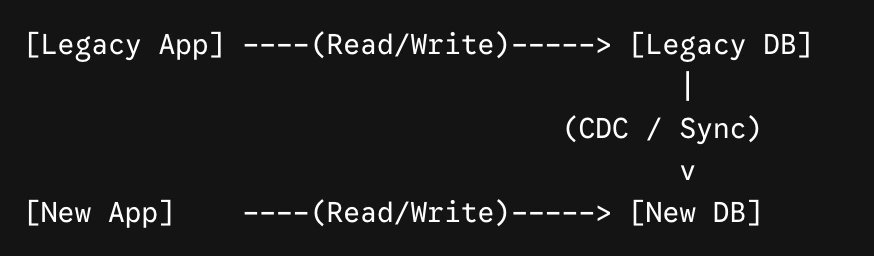
Phase 1: Establish Real-Time Data Replication (CDC)
Rather than taking a database offline to copy records, data synchronization must run continuously alongside live production operations.
Baseline Snapshot: Take a point-in-time snapshot of the legacy database and bulk-load it into the new database schema.
Enable Change Data Capture (CDC): Deploy an event-driven data streaming platform (such as Debezium, AWS DMS, or Kafka Connect) that hooks directly into the legacy database’s transaction logs (e.g., SQL Server log reader, Postgres WAL, MySQL binlog).
Continuous Streaming: Every subsequent
INSERT,UPDATE, andDELETEon the legacy system is automatically captured, converted into an event, and applied to the new database in near real-time.
Phase 2: Dual-Writing and Resilient Queues
In scenarios where database-level CDC cannot be enabled due to legacy infrastructure constraints, real-time sync is moved to the application or API layer via Dual Writing.
Primary Write: The active application path writes to the legacy database.
Asynchronous Secondary Write: The application enqueues the transaction to write to the new database asynchronously.
Fault Isolation: Secondary writes must be completely non-blocking. If a secondary write fails, it is routed to a Dead Letter Queue (DLQ) for replay, ensuring the end-user request is never impacted by new system latency or temporary network drops.
Phase 3: Shadow Traffic and Continuous Verification
Before routing live users to the new stack, the system must undergo thorough verification under actual production loads.
Shadow Reading (Dark Launches): Duplicate incoming production read traffic at the API Gateway level (using proxies like Envoy or NGINX
mirror). Send one copy to the legacy app and a duplicate copy to the new application. The new app's response is monitored for performance and accuracy, then safely discarded.Data Reconciliation Engine: Run automated background reconciliation workers that compare records across both databases. If data drift is detected (e.g., due to schema transformation mismatches), the reconciliation engine automatically corrects the new database to stay aligned with the legacy source of truth.
Phase 4: Canary Cutover and Bi-Directional Sync

Once real-time data streaming and shadow tests prove stability, traffic routing shifts incrementally using a Canary Deployment strategy.
Incremental Traffic Shifts: Route a small percentage of user traffic (e.g., 1% $\rightarrow$ 5% $\rightarrow$ 25%) to the new application using feature flags or weighted API Gateway rules.
Reverse Synchronization: Configure reverse CDC from the new database back to the legacy database. This ensures that any actions performed by users routed to the new system are immediately reflected in the legacy system, providing an instant, zero-data-loss rollback safety net if an issue arises.
Final Switch & Decommissioning: Gradually scale traffic to 100%. After a designated burn-in period where all production traffic runs on the new system without incident, reverse replication is disabled, and legacy infrastructure is safely retired.
Essential Technical Considerations
| Area | Technical Requirement |
|---|---|
| Primary Key Collisions | Avoid using database auto-incrementing integer IDs during dual-write or sync phases. Transition to globally unique identifiers (UUIDs or TSIDs) to eliminate key collisions across environments. |
| Idempotency | All event streaming consumers and migration scripts must be idempotent (e.g., executing UPSERT operations instead of plain INSERT) to safely handle duplicate message delivery. |
| Schema Mapping | If the legacy schema differs from the target domain model, place schema transformation logic directly inside the CDC event consumer to handle mapping out-of-band. |
Summary
Migrating enterprise systems without downtime is an operational strategy rather than a single technical event. By combining asynchronous data replication, continuous background verification, and incremental traffic shifting, organizations can modernize legacy platforms safely while maintaining uninterrupted availability for customers.
Join the conversation! Your thoughts help the community grow.