What Is an AI Governance Framework?
An AI governance framework is a structured approach to managing how AI systems are developed, deployed, monitored, and controlled. It defines who is accountable for AI decisions, what actions AI systems are permitted to perform, and how organizations manage security, operational, and compliance risks.
For product teams, governance should be integrated into software engineering workflows rather than treated as a separate documentation or compliance activity.
Why Do Product Teams Need AI Governance?
As AI agents become capable of writing code, interacting with tools, and accessing live systems, organizations need stronger controls over their actions.
Key reasons for implementing AI governance include:
Risk management: Identify potential failures before they affect customers or business operations.
Security and privacy: Control access to sensitive data, applications, and production systems.
Accountability: Assign clear ownership for AI systems and decisions.
Regulatory compliance: Align AI practices with applicable standards and legal requirements.
Operational reliability: Monitor AI behavior and ensure that changes can be validated or reversed.
How to Build an AI Governance Framework: 8 Steps
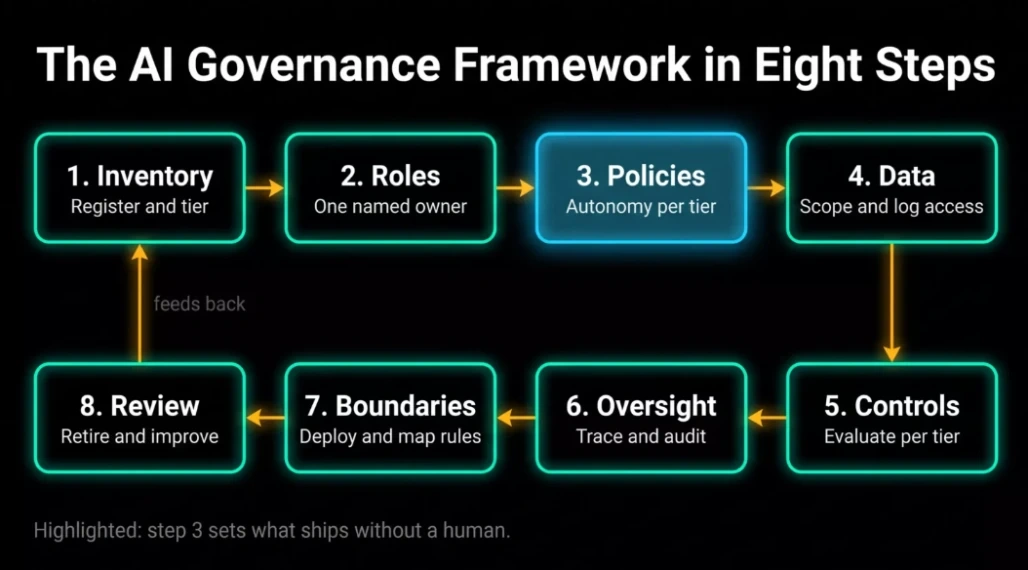
The blog outlines eight practical steps for establishing an effective AI governance framework.
1 Inventory and Classify AI Systems
Identify all AI applications, coding assistants, agents, models, and external APIs used across product development and operations. Classify each system according to its autonomy, data sensitivity, potential impact, and regulatory exposure.
2 Define Roles and Responsibilities
Assign clear ownership to AI system owners, engineering leaders, executive sponsors, security teams, and compliance reviewers. Establish who can approve risks, authorize access, and review high-impact decisions.
3 Establish AI Policies and Autonomy Levels
Define permitted AI use cases, prohibited actions, approval requirements, and the level of independence granted to each system. High-risk activities should require stronger human oversight.
4 Apply Data Governance and Context Controls
Restrict AI access to the information required for a task. Use least-privilege permissions, data masking, scoped queries, and appropriate logging to protect sensitive information.
5 Integrate AI Evaluation into Engineering Pipelines
Test output quality, security, tool usage, and system behavior before deployment. Include automated validation, functional tests, and rollback checks to reduce the risk of unsafe changes.
6 Implement AI Observability and Audit Trails
Monitor AI actions, inputs, outputs, tool calls, approvals, and outcomes. Maintain reliable records to help teams investigate incidents, identify unexpected behavior, and demonstrate accountability.
7 Set Deployment Boundaries and Address Regulations
Determine where AI systems can run, how data is handled, and which legal or regulatory requirements apply. Consider private cloud or isolated environments when required by security or customer needs.
8 Review and Continuously Improve
Reassess AI risks when models, prompts, permissions, or use cases change. Review incidents, update evaluation tests, remove unnecessary access, and periodically validate governance controls.
Balancing AI Autonomy with Human Oversight
AI systems should not receive the same level of independence for every task. Their autonomy should depend on the potential impact of their actions and how easily those actions can be reversed.
Suggest: AI recommends an action but does not execute it.
Draft: AI prepares code or changes for human review.
Execute with approval: AI performs an action after the required checks and authorization.
Execute autonomously: AI acts independently within defined permissions and monitoring controls.
Low-risk, reversible tasks may be suitable for greater automation. Changes affecting sensitive data, production systems, or customer outcomes generally require stricter approval and oversight.
AI Governance Standards and Regulatory Considerations
The blog highlights several useful references for building governance practices:
ISO/IEC 42001:2023: Provides a management-system approach to establishing and continually improving AI governance.
NIST AI Risk Management Framework and Generative AI Profile: Help organizations identify, assess, measure, and manage AI-related risks.
EU AI Act: Establishes risk-based legal obligations for AI systems within its scope.
OWASP Agentic AI guidance: Helps product teams identify security threats associated with AI agents, tools, and excessive permissions.
Organizations should select applicable standards and confirm their specific legal obligations based on their products, markets, and use cases.
How to Measure AI Governance Effectiveness
Product teams can evaluate their framework using measurable indicators such as:
Percentage of AI systems inventoried and assigned owners.
Compliance with required testing and approval gates.
Time taken to detect unexpected AI behavior.
Time required to recover from or reverse a failed change.
Percentage of incidents incorporated into future evaluation tests.
These measures help establish whether governance controls are working in practice, rather than existing only in written policies.
Key Takeaway
AI governance is an ongoing engineering responsibility. By combining risk classification, clear accountability, data controls, automated evaluation, observability, and human oversight, product teams can scale AI adoption while maintaining security, reliability, and control.


Join the conversation! Your thoughts help the community grow.