
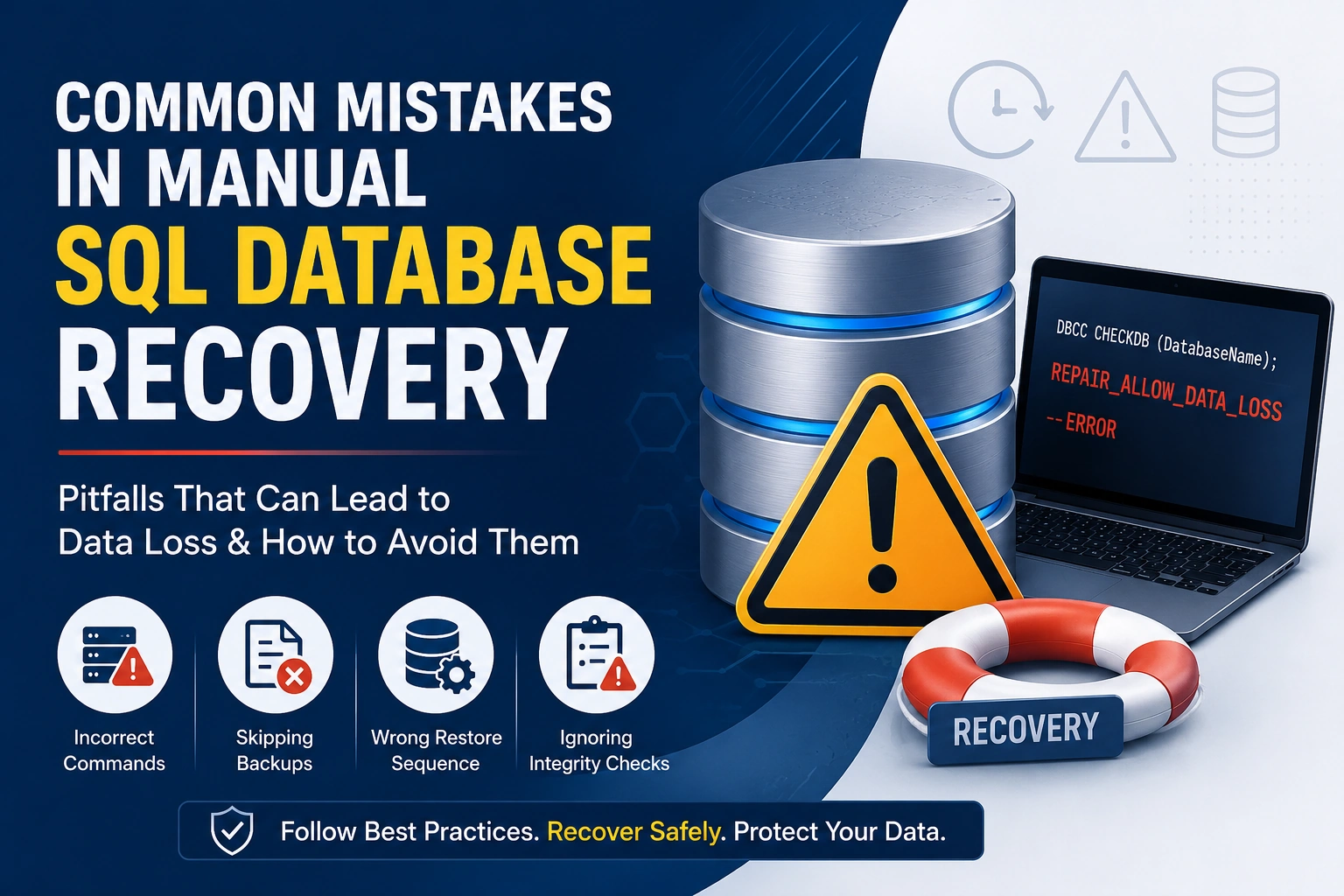
SQL Server database corruption is one of the most challenging situations a database administrator can encounter. Whether the issue is caused by hardware failures, abrupt system shutdowns, malware, storage corruption, or accidental deletion, the immediate goal is always the same—recover the database with minimal downtime and zero data loss.
When faced with corruption, many administrators prefer manual recovery methods because they are readily available and do not require additional software. SQL Server offers several built-in utilities such as DBCC CHECKDB, backup restoration, emergency mode, and repair commands that can help resolve database issues.
However, manual recovery isn't always as straightforward as it appears.
A small mistake during the recovery process can transform a recoverable database into one with permanent data loss. Running an incorrect command, restoring backups in the wrong order, or skipping validation checks can significantly worsen the situation.
This guide discusses the most common mistakes made during manual SQL database recovery, explains why they happen, and shares best practices to avoid them.
Why Manual SQL Database Recovery Can Be Risky?
SQL Server provides powerful recovery mechanisms, but these tools assume that the administrator understands the database architecture, recovery models, backup chains, transaction logs, and repair options.
Manual recovery becomes risky because:
Every recovery action directly affects the production database.
Some repair commands permanently delete damaged data.
Recovery mistakes are often irreversible.
Incorrect restoration sequences can invalidate backup chains.
Improper handling may increase downtime.
Understanding these risks is the first step toward performing a safe recovery.
Simplify SQL Database Recovery with Specialized Solution
When manual methods fail or data preservation is critical, the SysTools SQL Recovery Tool provides a reliable way to recover corrupted SQL Server databases without relying solely on repair commands.
The software is designed to repair damaged MDF and NDF files while preserving database objects such as tables, views, stored procedures, triggers, indexes, keys, functions, and more. It supports recovery from databases affected by corruption, unexpected shutdowns, storage failures, or damaged headers. It allows users to preview recoverable data before exporting it to a live SQL Server database or SQL-compatible scripts.
Instead of using repair options that may remove damaged records, the tool focuses on extracting maximum recoverable data, making it especially useful when maintaining data integrity is a priority.
Common Mistakes During Manual SQL Database Recovery
1. Not Identifying the Actual Cause of Corruption
Many administrators immediately start repairing the database without investigating what caused the corruption.
However, corruption is usually only a symptom.
The actual cause may include:
Disk failures
Bad sectors
RAID controller issues
Memory corruption
Power outages
Virus attacks
Faulty storage devices
If the underlying issue remains unresolved, the database may become corrupted again even after successful recovery.
Best Practice
Always review:
SQL Server Error Logs
Windows Event Viewer
Storage logs
Hardware diagnostics
Determine the root cause before attempting repairs.
2. Running DBCC CHECKDB with REPAIR_ALLOW_DATA_LOSS Immediately
One of the most common and dangerous mistakes is executing:
DBCC CHECKDB('Database_Name', REPAIR_ALLOW_DATA_LOSS)
without first understanding the corruption.
Despite its name, this command truly allows data loss.
It works by removing damaged pages, rows, indexes, or metadata to restore database consistency.
While the database may come online, missing records or broken relationships may never be recoverable.
Better Approach
Always follow this sequence:
Run DBCC CHECKDB without repair.
Review corruption details.
Restore from backup whenever possible.
Use repair only as the absolute last option.
3. Forgetting to Take a Backup Before Repair
Even when the database is corrupted, administrators should create a backup whenever SQL Server still allows it.
Many skip this step because they assume the database is already unusable.
In reality, a damaged database often contains recoverable information.
Without a backup, there is no rollback if the repair fails.
Best Practice
Before making any changes:
Create a full backup if possible.
Backup the transaction log.
Backup MDF and LDF files.
Never perform repairs on the only available copy.
4. Ignoring SQL Server Error Logs
SQL Server records detailed information about corruption.
These logs often identify:
Corrupted pages
Allocation errors
Checksum failures
Torn pages
Storage problems
Many administrators ignore these logs and rely solely on CHECKDB output.
Doing so can result in an incomplete diagnosis.
Always analyze the logs before deciding on a recovery strategy.
5. Restoring Backups in the Wrong Sequence
SQL Server backups must follow a proper restoration order.
A typical recovery chain looks like:
Full Backup
Differential Backup
Transaction Log Backup(s)
Skipping one log backup or restoring them in the wrong sequence breaks the recovery chain. The database may fail to restore or lose recent transactions.
Always verify the backup chain before restoration.
6. Overwriting the Existing Database Too Soon
Another common mistake is restoring directly over the production database.
If the restoration fails, both the original database and the backup may become unavailable.
Instead:
Restore to a different database name.
Validate the restored database.
Compare data integrity.
Replace production only after verification.
This minimizes risk during recovery.
7. Performing Recovery Directly on Production Servers
Attempting experimental recovery on the live server increases downtime and operational risk.
Recovery procedures should first be tested on:
Test servers
Development environments
Virtual machines
Restored backup copies
Only after successful validation should the same procedure be applied to production.
Additional Recovery Mistakes That Often Go Unnoticed
Even experienced DBAs occasionally overlook smaller mistakes that eventually become major problems.
These include:
Working without documenting recovery steps
Deleting transaction log files manually
Shrinking database files during recovery
Running multiple repair operations simultaneously
Restarting SQL Server repeatedly without investigation
Ignoring storage health warnings
Recovering databases without validating application functionality afterward
Avoiding these practices significantly improves recovery success rates.
Best Practices for Safe SQL Database Recovery
Identify the root cause before starting any recovery operation.
Create a backup of the database and log files whenever possible.
Validate backup integrity to ensure they are usable for restoration.
Restore backups in the correct sequence to maintain database consistency.
Run DBCC CHECKDB before and after recovery to verify integrity.
Avoid using REPAIR_ALLOW_DATA_LOSS unless all other recovery options have failed.
Test recovery procedures in a non-production environment first.
Preserve the original MDF, NDF, and LDF files before making any modifications.
Monitor SQL Server health regularly to detect corruption early.
Document every recovery step for easier troubleshooting and auditing.
Verify application functionality after the database has been recovered.
Use specialized SQL recovery software when manual methods cannot recover critical data without risking further loss.
Conclusion
Manual SQL database recovery is an essential skill for database administrators, but it requires careful planning and a thorough understanding of SQL Server's recovery mechanisms. Many recovery failures are not caused by corruption itself but by mistakes made during the repair process.
By identifying the root cause of corruption, validating backups, following the correct restore sequence, avoiding destructive repair commands unless absolutely necessary, and verifying database consistency after recovery, administrators can significantly reduce the risk of permanent data loss.
When corruption is too severe for native SQL Server tools, using a dedicated SQL recovery solution can help recover critical database objects while minimizing downtime and preserving valuable business data.
Join the conversation! Your thoughts help the community grow.