

Introduction
The way we build, operate, and support software has changed dramatically over the last two decades.
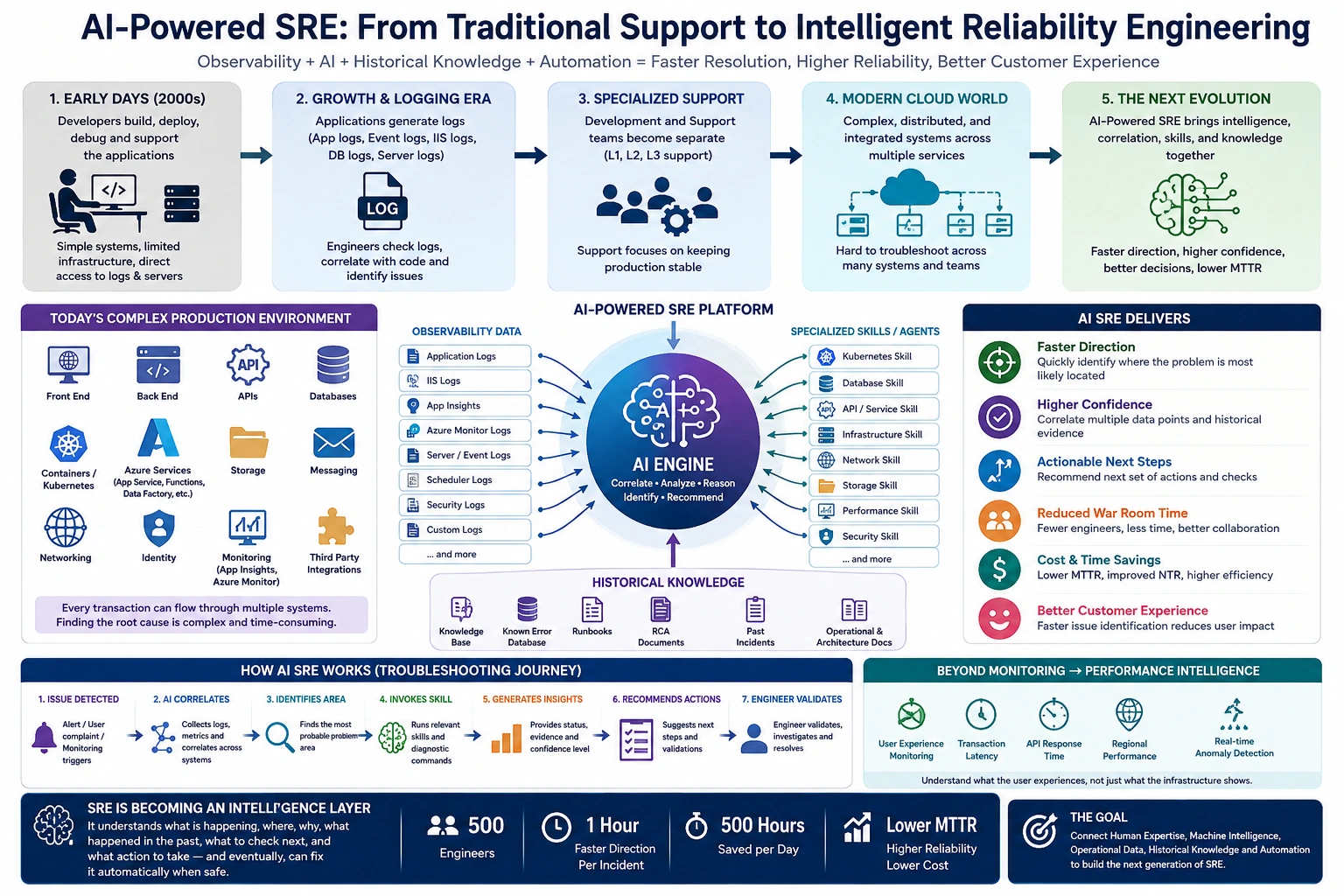
In the early days of software development, developers were often responsible for much more than writing code. They understood the application, deployed it, monitored it, debugged it, and supported it when something went wrong.
Today, the situation is very different.
Modern applications are highly distributed, cloud-native, integrated with multiple platforms, and supported by specialized teams. A single production issue can potentially involve application code, databases, APIs, containers, storage, networking, cloud infrastructure, identity, integrations, or even the end-user experience.
This is where Site Reliability Engineering (SRE) becomes increasingly important.
And now, with the evolution of AI and agentic systems, I believe SRE is entering its next major phase.
From Developer-Led Troubleshooting to Specialized Support
If we look back to the early 2000s, software systems were relatively simpler.
A software engineer could understand most of the application they had developed. When a production issue occurred, the same engineer could inspect the code, reproduce the issue, check the server, look at logs, identify the failing function or database query, and work toward a solution.
Development and production support were often closely connected.
As software platforms became more sophisticated, logging became an important part of troubleshooting.
Applications started generating application logs, server logs, event logs, IIS logs, scheduler logs, database logs, and other operational information.
Engineers could connect to the server, inspect the logs, identify an error, go back to the application code, and correlate the failure with a particular component.
But as systems grew larger, development and support became increasingly separated.
We created specialized L1, L2, and L3 support teams.
Development teams focused on building new capabilities.
Support teams focused on keeping production systems running.
This specialization was necessary, but it also created a new challenge:
The people troubleshooting the problem were often not the people who originally built the system.
The Complexity of Modern Production Systems
Fast-forward to today's cloud environment.
A modern enterprise application may consist of:
Front-end applications
Back-end services
APIs
Databases
Storage
Containers and Kubernetes
Azure App Services
Azure Data Factory
Azure SQL
Application Insights
Networking components
Identity services
File systems
External integrations
Messaging systems
Monitoring and alerting platforms
And these components may exist across multiple regions and environments.
A single transaction could travel through several of these systems before reaching the end user.
That makes production troubleshooting fundamentally different from troubleshooting a traditional standalone application.
The question is no longer simply:
"Which line of code failed?"
The question becomes:
"Where in this entire chain did the customer's experience start to deteriorate?"
Observability Became the Foundation
This is where centralized logging and observability became extremely important.
In a modern Azure environment, for example, organizations can bring information from multiple sources into centralized platforms.
Application logs, IIS logs, App Service logs, Azure Monitor data, Application Insights telemetry, server events, scheduler information, and other operational data can be brought together.
This gives engineers something that was difficult to achieve in traditional environments:
A broader view of the production ecosystem.
This is the foundation of observability.
But observability alone does not solve the problem.
And this is an important distinction.
Having millions of logs available does not automatically mean that we understand what happened.
The Problem With Too Much Data
Imagine a production incident where thousands—or even hundreds of thousands—of log records are generated.
An experienced engineer may know the architecture extremely well.
But they still need to:
Understand the architecture.
Identify the affected transaction.
Search the relevant logs.
Correlate events across systems.
Identify dependencies.
Check whether the database is responding correctly.
Validate APIs and backend services.
Check infrastructure health.
Determine whether the problem is application-related or platform-related.
Engage the appropriate team.
This can take significant time.
And during a production incident, time matters.
Often, a war room is created with several engineers from different teams.
One engineer checks the application.
Another checks the database.
Another checks Kubernetes.
Another checks infrastructure.
Another checks networking.
Everyone is looking at a different part of the same problem.
The traditional approach is not wrong.
It has worked for years.
But it is not necessarily the most efficient approach for today's complexity.
This Is Where AI-Powered SRE Starts to Change the Game
The emergence of AI-powered SRE introduces a fundamentally different approach.
Instead of asking engineers to manually navigate through thousands of pieces of information, an AI-driven SRE system can analyze the available telemetry and help identify where the problem is most likely located.
Whether the underlying agentic framework is based on Microsoft technologies, LangGraph, or another AI platform, the fundamental concept is similar:
Use AI to understand, correlate, reason, and guide troubleshooting across a complex production environment.
The biggest benefit is not necessarily that AI immediately fixes the problem.
The biggest benefit is that AI can give engineers direction.
For example:
"Based on the available telemetry, the application layer appears healthy. The latency is concentrated between the API and the backend service. The next area to investigate is the backend service and its dependency on the database."
That information can dramatically change the troubleshooting process.
Instead of five engineers investigating five different areas, the team can focus on the most probable area first.
AI SRE Does Not Mean "AI Will Fix Everything"
This is something I believe is important to clarify.
AI-powered SRE should not be viewed as:
Incident happens → AI fixes everything.
That is not how I see the immediate value of AI in SRE.
I see it more as:
Incident happens → AI understands the available evidence → correlates information → identifies probable problem areas → recommends the next actions → engineers validate and resolve.
That distinction is important.
The AI provides direction and confidence.
The engineer still provides judgment.
From One Big Problem to Smaller, Actionable Problems
One of the most powerful concepts in AI-driven SRE is the use of skills and specialized agents.
Initially, the problem may appear very broad.
For example:
"Users are experiencing application failures."
The AI SRE system can first analyze the overall architecture and telemetry.
It may determine:
"The application layer appears healthy, but there is an abnormality in the backend service."
Now the problem has become smaller.
The system can then invoke a specific skill.
For example:
Kubernetes health analysis
API health analysis
Database analysis
Storage analysis
Network analysis
Application performance analysis
Authentication analysis
Infrastructure analysis
Each skill can execute the appropriate commands and queries.
For example, instead of an engineer manually running multiple PowerShell commands, kubectl commands, KQL queries, or other diagnostic commands, the AI agent can execute the appropriate predefined actions and interpret the results.
The troubleshooting journey becomes something like:
Architecture → Problem Area → Skill → Diagnostic Actions → Evidence → Confidence
That is where I see significant potential in AI-powered SRE.
Skills Are the Next Important Layer
The concept of skills is particularly powerful.
Suppose the AI identifies a potential Kubernetes-related issue.
Instead of simply saying:
"Check Kubernetes."
A Kubernetes skill could automatically perform a series of checks:
Pod status
Container restarts
Timeout conditions
Resource utilization
Service availability
Deployment status
Application errors
Dependency health
Similarly, a database skill could perform database-specific checks.
An API skill could validate API behavior and latency.
A platform skill could check infrastructure health.
The AI becomes the reasoning layer, while the skills provide the operational capabilities.
This creates a much more structured troubleshooting experience.
The Missing Ingredient: Historical Knowledge
But there is another layer that I believe will make AI-powered SRE significantly more powerful.
Historical data.
Most enterprises have been operating systems for many years.
They already possess enormous amounts of knowledge.
The knowledge exists in:
Knowledge bases
Known Error Databases
Troubleshooting documents
Runbooks
Root Cause Analysis documents
Operational procedures
Architecture documents
Incident tickets
Problem records
Change records
Backlog items
Historical incidents
Resolution documents
The problem is that this knowledge is often distributed across different systems.
And traditionally, engineers have had to search for it manually.
AI changes this model.
The Combination of Telemetry + Historical Knowledge
Imagine that today's production problem looks very similar to an incident that happened three years ago.
Traditionally, the engineer may not know that.
But if the historical incident data is available to the AI SRE system, it can potentially identify the similarity.
It could say:
"A similar pattern occurred three years ago. The previous incident was related to database connection exhaustion. The resolution involved adjusting connection handling and restarting the affected service."
Now the engineer is not just troubleshooting based on today's telemetry.
They are troubleshooting based on:
Today's evidence + historical evidence + architectural knowledge + operational knowledge.
That can significantly improve troubleshooting confidence.
And this is where data becomes extremely important.
AI Is Only as Powerful as the Data Behind It
We often talk about AI models, agents, frameworks, and tools.
But there is another fundamental truth:
Without quality data, AI cannot provide reliable operational intelligence.
Enterprises have spent 20–30 years building systems and accumulating operational knowledge.
That knowledge is an extremely valuable asset.
If we can bring together:
Telemetry + Architecture + Historical Incidents + Runbooks + Known Errors + RCA + Operational Knowledge
then the AI SRE system has a much stronger foundation for reasoning.
The result is not simply an AI chatbot.
It becomes an operational intelligence layer.
Measuring the Real Business Value
Another important question is:
How do we measure the value of AI-powered SRE?
I don't think the only measurement should be:
"Did AI resolve the incident?"
That is too narrow.
We should also measure how quickly AI helps the engineer reach the correct troubleshooting direction.
For example, imagine a platform supported by 500 engineers.
If a traditional troubleshooting process takes four hours to reach the right problem area, but AI reduces that to three hours, that one-hour improvement can represent significant operational efficiency at scale.
More importantly, the reduction is not just about manpower.
It can reduce:
Mean Time to Identify
Mean Time to Resolve
War-room duration
Number of engineers involved
Customer impact
Operational noise
Escalation cycles
The real value is speed and precision.
From Infrastructure Monitoring to Performance Intelligence
I believe there is one more evolution required.
Traditional monitoring focuses heavily on infrastructure metrics:
CPU
Memory
Disk
Network
Pod health
Server availability
Service availability
These metrics are important.
But they don't always tell us what the customer is experiencing.
A system can show:
CPU: Normal
Memory: Normal
Server: Healthy
Database: Healthy
And yet the customer may still be experiencing significant latency.
That means modern SRE needs another dimension:
Performance Intelligence
The system should understand the user experience.
For example:
Is transaction latency increasing?
Are API response times degrading?
Are users experiencing timeouts?
Is a particular region affected?
Is one customer experiencing higher latency?
Did performance degrade after a deployment?
Which transaction is causing the degradation?
This moves SRE beyond infrastructure monitoring.
It moves toward user-centric reliability engineering.
The Future of SRE
I believe the future SRE model will increasingly look like this:
Observability
↓
AI Correlation
↓
Problem Identification
↓
Specialized Skills
↓
Historical Knowledge
↓
Evidence-Based Diagnosis
↓
Engineer Validation
↓
Resolution or Automated Remediation
And eventually, some classes of problems may move toward autonomous remediation.
But I believe that should happen progressively.
First, AI should help us observe.
Then correlate.
Then recommend.
Then validate.
Then, where confidence is high and appropriate controls exist, remediate automatically.
My View: SRE Is Becoming an Intelligence Layer
The way I see it, SRE is no longer just about keeping servers and applications available.
It is evolving into an intelligence layer that understands:
What is happening?
Where is it happening?
Why could it be happening?
What happened in the past?
What should we check next?
What evidence supports the hypothesis?
What action should the engineer take?
And eventually:
Can we safely fix it automatically?
That is the direction in which I believe AI-powered SRE is heading.
The goal is not to replace engineers.
The goal is to make engineers significantly more effective.
Instead of having five engineers spend an hour finding where the problem is, two engineers can use AI to reach the right direction much faster and spend their time solving the actual problem.
That is the real opportunity.
AI-powered SRE is not about replacing human expertise.
It is about connecting human expertise, machine intelligence, operational data, historical knowledge, and automation into one reliability engineering system.
And in today's increasingly complex IT landscape, I believe that is where the next generation of SRE will be built.
Monika MundraPosted Aug 23, 2026, 5:26 PM
Great article