

Here I want to show you how to create a 'Subscribe' button that changes text value (Subscribe, Unsubscribe) in a ListView.
First of all, you create your oun button, in this button class you add a BindableProperty that will help us to change the text value of the button :) It should be like this.
In this exemple we use in value, you can use a BOOL type.
In this exemple we use in value, you can use a BOOL type.
- public static readonly BindableProperty IsRegistredProperty =
- BindableProperty.Create("IsRegistred", typeof(int), typeof(SubscribeBtn), 0);
- public int IsRegistred
- {
- get { return (int)GetValue(IsRegistredProperty); }
- set
- {
- SetValue(IsRegistredProperty, value);
- }
- }
Now, we change the text value when this property's value is changed. So, our Button looks like,
- public class SubscribeBtn : Button
- {
- public static readonly BindableProperty IsRegistredProperty =
- BindableProperty.Create("IsRegistred", typeof(int), typeof(SubscribeBtn), 0);
- public int IsRegistred
- {
- get { return (int)GetValue(IsRegistredProperty); }
- set
- {
- SetValue(IsRegistredProperty, value);
- }
- }
- private string btnText => IsRegistred == 1 ? "Unsubscribe" : "Subscribe";
- public SubscribeBtn()
- {
- this.Text = btnText;
- PropertyChanged += SubscribeBtn_PropertyChanged;
- Clicked += SubscribeBtn_Clicked;
- }
- private void SubscribeBtn_Clicked(object sender, EventArgs e)
- {
- IsRegistred = 1 - IsRegistred; // 1 --> 0 // 0 --> 1
- }
- private void SubscribeBtn_PropertyChanged(object sender, System.ComponentModel.PropertyChangedEventArgs e)
- {
- if (e.PropertyName == IsRegistredProperty.PropertyName)
- {
- this.Text = btnText;
- }
- }
- }
- public class MyViewModel
- {
- public int Registred { get; set; } = 0; // 1 : yes , 0:no (0 as default)
- }
- public class MyCollection
- {
- public ObservableCollection<MyViewModel> Items { get; set; }
- public MyCollection()
- {
- Items = new ObservableCollection<MyViewModel>()
- {
- new MyViewModel(),
- new MyViewModel(),
- new MyViewModel() {Registred = 1}, //this one is registred
- new MyViewModel()
- };
- }
- }
I hope you are enjoying that :) !
Now, we set the BindingContext of our MainPage (In MainPage.xaml.cs),
- public partial class MainPage : ContentPage
- {
- protected MyCollection Collection = null;
- public MainPage()
- {
- InitializeComponent();
- Collection = new MyCollection();
- BindingContext = Collection;
- }
- }
- <?xml version="1.0" encoding="utf-8" ?>
- <ContentPage xmlns="http://xamarin.com/schemas/2014/forms"
- xmlns:x="http://schemas.microsoft.com/winfx/2009/xaml"
- xmlns:local="clr-namespace:App3"
- x:Class="App3.MainPage">
- <ContentPage.Content>
- <ListView x:Name="MyListView" ItemsSource="{Binding Items}">
- <ListView.ItemTemplate>
- <DataTemplate>
- <ViewCell>
- <local:SubscribeBtn IsRegistred="{Binding Registred}"></local:SubscribeBtn>
- </ViewCell>
- </DataTemplate>
- </ListView.ItemTemplate>
- </ListView>
- </ContentPage.Content>
- </ContentPage>
Dont forget to set the right Binding in line 12 :) As you see, we used our SubscribeBtn.

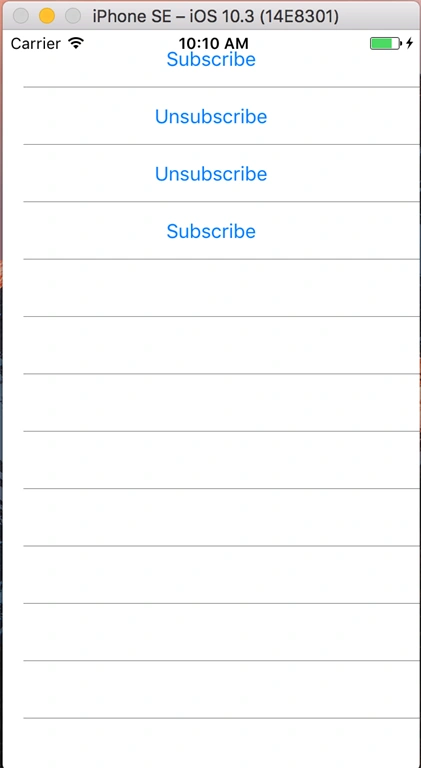
I hope that helps you!
(Source Code in the attached zip file)
Best regards from Regensburg! Mabrouk Mahdhi
Alain NataliniPosted Aug 25, 2017, 2:10 AM
Good article. Thank you.