

Introduction:
API gateways, load balancers, and ingress controllers form critical layers in modern deployment architectures, enhancing scalability, security, and traffic management in microservices and containerized environments.
API gateways act as a unified entry point for client requests, handling authentication, rate limiting, and routing to backend services, which simplifies client interactions and centralizes security. Load balancers distribute incoming traffic across multiple servers or instances to prevent overload, ensure high availability, and support scalability in distributed systems. Ingress controllers, often used in Kubernetes, manage external access to services by interpreting Ingress resources, enabling HTTP/HTTPS routing based on host headers or paths
Architectural Integration:
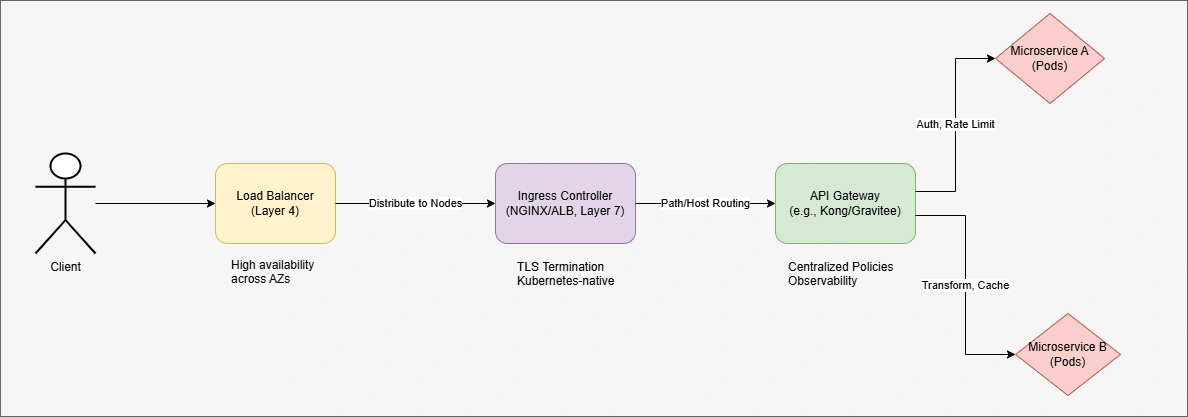
In a typical stack, a load balancer sits at the edge, receiving external traffic and forwarding it to cluster nodes or an ingress controller for L7 (application-layer) routing inside the cluster. The ingress controller then proxies requests to appropriate pods or services, dynamically adjusting for pod health and scaling. An API gateway often layers on top or integrates with these, adding advanced features like protocol translation, caching, and analytics for microservices
Key Benefits:
Security: API gateways enforce centralized auth, authorization, and threat protection; load balancers provide SSL termination; ingress controllers handle TLS passthrough.
Performance: Load balancers optimize even traffic distribution; gateways apply rate limits and caching; ingress enables efficient internal routing.
Observability: Gateways centralize logging and metrics; combined with ingress and balancers, they offer end-to-end visibility without backend duplication.
Load Balancer:
L4 traffic distribution, high availability across regions
Redirecting to healthy nodes in multi-AZ Kubernetes clusters
Ingress Controller
Kubernetes-native L7 routing, path/host-based rules
NGINX or AWS ALB routing traffic to services via Ingress YAML notes
API Gateway
API gateways, load balancers, and ingress controllers integrate as layered components in deployment architectures, managing traffic flow from clients to services. The following deployment diagram illustrates their roles and interactions in a Kubernetes-based microservices setup.
This deployment diagram shows traffic progression: The load balancer handles initial L4 distribution, the ingress controller enables L7 routing within the cluster, and the API gateway applies advanced microservices logic before reaching backend pods. Arrows depict request flow, with notes highlighting unique benefits per component.
Summary:
This layered approach ensures resilient, observable deployments, reducing complexity for teams managing cloud-native apps.
Join the conversation! Your thoughts help the community grow.