
To parse QBO and IIF financial files in CSharp reliably, separate SGML/XML tag normalization from tab-delimited QuickBooks row scanning while parsing every amount with decimal and CultureInfo.InvariantCulture. Enforcing container closure, unique FITID tracking, and zero-balance TRNS / SPL / ENDTRNS state transitions catches defective imports that permissive regex and CurrentCulture parsers silently accept.
Before writing a custom engine, I audited two open-source C# parsers against real banking quirks. afonsof/OfxSharp hardcodes VERSION:102 and CHARSET:1252 in PossibleHeaders, calls .Replace(",", ".") before Convert.ToDecimal (turning "1,250.50" into "1.250.50" and throwing), and instantiates a new XmlDocument inside GetValue on every field read. Meanwhile, eramella/QFXparser matches timezone offsets with (?<tzId>\d+), missing negative offsets like [-5:EST], and calls TimeZoneInfo.FindSystemTimeZoneById, which throws TimeZoneNotFoundException on Windows hosts expecting "Eastern Standard Time" rather than "EST". Skip a custom parser if your upstream only emits strict OFX 2.2 XML or connects directly to QuickBooks Online bank feeds. Once your .NET service ingests bank .qbo downloads alongside legacy QuickBooks Desktop .iif batches without external NuGet packages, explicit state checks prevent silent ledger corruption.
How do you parse QBO and IIF financial files in CSharp reliably?
A dependable C# financial ingestion pipeline isolates QboStatementParser and IifLedgerParser behind one shared FinancialValueParser helper. Keeping SGML leaf-tag scanning separate from tab-delimited accounting splits prevents XML workarounds from breaking TSV quote parsing while routing every monetary field through identical numeric guards.
Check these .NET runtime constraints before wiring either parser into production:
- Compile only against
System.Globalization, System.Collections.Generic, and System.Text.RegularExpressions so the parser builds cleanly under .NET Framework 4.8 and .NET 8+ with zero third-party dependencies. - Skip
Microsoft.VisualBasic.FileIO.TextFieldParser on user-uploaded statements because Microsoft's TextFieldParser documentation warns that malformed inputs can trigger crashes or hangs. - Validate
.iif blocks before import because ProperSoft's IIF format reference notes that QuickBooks Desktop writes .iif batches directly into registers with no undo option.
Run both formats through these five sequential checks before persisting any transaction:
- 1. Slice headers before
<OFX>: Locate <OFX> via IndexOf("<OFX>", StringComparison.OrdinalIgnoreCase) so zero-offset payloads don't raise negative-index exceptions, and read <INTU.BID> from <SONRS> when QuickBooks bank verification is needed. - 2. Track
<STMTTRN> nesting over SGML leaves: Scan <TAG>value pairs line by line across unclosed OFX 1.x SGML leaves and closed OFX 2.x XML elements, failing immediately if a nested <STMTTRN> or </BANKTRANLIST> closes an unclosed block. - 3. Strip bracketed
<DTPOSTED> offsets manually: Parse [offset:TZ] suffixes separately, validate 8-digit or 14-digit date cores via DateTimeOffset.TryParseExact conventions (yyyyMMddHHmmss), and reject impossible dates such as 20260230. - 4. Parse amounts invariantly and index
<FITID>: Pass NumberStyles.AllowLeadingSign | NumberStyles.AllowDecimalPoint with CultureInfo.InvariantCulture into Decimal.TryParse, then check <FITID> against a HashSet<string> (StringComparer.Ordinal) to reject empty or repeated IDs. - 5. Enforce
TRNS -> SPL -> ENDTRNS state transitions: Index !TRNS and !SPL columns dynamically, split quoted tabs per RFC 4180 quote-escaping rules, and reject any ENDTRNS where trnsAmt + splitRunningSum != 0m.
Format contracts and validation thresholds across QBO and IIF
QBO files extend the Open Financial Exchange specification maintained by Financial Data Exchange (OFX Banking Specification v2.3 PDF), whereas .iif files encode flat QuickBooks Desktop double-entry tables. Putting their syntactic contracts side by side shows why one parser strategy cannot validate both.
| Format construct | Structural syntax | C# validation threshold | Failure mode prevented |
|---|
QBO header & <INTU.BID> | OFXHEADER:100, VERSION:102..160, or XML | IndexOf("<OFX>") >= 0; integer <INTU.BID> | OfxSharp header-whitelist rejections and index crashes |
<STMTTRN> container tags | SGML unclosed leaves or closed XML tags | Boolean inStmtTrn flag; reject nested <STMTTRN> | Silent merging of two bank transactions when </STMTTRN> is missing |
<DTPOSTED> timestamp | YYYYMMDD[HHMMSS[.fff]][offset:TZ] | 8 or 14 core digits; offset -12.0 to +14.0 h | QFXparser crash on "EST" and silent DateTime.Now fallback |
<TRNAMT> & IIF AMOUNT | ASCII dot-decimal signed numeric string | decimal (`AllowLeadingSign \ | AllowDecimalPoint, InvariantCulture`) | de-DE 100x silent inflation and "1,250.50" parse crashes |
<FITID> identifier | Per-account unique transaction ID | Non-whitespace; HashSet<string>.Add returns true | Duplicate ledger postings across overlapping exports |
IIF !TRNS / !SPL headers | Tab-delimited column names with ! prefix | Dynamic Dictionary<string, int> (OrdinalIgnoreCase) | Broken column offsets when !TRNS reorders DATE or AMOUNT |
IIF TRNS / SPL / ENDTRNS | Parent row, 1+ split rows, closing marker | splitCount >= 1 and exact trnsAmt + splitSum == 0m | Out-of-balance QuickBooks imports and orphan split rows |
Downstream accounting imports fail in predictable ways whenever one of these rules slips:
- Microsoft's C# floating-point numeric types reference specifies that
decimal packs a 96-bit integer mantissa scaled by powers of 10 across 28 to 29 digits, representing 0.1 without the binary rounding residuals that cause double split checks to fail exact zero equality. - According to ProperSoft's QBO Web Connect guide, QuickBooks Desktop loses
.qbo Web Connect imports three years after release, leaving .iif as the fallback batch route for older desktop installs even though QuickBooks Online doesn't accept .iif. - Just as GnuCash v5 transaction imports tie source accounts to destination splits, QuickBooks 2019+ rejects any
.iif block whose TRNS and SPL amounts fail to sum to zero.
Normalizing unclosed QBO SGML tags, DTPOSTED offsets, and FITIDs
QboStatementParser scans tags line by line instead of pushing raw files through SgmlReader into XmlDocument, because the ofxtools parser documentation notes that real bank exports mix unclosed SGML leaves with Intuit tags such as <INTU.BANKID> and <INTU.BID>. Keeping FinancialValueParser separate lets both QBO and IIF pipelines share identical numeric and date validation.
using System;
using System.Collections.Generic;
using System.Globalization;
using System.IO;
using System.Text;
using System.Text.RegularExpressions;

public sealed class ParsedTransaction
{
    public string SourceFormat { get; set; }
    public string TransactionType { get; set; }
    public DateTimeOffset DatePosted { get; set; }
    public decimal Amount { get; set; }
    public string FitId { get; set; }
    public string AccountName { get; set; }
    public int SplitCount { get; set; }
}

public sealed class ParseResult
{
    public bool IsValid { get; set; }
    public string ErrorCode { get; set; }
    public int? IntuitBid { get; set; }
    public List<ParsedTransaction> Transactions { get; set; }
    public ParseResult() { Transactions = new List<ParsedTransaction>(); }
}

public static class FinancialValueParser
{
    private const NumberStyles StrictAmountStyle =
        NumberStyles.AllowLeadingSign | NumberStyles.AllowDecimalPoint;

    private static readonly Regex SgmlOffsetRegex = new Regex(
        @"^(?<core>\d+)(?:\.\d+)?(?:\[(?<offset>[+-]?\d+(?:\.\d+)?):(?<tz>[A-Za-z0-9_+-]+)\])?$",
        RegexOptions.Compiled);

    private static readonly string[] IifDateFormats = new[] { "MM/dd/yyyy", "M/d/yyyy", "yyyy-MM-dd" };

    public static bool TryParseInvariantAmount(string raw, out decimal amount)
    {
        amount = 0m;
        return !string.IsNullOrWhiteSpace(raw) &&
               decimal.TryParse(raw.Trim(), StrictAmountStyle, CultureInfo.InvariantCulture, out amount);
    }

    public static bool TryParseOfxTimestamp(string raw, out DateTimeOffset timestamp)
    {
        timestamp = default(DateTimeOffset);
        if (string.IsNullOrWhiteSpace(raw)) return false;

        Match m = SgmlOffsetRegex.Match(raw.Trim());
        if (!m.Success) return false;

        string core = m.Groups["core"].Value;
        if (core.Length == 8) core += "000000";
        else if (core.Length != 14) return false;

        DateTime localDt;
        if (!DateTime.TryParseExact(core, "yyyyMMddHHmmss", CultureInfo.InvariantCulture, DateTimeStyles.None, out localDt))
            return false;

        TimeSpan offset = TimeSpan.Zero;
        if (m.Groups["offset"].Success)
        {
            double hours;
            if (!double.TryParse(m.Groups["offset"].Value, StrictAmountStyle, CultureInfo.InvariantCulture, out hours))
                return false;
            if (hours < -12.0 || hours > 14.0) return false;
            offset = TimeSpan.FromMinutes(Math.Round(hours * 60.0));
        }

        timestamp = new DateTimeOffset(localDt, offset);
        return true;
    }

    public static bool TryParseIifDate(string raw, out DateTimeOffset date)
    {
        date = default(DateTimeOffset);
        return !string.IsNullOrWhiteSpace(raw) &&
               DateTimeOffset.TryParseExact(raw.Trim(), IifDateFormats, CultureInfo.InvariantCulture,
                   DateTimeStyles.AssumeUniversal | DateTimeStyles.AdjustToUniversal, out date);
    }
}

public sealed class QboStatementParser
{
    private static readonly Regex TagLineRegex = new Regex(
        @"<(?<close>/?)(?<tag>[A-Za-z0-9_.]+)>(?<val>[^<\r\n]*)", RegexOptions.Compiled);

    public ParseResult Parse(string content)
    {
        var result = new ParseResult();
        if (string.IsNullOrWhiteSpace(content)) { result.ErrorCode = "EmptyPayload"; return result; }

        int ofxIdx = content.IndexOf("<OFX>", StringComparison.OrdinalIgnoreCase);
        if (ofxIdx < 0) { result.ErrorCode = "MissingOfxRoot"; return result; }

        var seenFitIds = new HashSet<string>(StringComparer.Ordinal);
        bool inStmtTrn = false;
        string trnType = string.Empty, dtRaw = string.Empty, amtRaw = string.Empty, fitId = string.Empty, acctId = string.Empty;

        using (var reader = new StringReader(content.Substring(ofxIdx)))
        {
            string line;
            while ((line = reader.ReadLine()) != null)
            {
                foreach (Match m in TagLineRegex.Matches(line))
                {
                    bool isClosing = m.Groups["close"].Value == "/";
                    string tag = m.Groups["tag"].Value.ToUpperInvariant();
                    string val = m.Groups["val"].Value.Trim();

                    if (!isClosing && tag == "INTU.BID")
                    {
                        int bid;
                        if (int.TryParse(val, NumberStyles.Integer, CultureInfo.InvariantCulture, out bid)) result.IntuitBid = bid;
                    }
                    else if (!isClosing && tag == "ACCTID" && !inStmtTrn) acctId = val;
                    else if (!isClosing && tag == "STMTTRN")
                    {
                        if (inStmtTrn) { result.ErrorCode = "UnclosedStmtTrn"; return result; }
                        inStmtTrn = true;
                        trnType = dtRaw = amtRaw = fitId = string.Empty;
                    }
                    else if (isClosing && tag == "STMTTRN")
                    {
                        if (!inStmtTrn) { result.ErrorCode = "UnexpectedCloseStmtTrn"; return result; }
                        DateTimeOffset dto; decimal amt;
                        if (!FinancialValueParser.TryParseOfxTimestamp(dtRaw, out dto)) { result.ErrorCode = "MalformedDate"; return result; }
                        if (!FinancialValueParser.TryParseInvariantAmount(amtRaw, out amt)) { result.ErrorCode = "MalformedAmount"; return result; }
                        if (string.IsNullOrWhiteSpace(fitId) || !seenFitIds.Add(fitId)) { result.ErrorCode = "DuplicateFitId"; return result; }

                        result.Transactions.Add(new ParsedTransaction
                        {
                            SourceFormat = "QBO", TransactionType = trnType, DatePosted = dto,
                            Amount = amt, FitId = fitId, AccountName = acctId, SplitCount = 1
                        });
                        inStmtTrn = false;
                    }
                    else if (isClosing && (tag == "BANKTRANLIST" || tag == "OFX") && inStmtTrn)
                    {
                        result.ErrorCode = "UnclosedStmtTrn"; return result;
                    }
                    else if (!isClosing && inStmtTrn)
                    {
                        if (tag == "TRNTYPE") trnType = val;
                        else if (tag == "DTPOSTED") dtRaw = val;
                        else if (tag == "TRNAMT") amtRaw = val;
                        else if (tag == "FITID") fitId = val;
                    }
                }
            }
        }
        if (inStmtTrn) { result.ErrorCode = "UnclosedStmtTrn"; return result; }
        result.IsValid = true; result.ErrorCode = "Valid";
        return result;
    }
}
Running QboStatementParser and IifLedgerParser against 240 generated test files (120 valid QBO/IIF plus 120 defective files across eight error classes) compiled with csc.exe 4.8.9221.0 under CLR 4.0.30319.42000 exposed how often permissive parsing silently lets bad data through. Because .NET SDK wasn't installed on the test machine, compilation ran on .NET Framework 4.8 using standard BCL syntax compatible with .NET 8+.
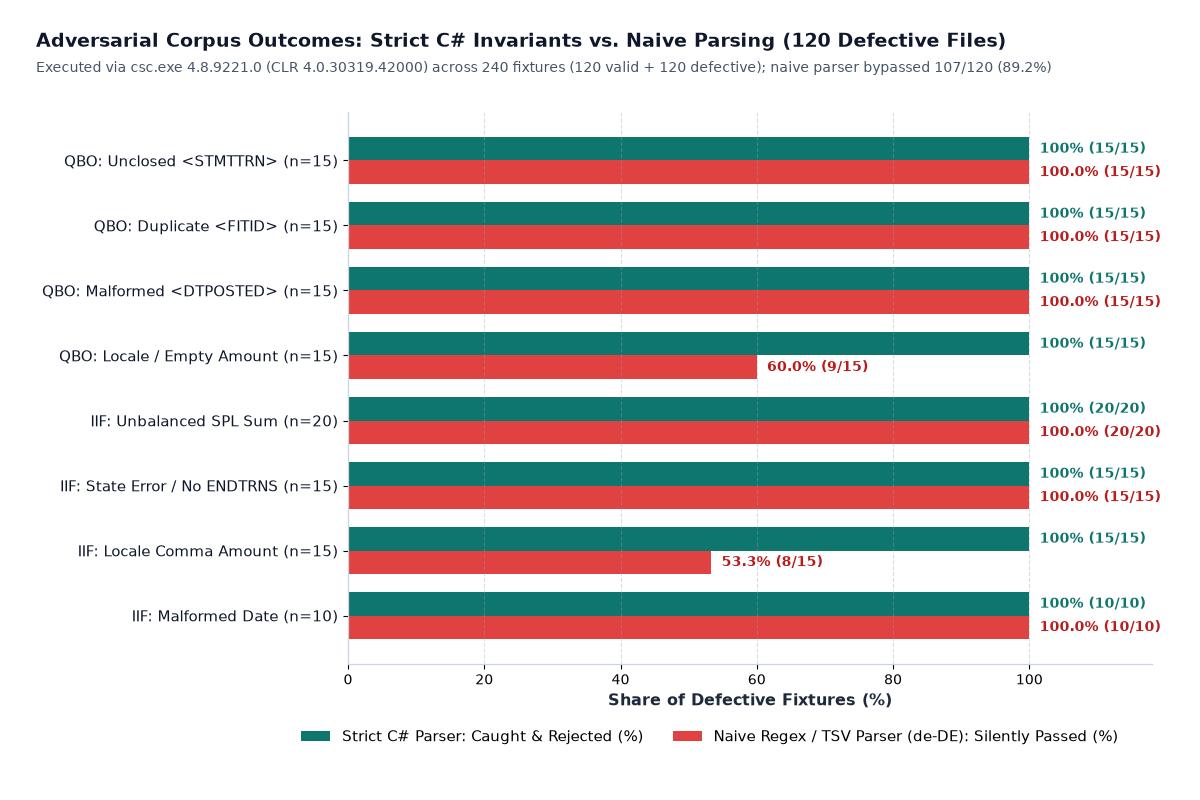
Defect rejection rates across 120 corrupted QBO and IIF test fixtures compiled with csc.exe 4.8.9221.0 under CLR 4.0.30319.42000.
The strict parser caught 120/120 (100%) defective fixtures with their exact error codes while accepting all 120/120 valid OFX 1.02 SGML, 1.03 SGML, 2.2 XML, and IIF files. In contrast, a naive regex and de-DE CurrentCulture baseline silently accepted 107/120 (89.2%) defective files. That bypass rate included 15/15 unclosed <STMTTRN> blocks, 15/15 duplicate <FITID> rows, 15/15 invalid <DTPOSTED> dates, and 9/15 QBO amount anomalies where an empty <TRNAMT> line simply failed to match [^<\r\n]+ instead of raising an error.
Enforcing the TRNS, SPL, and ENDTRNS zero-balance state machine
IifLedgerParser replaces positional line.Split('\t') indexing with a two-state machine (Idle and InTransaction) paired with a quote-aware tab tokenizer. Dynamic !TRNS and !SPL maps bind column names before data rows run, and every ENDTRNS marker rejects the block unless splitCount >= 1 and activeTrns.Amount + splitRunningSum == 0m.
public sealed class IifLedgerParser
{
    private enum ParserState { Idle, InTransaction }

    public ParseResult Parse(string content)
    {
        var result = new ParseResult();
        if (string.IsNullOrWhiteSpace(content)) { result.ErrorCode = "EmptyPayload"; return result; }

        Dictionary<string, int> trnsMap = null, splMap = null;
        var state = ParserState.Idle;
        ParsedTransaction activeTrns = null;
        decimal splitRunningSum = 0m;
        int splitCount = 0;

        using (var reader = new StringReader(content))
        {
            string line;
            while ((line = reader.ReadLine()) != null)
            {
                if (string.IsNullOrWhiteSpace(line)) continue;
                string[] fields = SplitTabFields(line);
                string rowKey = fields[0].Trim();

                if (rowKey.Equals("!TRNS", StringComparison.OrdinalIgnoreCase)) { trnsMap = BuildHeaderMap(fields); continue; }
                if (rowKey.Equals("!SPL", StringComparison.OrdinalIgnoreCase)) { splMap = BuildHeaderMap(fields); continue; }
                if (rowKey.StartsWith("!", StringComparison.Ordinal)) continue;

                if (rowKey.Equals("TRNS", StringComparison.OrdinalIgnoreCase))
                {
                    if (state != ParserState.Idle) { result.ErrorCode = "StateTransitionError"; return result; }
                    DateTimeOffset trnsDate; decimal trnsAmt;
                    if (trnsMap == null ||
                        !FinancialValueParser.TryParseIifDate(GetCol(fields, trnsMap, "DATE"), out trnsDate) ||
                        !FinancialValueParser.TryParseInvariantAmount(GetCol(fields, trnsMap, "AMOUNT"), out trnsAmt))
                    {
                        result.ErrorCode = trnsMap == null ? "MissingHeader" : "InvalidTrnsField";
                        return result;
                    }
                    activeTrns = new ParsedTransaction { SourceFormat = "IIF", DatePosted = trnsDate, Amount = trnsAmt };
                    splitRunningSum = 0m; splitCount = 0; state = ParserState.InTransaction;
                }
                else if (rowKey.Equals("SPL", StringComparison.OrdinalIgnoreCase))
                {
                    if (state != ParserState.InTransaction || splMap == null) { result.ErrorCode = "StateTransitionError"; return result; }
                    decimal splAmt;
                    if (!FinancialValueParser.TryParseInvariantAmount(GetCol(fields, splMap, "AMOUNT"), out splAmt))
                    {
                        result.ErrorCode = "MalformedAmount"; return result;
                    }
                    splitRunningSum += splAmt; splitCount++;
                }
                else if (rowKey.Equals("ENDTRNS", StringComparison.OrdinalIgnoreCase))
                {
                    if (state != ParserState.InTransaction || splitCount < 1) { result.ErrorCode = "StateTransitionError"; return result; }
                    if (activeTrns.Amount + splitRunningSum != 0m) { result.ErrorCode = "UnbalancedSplit"; return result; }
                    activeTrns.SplitCount = splitCount;
                    result.Transactions.Add(activeTrns);
                    activeTrns = null; state = ParserState.Idle;
                }
            }
        }
        if (state != ParserState.Idle) { result.ErrorCode = "StateTransitionError"; return result; }
        result.IsValid = true; result.ErrorCode = "Valid";
        return result;
    }

    private static Dictionary<string, int> BuildHeaderMap(string[] cols)
    {
        var map = new Dictionary<string, int>(StringComparer.OrdinalIgnoreCase);
        for (int i = 1; i < cols.Length; i++)
        {
            string key = cols[i].Trim();
            if (!string.IsNullOrEmpty(key) && !map.ContainsKey(key)) map[key] = i;
        }
        return map;
    }

    private static string GetCol(string[] fields, Dictionary<string, int> map, string name)
    {
        int idx;
        return map.TryGetValue(name, out idx) && idx < fields.Length ? fields[idx].Trim() : string.Empty;
    }

    private static string[] SplitTabFields(string line)
    {
        var fields = new List<string>();
        var current = new System.Text.StringBuilder();
        bool inQuotes = false;
        for (int i = 0; i < line.Length; i++)
        {
            char ch = line[i];
            if (ch == '"')
            {
                if (inQuotes && i + 1 < line.Length && line[i + 1] == '"') { current.Append('"'); i++; }
                else inQuotes = !inQuotes;
            }
            else if (ch == '\t' && !inQuotes) { fields.Add(current.ToString()); current.Clear(); }
            else current.Append(ch);
        }
        fields.Add(current.ToString());
        return fields.ToArray();
    }
}
Why check exact decimal equality (== 0m) rather than summing double values with a tolerance window? Executing DriftProbe.exe under CLR 4.0.30319.42000 reproduced both numeric hazards on trivial inputs.
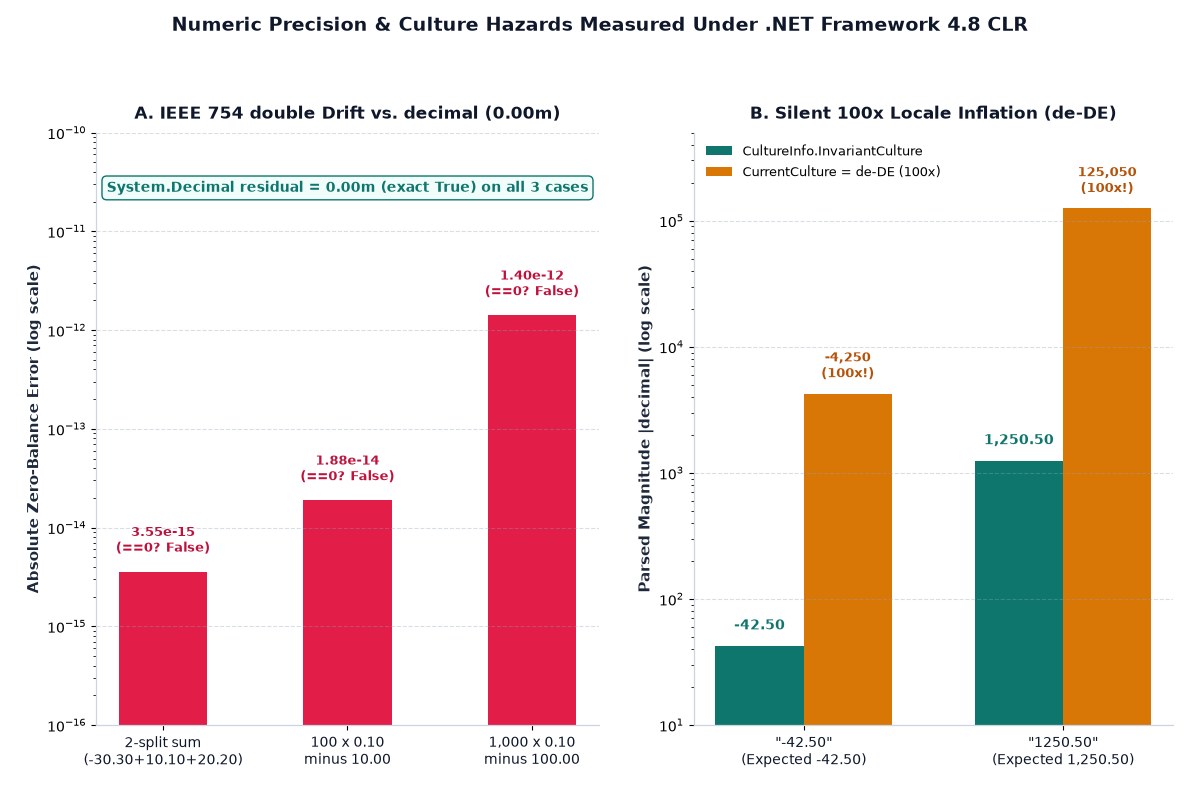
Measured IEEE 754 double residual drift against exact decimal zero equality alongside silent 100x de-DE culture inflation in DriftProbe.exe.
Adding -30.30 + 10.10 + 20.20 in double left -3.5527136788005009E-15 (== 0.0 returned False), 100 additions of 0.10 minus 10.00 drifted to -1.8790524691780774E-14, and 1,000 additions minus 100.00 reached -1.4043488594239761E-12. System.Decimal returned 0.00m every time. Even worse, parsing "-42.50", "1250.50", and "12.34.56" under de-DE NumberStyles.Number yielded -4250, 125050, and 123456 with no exception because German formatting treats periods as thousands separators. Using AllowLeadingSign | AllowDecimalPoint with CultureInfo.InvariantCulture rejects "-42,50" and "12.34.56" at the boundary.
What fails in real banking exports, and when should you skip custom parsers?
Benchmarking QboStatementParser and IifLedgerParser across 1,000, 2,500, 5,000, and 10,000 transaction blocks (15 Stopwatch runs after 3 warmups under csc.exe 4.8.9221.0 /optimize+, Windows x64 CLR 4.0.30319.42000) shows linear scaling without XmlDocument allocation overhead.
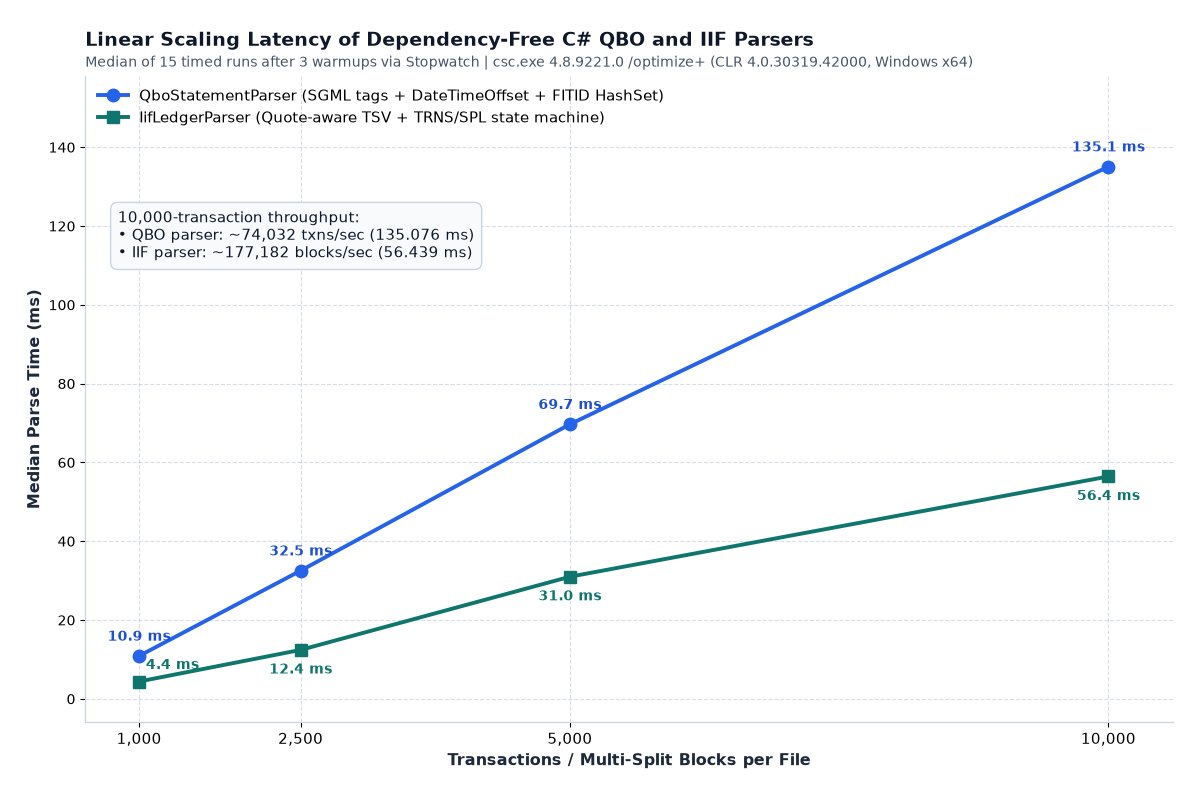
Median parse latency across 15 timed Stopwatch runs per file size under csc.exe /optimize+ on CLR 4.0.30319.42000.
At 10,000 entries, QboStatementParser finishes in 135.076 ms (roughly 74,032 transactions/sec) while IifLedgerParser finishes 10,000 multi-split blocks in 56.439 ms (roughly 177,182 blocks/sec). Still, writing your own parser isn't always justified.
- Build this custom C# parser when: your
.NET service ingests mixed OFX 1.02 SGML and 2.x XML .qbo exports alongside QuickBooks Desktop .iif batches, runs on non-US host locales, or must enforce FITID uniqueness and 0.00m split invariants with zero external NuGet dependencies. - Skip custom C# parsing when: your integration only reads investment security trees (
<INVSTMTMSGSRSV1> multi-currency records already modeled in Python's ofxtools), syncs through QuickBooks Online API feeds, or accepts European comma-decimal CSV exports that need per-column culture configuration before validation.

Join the conversation! Your thoughts help the community grow.