Conversational AI: The Intelligence Is Not Just in the Machine, It's in the Conversation
Introduction
We have reached a point where machines can write emails, generate code, explain complex concepts, and even simulate human conversations.
But here is something interesting:
If Conversational AI has become so advanced, why do we still find ourselves repeating the same instructions, correcting the same misunderstandings, and explaining the same context again and again?
In my opinion, the real challenge in Conversational AI isn't generating human-like responses. It's understanding human intent.
And perhaps, the problem isn't always with the AI. Sometimes, it's with how we communicate with it.
1. The Problem With Today's Conversational AI
Today's conversational AI systems are extremely fast, but speed doesn't necessarily translate into understanding.
Consider a simple situation.
You ask an AI:
"How do I build a scalable backend?"
You might receive a technically correct answer covering microservices, caching, databases, load balancing, and distributed systems.
But what if you are a beginner building your first application? What if you already have a production system handling thousands of requests? Or what if you are trying to solve a specific performance bottleneck?
The same question can have completely different answers depending on the context.
This brings me to what I call the Habitual Problem.
As humans, we often know that something is wrong, but we don't always know how to explain it. Sometimes, we don't even understand the problem completely ourselves.
We ask questions before questioning what we actually need to know.
And then we expect AI to understand everything we haven't communicated.
Think about it: if another human being cannot understand a problem without sufficient information, why should we expect a machine to do so?
At its foundation, a language model predicts what comes next based on patterns learned during training. Modern AI systems can extend this capability through retrieval, tools, memory, and reasoning workflows, but the quality of their output still depends heavily on the information and objectives provided.
So, instead of simply asking AI a question, try questioning your prompt first.
Question your prompt. Question your question.
This small habit can make our thinking sharper and significantly improve our problem-solving abilities.
2. Conversation vs. Intelligence
Intelligence is not simply about knowing more information. It is also about how effectively we understand, connect, and apply what we know.
Consider software engineering.
When we start our careers, even a relatively simple technical problem can take hours to approach. We spend time understanding the codebase, identifying dependencies, exploring possible solutions, and figuring out where the actual problem exists.
But with experience, something changes.
We begin recognizing patterns. We understand architectural decisions. We can identify potential problems before they become actual problems.
Why?
Because experience builds mental models.
Our previous experiences allow us to approach new situations with better judgment. That is one of the ways practical intelligence develops.
Now, let's bring this back to Conversational AI.
Why does one person get an exceptional response from an AI system while another person using the same model gets an average response?
One important factor is context.
An intelligent conversation requires more than exchanging sentences. It requires understanding the objective, relevant background, constraints, and expectations behind those sentences.
A highly capable AI model can produce a disappointing answer when given an incomplete problem. Meanwhile, a comparatively simpler model can provide a useful answer when the user communicates the problem precisely.
Of course, context isn't the only factor. The model's capabilities, available knowledge, reasoning, and access to relevant information also matter.
But context is often the starting point.
The quality of a conversation is not determined only by how intelligent the participants are, but also by how effectively they understand the problem being discussed.
3. The Missing Layer: Context Engineering
We often talk about Prompt Engineering, but I believe there is a bigger concept developers and AI users should understand: Context Engineering.
Prompt Engineering focuses on how we structure instructions.
Context Engineering goes further. It concerns how we provide and manage the information an AI system needs to perform a task effectively.
Think about what happens when you join an existing software project.
Would you start debugging without understanding its architecture, database structure, dependencies, business requirements, and existing implementation?
Probably not.
You first understand the environment.
Conversational AI deserves a similar approach.
A useful context can include:
Background: What is the situation?
Objective: What are we actually trying to achieve?
Constraints: What limitations should the solution respect?
Previous attempts: What have we already tried?
Expected outcome: What should the final result look like?
This becomes even more important when developing enterprise AI applications.
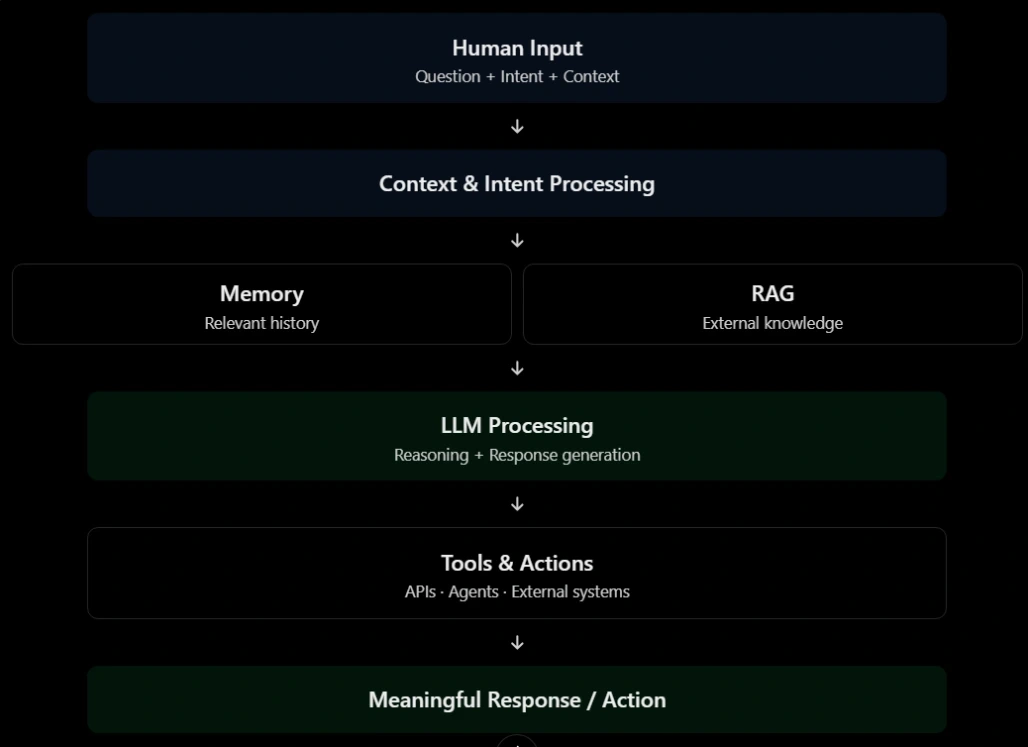
For example, a Retrieval-Augmented Generation (RAG) system can retrieve relevant information from an organization's knowledge base and provide it to an LLM as additional context.
Similarly, memory systems can preserve relevant information across interactions, while tool calling allows AI applications to interact with external systems.
These technologies are important because they help move conversational AI beyond isolated question-and-answer interactions.
However, better context doesn't automatically guarantee a correct answer. The quality of retrieval, source information, system design, and model capabilities still matters.
4. From Chatbots to Systems That Can Actually Do Things
Traditional chatbots were primarily designed to respond to predefined questions or follow structured conversation flows.
Modern conversational AI is moving beyond that.
We are seeing systems that can:
Retrieve information from internal knowledge bases.
Interact with APIs and external services.
Execute code and perform calculations.
Maintain relevant conversational memory.
Break complex objectives into smaller tasks.
Coordinate multiple tools to accomplish an objective.
This is where AI agents and agentic workflows become interesting.
Imagine asking an AI assistant:
"Analyze my application's performance, identify the bottleneck, inspect the relevant logs, and suggest a solution."
A conventional chatbot might explain general performance optimization techniques.
A tool-enabled AI system could potentially inspect actual logs, query monitoring systems, analyze metrics, and produce findings.
The difference is not merely in the quality of the conversation.
It is in the system's ability to connect understanding with action.
A conversational interface becomes significantly more useful when it can interact with the environment in which the problem exists.
However, this also introduces new engineering challenges: permissions, security, tool reliability, observability, validation, and human oversight.
We shouldn't confuse an AI system that can perform actions with one that can always perform them correctly.
5. The Human Side: Are We Becoming Better Problem Solvers?
This is probably the most interesting part of Conversational AI for me.
We frequently discuss how AI will make developers more productive, automate repetitive work, and reduce the time required to complete tasks.
But there is another question worth asking:
Can interacting with AI make us better thinkers?
I believe it can, provided we use it correctly.
Consider two different approaches.
Approach A:
You encounter a problem, immediately ask AI for a solution, copy the answer, and move forward without understanding the reasoning.
Approach B:
You encounter a problem, investigate it, identify what you already know, explain the missing information, ask AI to challenge your assumptions, and evaluate the suggested solution.
Both approaches use AI.
But the learning outcomes can be completely different.
In the second approach, AI becomes more than an answer-generation tool. It becomes a thinking partner.
We can ask it to:
Challenge our assumptions.
Identify weaknesses in our reasoning.
Explain alternative approaches.
Compare different technical decisions.
Ask us questions instead of immediately providing answers.
Explain why a particular solution might fail.
This changes our relationship with technology.
Instead of allowing AI to do all the thinking, we use it to improve the quality of our own thinking.
And I believe this is one of the most valuable opportunities Conversational AI offers us.
--> Architecture diagram.
6. My Perspective: Where Conversational AI Is Heading
I don't believe the future of Conversational AI will be determined simply by which model has the highest benchmark score or generates the most human-like responses.
The real competition will involve building systems that understand objectives, maintain relevant context, retrieve reliable information, reason through problems, and interact with the world safely.
We will see more personalized assistants, enterprise AI agents, multimodal systems, and applications that combine language models with domain-specific knowledge.
But there is one thing I don't want us to overlook.
As AI becomes more capable, our ability to communicate effectively with it becomes increasingly important.
A more powerful model can expand what we can accomplish, but it cannot always compensate for an objective we haven't properly defined.
The responsibility of thinking, questioning, validating, and making decisions should not disappear simply because AI can generate an answer in seconds.
Conclusion
Perhaps we have been looking at Conversational AI from the wrong perspective.
We keep asking how intelligently machines can communicate with humans.
But maybe we should also ask how intelligently humans can communicate with machines.
The next generation of Conversational AI won't be defined only by how naturally it talks. It will be defined by how effectively it understands context, supports reasoning, retrieves information, and helps us accomplish meaningful objectives.
And ultimately, I believe the biggest opportunity isn't just building smarter AI.
It's becoming smarter at using it.
What do you think? Is the future of Conversational AI primarily about building more intelligent models, or about building better ways for humans and machines to understand each other?


Join the conversation! Your thoughts help the community grow.