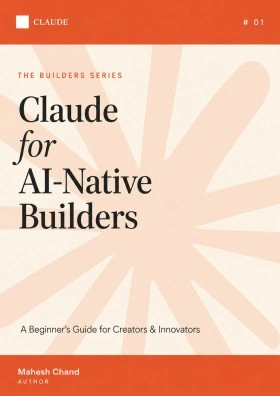

Claude for AI-Native Builders A Beginners Guide for Claude Developers — Mahesh Chand · First Edition · 2026 · 15 chapters · 201 sections
Most developers learning AI-native engineering start in the wrong place. They collect prompts, copy clever one-liners, and wonder why nothing holds together past the second week. This book is built on a different premise: real AI-native engineering is a platform problem, not a prompting problem — and the platform has a knowable shape.
Across fifteen chapters, the book takes the twelve primitives underneath Claude Code and assembles them into a single coherent architecture across four layers: governance, workflow, distribution, and integration. Each chapter covers one primitive — what it is, why it exists, how it works, where it fails, and how it connects to everything around it. The capstone wires all twelve into a working system: one command, five specialised agents, full governance, recoverable at every step.
Table of Contents
Introduction — the shift to AI-native development, and why context beats prompts
CLAUDE.md — the instruction layer: the most important file in an AI-native repo
Permissions — governance and control, the four permission modes, Auto Mode, and sandboxing
Plan Mode — thinking before doing: Claude proposes, the developer approves
Checkpoints — recovery and reversibility: safe experimentation, fast rollback
Skills — reusable intelligence: apps for Claude, loaded only when needed
Hooks — from assistant to orchestrator: when X happens, do Y
MCP — connected intelligence: the universal connector to your infrastructure
Plugins — from tool to platform: Skills + Hooks + MCP, packaged and distributable
Context — the operating memory of AI, and the discipline of context engineering
Slash Commands — from chat to command line: the operational interface
Compaction — memory at scale: compressing history into intent
Subagents — distributed AI engineering: nested agents, cost attribution, budget caps
Building Your First AI-Native Workflow — the capstone: twelve primitives, one platform
The Future of AI-Native Software Engineering — the decade ahead
Who it's for — developers new to Claude Code, engineers moving past AI-as-autocomplete, tech leads writing their team's adoption playbook, indie hackers who ship alone but want to operate like a team, and security engineers who care about governance done right.
It assumes no prior AI experience — but it doesn't stop at hello world. By the end you'll understand how production AI-native systems are designed, governed, and operated.
Join the conversation! Your thoughts help the community grow.