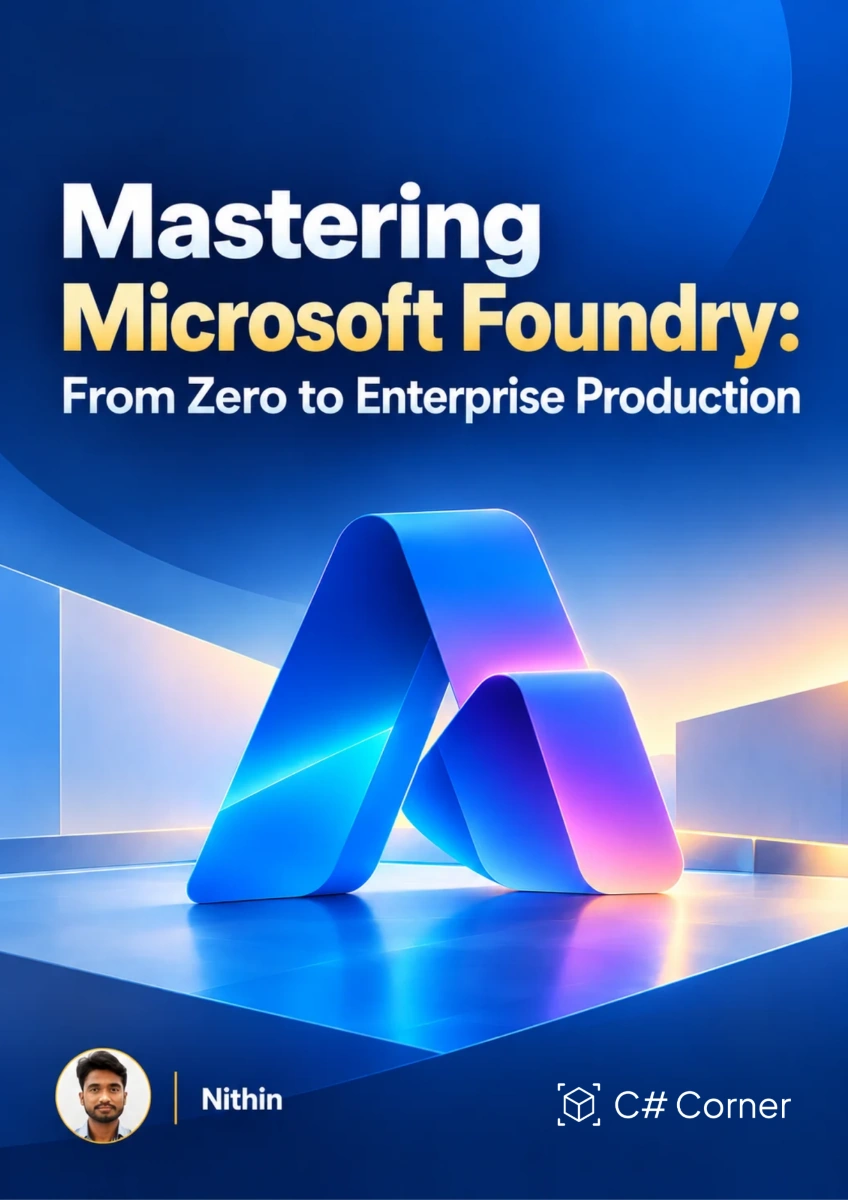

Microsoft Foundry provides a platform for building AI applications and agents, connecting enterprise data, integrating tools, and deploying solutions for real-world use. However, moving from a basic model API call to a secure, reliable, and production-ready AI system requires a clear understanding of architecture, agent workflows, infrastructure, and governance.
Mastering Microsoft Foundry: From Zero to Enterprise Production is a practical engineering guide designed to help developers, architects, and technical teams understand the Microsoft Foundry ecosystem and build AI solutions with C# (.NET) and Python.
Across 12 chapters, this book takes you from the fundamentals of Microsoft Foundry to a complete enterprise application architecture. You will explore the Responses API, model selection and routing, AI agents, Model Context Protocol (MCP) toolboxes, enterprise knowledge retrieval, multi-agent workflows, monitoring, security, and private network deployments.
The book also demonstrates how these components fit together in a real-world Contoso Policy and Claims Portal project. You will learn about Virtual Network architecture, private DNS, Azure Cosmos DB, Blob Storage, Azure AI Search, managed identities, and infrastructure provisioning with Bicep.
What You Will Learn
Understand Microsoft Foundry architecture and its core components.
Work with the Responses API and manage multi-turn AI conversations.
Explore model catalogs, model routing, structured outputs, and local model execution.
Build Prompt Agents, Voice Agents, and Hosted Agents.
Integrate external tools and APIs using MCP toolboxes and dynamic tool search.
Connect AI applications to enterprise knowledge sources using Foundry IQ and related data services.
Design multi-agent workflows using the Microsoft Agent Framework.
Monitor AI applications with OpenTelemetry tracing and evaluate agent behavior.
Apply security controls, managed identities, role-based access control, and private networking.
Provision Microsoft Foundry infrastructure using Bicep templates.
Build backend functionality in C# (.NET) and Python.
Configure API gateway policies, validate deployments, and plan for disaster recovery.
Who Should Read This Book?
This book is intended for .NET developers, Python developers, AI engineers, cloud architects, backend engineers, and technical professionals who want to move beyond basic AI integrations and understand how enterprise AI applications are designed and deployed.
It is also useful for engineering leads and solution architects who need a clearer picture of the infrastructure, security, governance, and operational considerations involved in production AI systems.
A Practical Path to Enterprise AI
Rather than treating models, agents, tools, data, and infrastructure as separate topics, this guide connects them into a complete application architecture. Each chapter builds on the previous one, helping you understand not only how individual components work but also how they contribute to a production deployment.
With practical examples, C# and Python implementations, architecture guidance, and infrastructure-as-code coverage, this book provides a structured starting point for developers who want to build, secure, and operate AI-powered applications using Microsoft Foundry.
Start with the fundamentals. Build with practical examples. Progress toward enterprise production.
Join the conversation! Your thoughts help the community grow.