
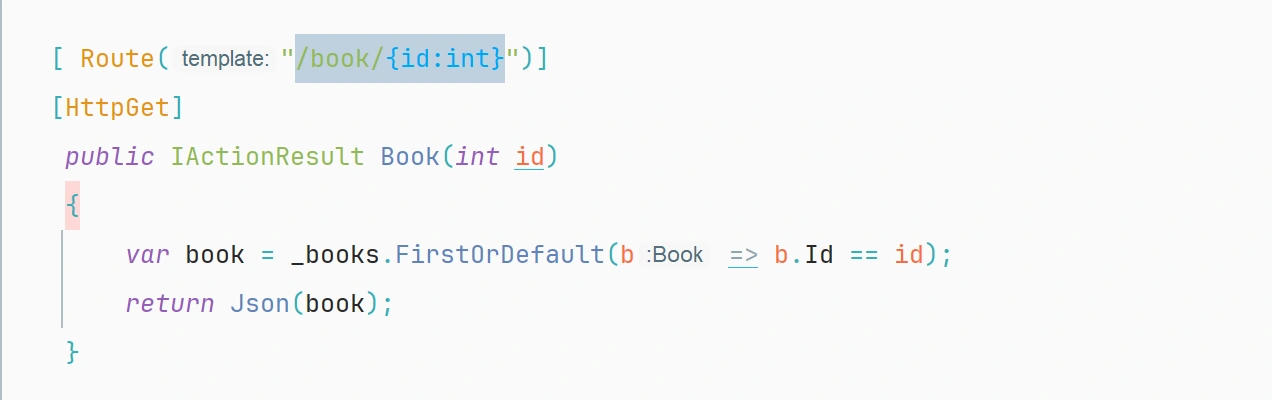
in senarios like below where we want to retrive a book using the id as an example there is no need to make validaton because id will be passed from the view as an anchor tag
Loading
in senarios like below where we want to retrive a book using the id as an example there is no need to make validaton because id will be passed from the view as an anchor tag
Know the answer? Post it — somebody with the same question will find it here.
Sign in to answer this question
It is the same account you read, post and publish with — and you will come straight back to this page.
Tuhin PaulPosted Mar 2, 2025, 7:49 PM
refactor the code to include these validations:
Even when the
idis passed from a view as an anchor tag, it's important to validate it within the method to ensure data type correctness, handle missing records, prevent SQL injection, maintain robustness, and secure against unauthorized access.Tuhin PaulPosted Mar 2, 2025, 7:48 PM
If the
idcorresponds to sensitive data, ensure that the user has permission to access the requested resource. Implement proper authorization checks.Tuhin PaulPosted Mar 2, 2025, 7:48 PM
In the scenario you've described, where an
idis passed from a view as part of an anchor tag and used to retrieve a book, it might seem like validation isn't necessary. However, there are still several important reasons why validation is crucial:Even though the route constraint
{id:int}ensures that only integer values can be passed, it's still good practice to validate theidwithin the method. This prevents unexpected behavior if the route constraint fails or is bypassed.Handle Missing Records
If the
iddoes not correspond to an existing record in the database, you should handle this gracefully by returning a meaningful response.Although direct SQL injection is less likely with LINQ queries, ensuring the
idis valid helps prevent other forms of injection or malicious input.Jignesh KumarPosted Mar 2, 2025, 11:36 AM
Hello Mina,
Still, We need to make sure, incase we do have zero(0) if we are using model property with int field, we can have validation for that,
mina shakerPosted Mar 2, 2025, 2:42 AM
@Eliana Blake i made another senario for validation but i dont think this is a convintion i added a viewModel for the getting the book by id that has id as prop and i used the attribure requred and i did not retive the data untill it is passed also i did not learnt authentication and authrization yet obu of cource i will use them when i learn them
Eliana BlakePosted Mar 2, 2025, 2:36 AM
It sounds like you're interested in discussing model binding and validation in the context of retrieving a book using an ID in a scenario where validation may not be necessary. In this specific case, since the ID is being passed from the view as an anchor tag, there may indeed be situations where validation is not required.
When retrieving a book using an ID that is directly passed from the view, the assumption is that the ID is valid and exists within the system. In such cases, you can bypass additional validation since the ID is already present and presumably accurate due to being provided by the system itself.
However, it's essential to ensure that the system is secure and that the IDs are not tampered with in transit. The backend should still implement measures to prevent unauthorized access to book data by verifying the user's permissions or utilizing other security mechanisms.
In scenarios where user input is involved, especially with sensitive operations like data modification, it's crucial to implement proper validation to prevent potential security risks such as injection attacks or unauthorized access.
Overall, while validation may not be needed in this specific example due to the nature of the data being retrieved, it's always a best practice to consider security implications and implement appropriate measures to safeguard the application and user data.