

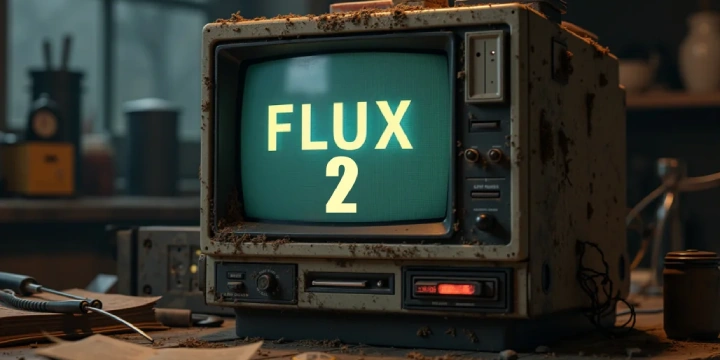
Credit: BlackForestLabs
Black Forest Labs has launched FLUX.2, its newest family of frontier image generation models, delivering major improvements in photorealism, consistency and text rendering. The models come with a new multi-reference capability, sharper typography, and support for detailed, pose-controlled image generation.
In collaboration with NVIDIA, FLUX.2 is available at launch in FP8 quantized variants that cut VRAM requirements by 40 percent while boosting performance by an equivalent 40 percent on RTX GPUs. The models run directly in ComfyUI, with no additional software required.
Next-generation visual quality
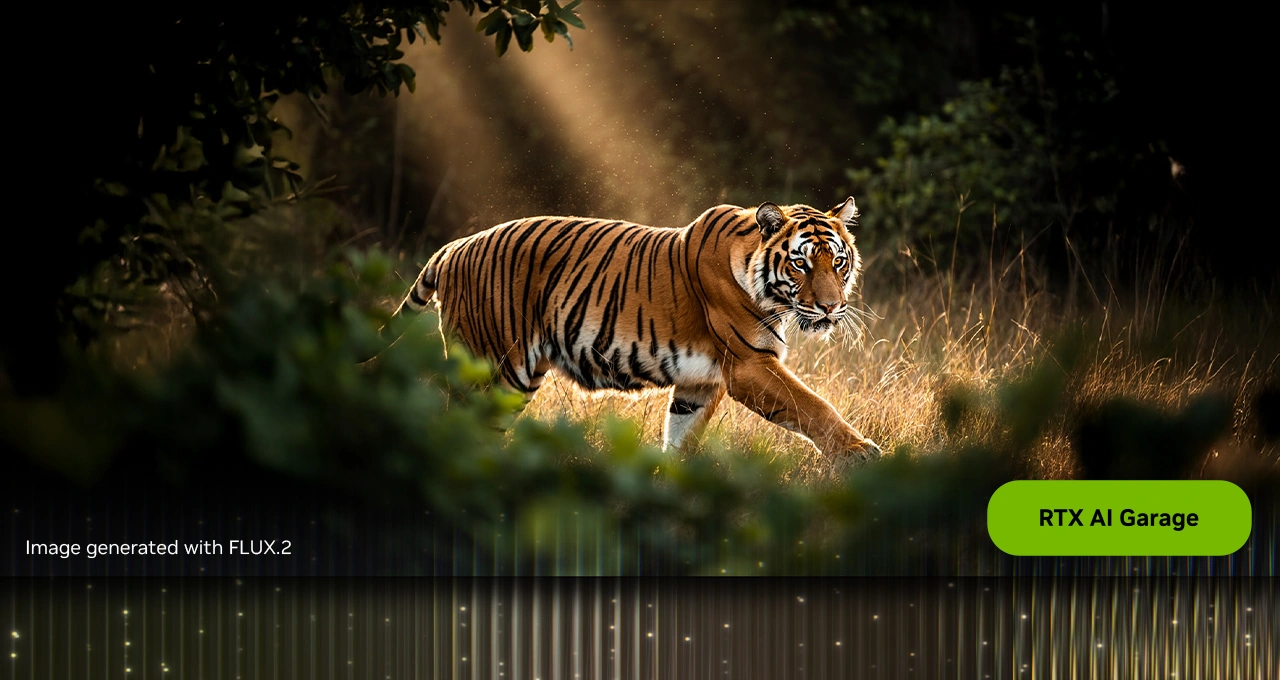
Credit: nvidia
FLUX.2 produces photorealistic images up to 4 megapixels, with real-world lighting and physics to eliminate the “AI look.” Artists can apply explicit pose control and generate clean, legible text across UI screens, infographics and multilingual layouts. The new multi-reference feature lets creators use up to six reference images to maintain consistent style and subjects without fine-tuning.
Built for RTX performance
The full FLUX.2 model is large, at 32 billion parameters, and requires 90GB VRAM to load fully or 64GB in low-VRAM mode — beyond the limits of typical consumer GPUs. To make the model widely accessible, NVIDIA and Black Forest Labs introduced FP8 quantization, reducing memory demand without a significant hit to quality.
NVIDIA and ComfyUI also enhanced weight streaming, enabling parts of the model to offload to system RAM, and added optimizations for FP8 checkpoints to further improve RTX performance.
Get started
Users can access FLUX.2 today by updating ComfyUI and exploring the built-in templates, or by downloading model weights from Black Forest Labs’ Hugging Face page.
Brian WoodPosted Feb 18, 2026, 3:24 PM
Hi! Really interesting move with the FLUX.2 models being optimized specifically for NVIDIA RTX GPUs. It’s a smart direction considering how much local generation has grown lately — creators clearly want more control without always relying on cloud processing. The performance boost on RTX cards could make a noticeable difference for designers and developers working on heavier workloads.One thing I’ve noticed in AI image workflows is that generation is only half the battle — post-processing matters just as much. Tools like https://bestphotos.ai/super-resolution can be helpful when refining outputs, especially if you’re scaling assets for commercial or high-resolution use. Optimizing both generation and enhancement really rounds out the pipeline. Curious to see how FLUX.2 compares against other GPU-optimized models in real-world benchmarks.