

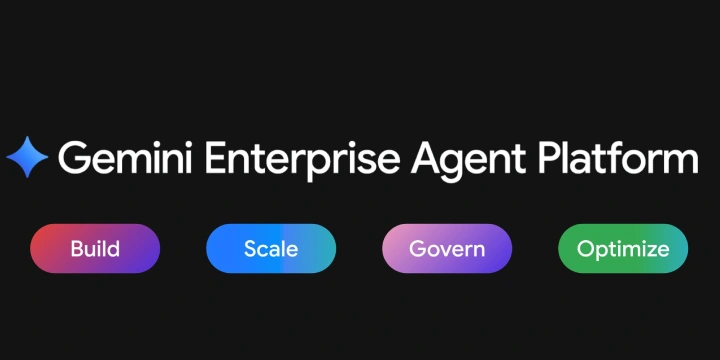
Google Cloud has officially launched the Gemini Enterprise Agent Platform, a comprehensive new ecosystem designed to transition businesses from managing individual AI tasks to delegating complex business outcomes to autonomous agents. As the evolution of Vertex AI, this platform provides a unified environment to build, scale, govern, and optimize agents, specifically tailored for enterprise-grade reliability and security.
The Evolution of Agentic Infrastructure
The Gemini Enterprise Agent Platform provides a single destination for technical teams to build agents that interact across multiple systems. Key capabilities include:
Build: Developers can use Agent Studio for a low-code, visual interface, or the upgraded Agent Development Kit (ADK) for a code-first, logic-heavy environment. This simplifies the entire lifecycle, from simple prompts to complex agentic architectures.
Scale: The revamped Agent Runtime supports long-running agents that maintain state for days, backed by Memory Bank for persistent, long-term context. It also features Agent Sandbox—a secure, hardened environment for executing model-generated code and browser-based automation.
Govern: Centralized control is managed via Agent Identity (cryptographic IDs for every agent), Agent Registry (a library of approved assets), and Agent Gateway (air-traffic control for agent interactions with tools and other systems).
Optimize: Integrated Agent Simulation, Evaluation, and Observability provide teams with a real-time lens into agent reasoning, enabling them to debug issues, track performance, and automate agent refinement.
Enterprise-Ready Capabilities
The platform is built to support complex, production-grade workflows:
Model Flexibility: Provides first-class access to Google's breakthroughs—including Gemini 3.1 Pro and Flash Image, and Lyria 3—alongside open models like Gemma 4 and third-party models like Anthropic’s Claude Opus, Sonnet, and Haiku.
Agent-to-Agent Orchestration: Agents can seamlessly delegate tasks to one another, supporting both generative and deterministic patterns, which is critical for compliance-heavy workflows.
Real-Time Interactivity: Using WebSocket-based Bidirectional Streaming, agents can process audio and video inputs without lag, enabling human-like, real-time customer and employee interactions.
Advanced Security: Agent Anomaly Detection and Agent Threat Detection work with the Security Command Center to detect unusual reasoning, reverse shells, or malicious connections in real-time.
Industry Adoption
Major enterprises are already deploying the platform to transform their operations:
Comcast has rebuilt its Xfinity Assistant to move beyond scripted automation to personalized, conversational troubleshooting.
L’Oréal is leveraging the ADK to build a proprietary "Beauty Tech Agentic Platform," securely connecting agents to core operational data via the Model Context Protocol (MCP).
PayPal is utilizing the platform to visualize multi-agent workflows and build a foundation for trusted agent-based commerce payments.
This launch signals a clear maturation of the AI agent landscape. The shift toward a platform that emphasizes governance and long-term memory suggests that enterprise development is moving past "simple prompts" toward durable, outcome-oriented digital teammates. Developers can begin exploring the platform today in the Google Cloud console.
Join the conversation! Your thoughts help the community grow.