


MOUNTAIN VIEW, Calif. — January 2026 — Google has unveiled agentic vision capabilities powered by Gemini 3 Flash, giving developers a new way to build AI systems that can see, reason, and act in real time.
The update brings visual understanding directly into agent workflows, allowing AI systems to interpret images and video streams, make decisions, and take actions without heavy orchestration or slow model handoffs. Google said the goal is to make visual AI more practical for real-world, time-sensitive applications.
Gemini 3 Flash is designed for speed and low latency, making it well suited for agentic use cases where models need to respond quickly to what they see. With agentic vision, developers can build systems that understand scenes, track changes, and reason about visual context as part of an ongoing task rather than a one-off analysis.
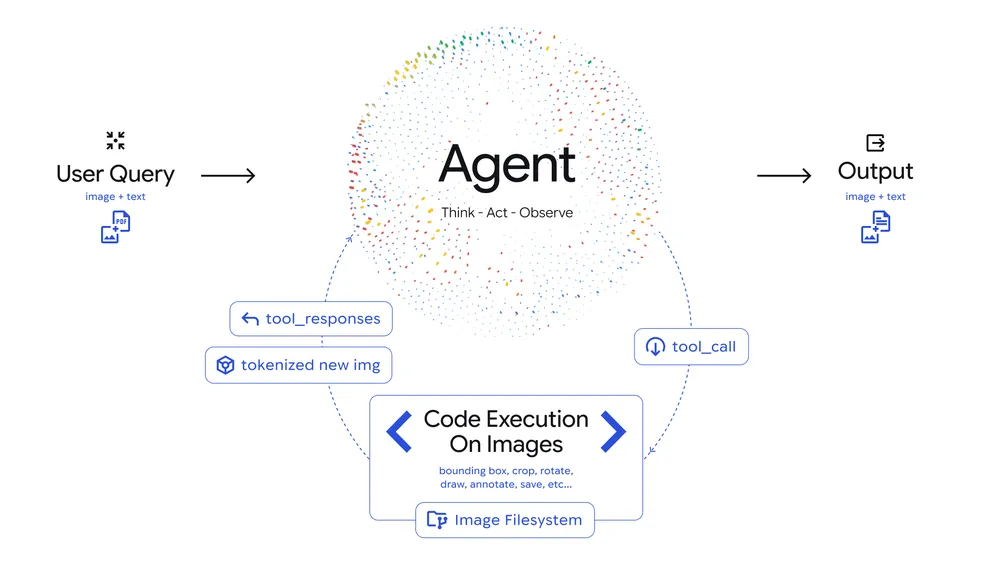
Google highlighted use cases such as monitoring interfaces, guiding users through visual tasks, understanding diagrams or screenshots, and supporting robotics or automation workflows where perception and action need to stay tightly linked. Instead of treating vision as a separate step, agentic vision allows models to continuously observe and adapt.
The company emphasized that Gemini 3 Flash balances strong multimodal reasoning with efficiency, enabling developers to deploy visual agents at scale without the cost and latency typically associated with larger models. The approach is aimed at production systems rather than research demos.
Agentic vision is available to developers through Google’s AI tooling, with documentation and examples focused on helping teams integrate visual reasoning into broader agent architectures.
With the launch, Google is signaling that the next phase of AI development is not just about understanding text or images in isolation, but about building agents that can perceive the world, reason about it, and respond in real time.
Source: Google
Join the conversation! Your thoughts help the community grow.