

Google has introduced Veo 3.1 Lite, a lighter and more efficient version of its advanced AI video generation model, aimed at making high-quality video creation faster, cheaper, and more accessible. The release expands Google’s Veo family by offering a model optimized for speed and scalability, while still retaining many of the core capabilities of Veo 3.1.
The move reflects a broader trend in AI: delivering “lite” models that balance performance with cost efficiency, especially for high-volume production use cases.
What Is Veo 3.1 Lite?
Veo 3.1 Lite is part of Google’s Veo 3.1 video generation ecosystem, which allows users to create videos from text prompts, images, or a combination of both.
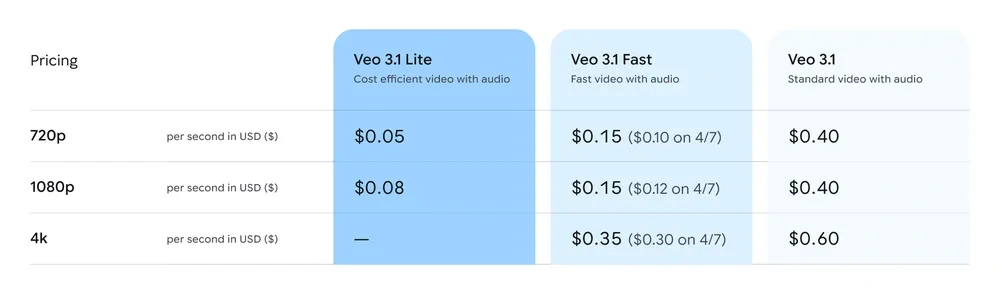
The standard Veo 3.1 model already offers:
High-quality video generation (720p–1080p)
Native audio including dialogue and sound effects
Strong prompt adherence and cinematic realism
The Lite version builds on this foundation but focuses on:
👉 Lower latency, reduced cost, and faster iteration
Designed for Speed and Scale
Veo 3.1 Lite is optimized for scenarios where developers and creators need to generate large volumes of video quickly.
Typical use cases include:
Social media content generation
Rapid prototyping of video ideas
Marketing and ad variations
Automated video pipelines
Instead of prioritizing maximum cinematic quality, Lite focuses on efficient generation with acceptable quality, making it ideal for production workflows.
Core Capabilities Still Intact
Despite being a lighter model, Veo 3.1 Lite retains many key features from the main Veo system:
🎬 Text-to-Video and Image-to-Video
Users can generate short clips from prompts or reference images.
🔊 Native Audio Generation
Supports dialogue, sound effects, and ambient audio synchronized with visuals.
🎭 Improved Consistency
Maintains characters, objects, and scenes across frames using reference inputs.
📱 Vertical & Mobile-First Output
Supports formats optimized for platforms like YouTube Shorts and TikTok.
Lite vs Standard: What’s the Difference?
The key difference comes down to quality vs efficiency trade-offs:
Veo 3.1 (Standard)
Higher fidelity visuals
More cinematic control
Better for storytelling and production
Veo 3.1 Lite
Faster generation
Lower cost
Better for scale and iteration
👉 This mirrors the same strategy seen in AI models like “Mini” or “Flash” variants.
Integrated Across Google’s AI Stack
Veo models—including Lite—are being integrated across Google’s ecosystem:
Gemini app
Google AI Studio
Vertex AI
Flow (Google’s creative video tool)
This allows both developers and creators to access the model through APIs or visual tools.
Join the conversation! Your thoughts help the community grow.