

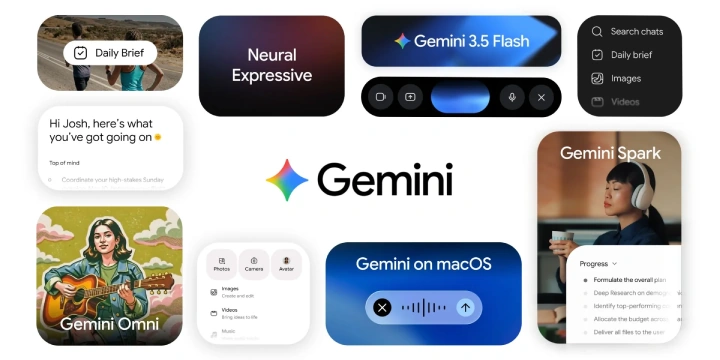
Google has announced one of the biggest updates yet to the Gemini ecosystem during Google I/O 2026, transforming the Gemini app from a conversational chatbot into a far more proactive and agentic AI platform.
The announcement introduces always-running AI agents, deeper integrations across Google products, a redesigned user experience, multimodal generation features, personalized AI workflows, and major improvements powered by Gemini 3.5 Flash.
According to Google, the company is entering what CEO Sundar Pichai described as the “Agentic Gemini Era,” where AI systems move beyond answering prompts and begin proactively assisting users across their daily workflows.
The update reflects a broader industry transition happening across AI platforms. Instead of reactive assistants that wait for commands, companies are increasingly building persistent AI systems capable of automating tasks, organizing information, monitoring workflows, and interacting continuously with software ecosystems.
Gemini Spark: Google’s Always-Running AI Agent
One of the most important announcements is Gemini Spark, a new proactive AI agent system integrated directly into the Gemini app.
Unlike traditional AI chatbots that only respond when prompted, Gemini Spark is designed to operate continuously in the background using Google Cloud infrastructure.
Google says Spark can:
Monitor workflows continuously
Organize information automatically
Generate summaries proactively
Track subscriptions and expenses
Coordinate tasks across Google services
Create reminders and schedules
Build personalized study materials
Surface relevant information before users ask for it
During the Google I/O demonstrations, Spark was shown automatically scanning emails for recurring subscriptions, generating study guides, preparing summaries, and helping users organize day-to-day tasks.
This marks a major shift from prompt-based AI toward persistent AI agents capable of long-running execution.
Gemini 3.5 Flash Powers the New Experience
Google confirmed that Gemini 3.5 Flash is now the default model powering the Gemini app.
The company says the model introduces major improvements in:
Agentic reasoning
Long-context understanding
Coding capabilities
Task planning
Workflow orchestration
Response latency
Multimodal interactions
According to Google, Gemini 3.5 Flash is specifically optimized for AI agent workflows where systems must continuously manage multi-step tasks instead of generating single responses.
The model also improves performance across mobile devices, web apps, and integrated Google services.
The Gemini App Is Becoming More Agentic
Google repeatedly emphasized the word “agentic” throughout the keynote.
The company says the Gemini app is evolving into an AI platform that can:
Understand context continuously
Act proactively
Coordinate workflows
Maintain ongoing tasks
Interact with multiple apps simultaneously
Execute actions on behalf of users
Instead of opening Gemini solely for questions or conversations, Google wants users to rely on Gemini as an ongoing digital assistant embedded across their daily digital lives.
This strategy closely resembles the larger movement happening across the AI industry, where platforms are racing to build autonomous AI systems rather than traditional chatbot interfaces.
Gemini Daily Brief: Personalized AI Summaries
Google also introduced Gemini Daily Brief, a new feature that automatically generates personalized summaries using data from:
Gmail
Google Calendar
Google Docs
Google Workspace apps
Connected Google services
Daily Brief provides users with contextual summaries, reminders, schedules, important updates, and relevant information tailored to individual workflows.
The feature is designed to reduce information overload by proactively surfacing useful insights before users search for them manually.
Google says Daily Brief will continue learning user preferences over time to improve relevance and personalization.
A Completely Redesigned Gemini Interface
The Gemini app is also receiving a major visual redesign.
Google introduced a new design language called “Neural Expressive,” focused on creating richer, more dynamic AI interactions.
The redesign includes:
Fluid UI animations
Updated typography
Interactive cards
Visual timelines
Rich media previews
Improved voice experiences
Enhanced haptic feedback
More immersive conversational interfaces
According to Google, the goal is to make AI interactions feel less like static chat windows and more like interactive operating systems.
The redesign is rolling out across:
Android
iOS
Web
Workspace integrations
Gemini Omni Flash and Multimodal AI Generation
Google also connected the Gemini app to Gemini Omni Flash, the company’s newly announced multimodal generation model.
The system allows users to generate and edit media using combinations of:
Text
Images
Audio
Video
Unlike earlier AI generation systems that focused primarily on text prompts, Gemini Omni Flash can process multiple input types simultaneously.
Google demonstrated:
AI-generated videos
Video remixing
Conversational video editing
Media generation from uploaded photos
Audio-synchronized video clips
This integration significantly expands the Gemini app beyond text conversations into a broader multimodal creation platform.
Deep Integration Across Google’s Ecosystem
Google is aggressively integrating Gemini into nearly every major product inside its ecosystem.
The updated Gemini app now connects deeply with:
Gmail
Google Docs
Google Sheets
Google Slides
Android
Google Search AI Mode
YouTube
Workspace
Google Photos
This integration allows Gemini agents to move across services and maintain context while executing tasks.
For example, Gemini can:
Read emails
Update schedules
Summarize documents
Create presentations
Manage tasks
Search files
Generate responses
Coordinate workflows between apps
This ecosystem-level integration is one of Google’s biggest competitive advantages in the AI market.
Persistent Background AI Workflows
One of the biggest strategic shifts revealed during I/O is Google’s move toward persistent background AI execution.
Instead of users manually launching AI sessions repeatedly, Gemini agents can continue operating after the user leaves the app.
Google says these systems can:
Continue long-running workflows
Monitor changes continuously
Update users proactively
Execute tasks asynchronously
Coordinate actions over time
This approach mirrors trends emerging across the broader AI industry, where companies are increasingly building autonomous systems capable of continuous execution.
Competition With ChatGPT, Claude, and AI Agent Platforms
The Gemini update comes during intense competition in the AI assistant market.
Google is now competing directly with:
OpenAI ChatGPT
OpenAI Codex
Anthropic Claude
Claude Code
Microsoft Copilot
Perplexity AI
Cursor
Replit
Agentic developer platforms
Industry analysts say Google is repositioning Gemini from a standalone chatbot into a full AI operating layer integrated across consumer and enterprise products.
The company is also aggressively pushing into:
AI coding
Autonomous agents
Multimodal generation
Workflow automation
AI-powered productivity systems
Rollout and Availability
Google says many of the new Gemini features are rolling out beginning today across:
Android
iOS
Web
Google Workspace
Gemini app experiences
Additional capabilities will continue expanding over the coming months.
Some enterprise and advanced features may initially roll out in limited preview before wider global availability.
Official Resources
Google Gemini Announcement: https://blog.google/innovation-and-ai/products/gemini-app/next-evolution-gemini-app/
Google I/O 2026 Updates: https://blog.google/innovation-and-ai/sundar-pichai-io-2026/
Gemini App: https://gemini.google.com/
Gemini Models Overview: https://blog.google/innovation-and-ai/models-and-research/gemini-models/
Join the conversation! Your thoughts help the community grow.