


The potential transaction would nearly triple Hugging Face’s last reported valuation and demonstrate the growing strategic value of AI developer communities, model distribution and open-source infrastructure.
Hugging Face, one of the world’s most influential artificial intelligence developer platforms, is reportedly exploring a potential sale that could value the company at $13 billion or more.
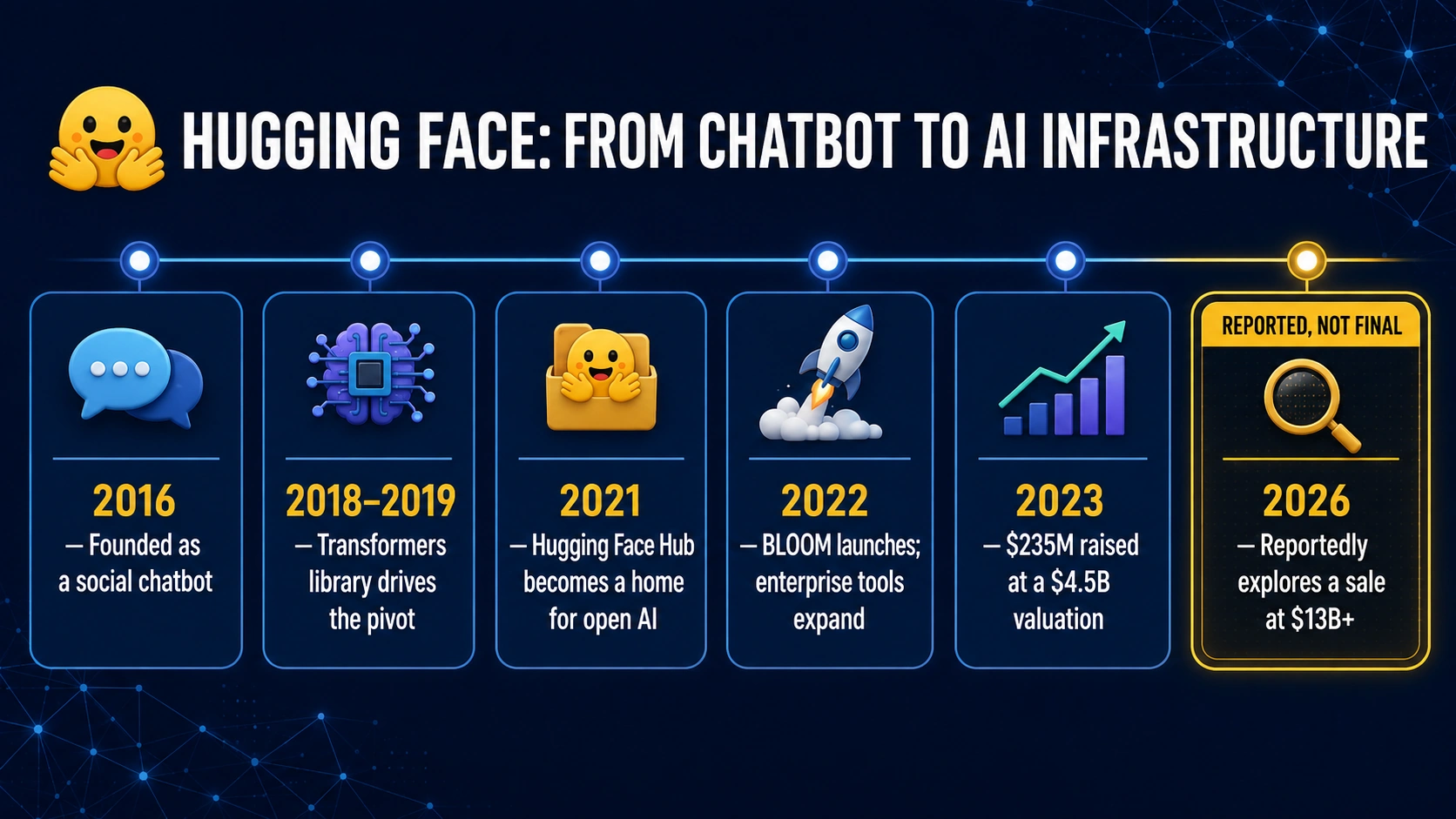
According to a Business Insider report, Hugging Face has engaged a bank to evaluate acquisition interest. The discussions appear to be exploratory, and no buyer or finalized transaction has been announced.
That distinction is important: Hugging Face has not confirmed that it has agreed to sell the company. It is reportedly testing the market and evaluating potential offers.
Nevertheless, the proposed valuation is significant. Hugging Face was last officially valued at $4.5 billion in August 2023, when it raised $235 million from a group of investors that included Salesforce, Google, Amazon, Nvidia, AMD, Intel, IBM and Qualcomm.
A sale at $13 billion would represent an increase of approximately 189% over its 2023 valuation.
From a Teenage Chatbot to Critical AI Infrastructure
Hugging Face was founded in New York in 2016 by French entrepreneurs Clément Delangue, Julien Chaumond and Thomas Wolf.
The company did not begin as an AI infrastructure platform. Its original product was a social chatbot application designed primarily for teenagers. The founders wanted to make interacting with artificial intelligence feel more conversational, friendly and entertaining.
The company’s name was inspired by the popular hugging-face emoji: 🤗.
The consumer chatbot did not become Hugging Face’s defining product. Instead, the company made a pivotal decision to open-source parts of the natural language processing technology it had developed internally.
That decision changed the company’s direction—and ultimately its value.
The Transformers Breakthrough
In 2018 and 2019, Hugging Face’s open-source Transformers library began attracting significant attention from machine learning researchers and developers.
At the time, using advanced language models required substantial technical expertise. Developers often had to understand individual research implementations, configure complex machine learning environments and write significant amounts of specialized code.
Transformers simplified that experience.
The library gave developers a more consistent way to download, test, fine-tune and deploy pretrained models. It eventually supported models based on architectures from Google, Meta, Microsoft and numerous AI research organizations.
As adoption accelerated, Hugging Face moved away from its original consumer-chatbot business and repositioned itself around open-source machine learning.
The company was no longer attempting to create one successful AI application. It was building tools that thousands—and eventually millions—of other developers could use to create their own AI applications.
Building the “GitHub for AI”
The next major step was the development of the Hugging Face Hub.
The Hub allows developers, researchers and organizations to publish and discover:
AI and machine learning models
Training and evaluation datasets
Interactive AI applications
Model documentation and configuration files
Research experiments and demonstrations
This model created a powerful network effect. More developers publishing models attracted more users. More users encouraged organizations to distribute their models through Hugging Face. That activity made the platform increasingly important to the broader AI ecosystem.
Hugging Face currently describes its platform as hosting more than two million models, alongside extensive collections of datasets and AI applications.
Its ecosystem now includes prominent open models and technologies from organizations such as Meta, Google, Microsoft, Mistral AI, DeepSeek and thousands of independent developers and research teams.
This is why Hugging Face is frequently described as the “GitHub of AI.” GitHub became the central collaboration and distribution platform for source code. Hugging Face is attempting to play a comparable role for AI models, datasets and applications.
BigScience and BLOOM
Hugging Face also established itself as an advocate for open and collaborative AI research.
In 2021, it helped organize the BigScience Research Workshop, bringing together researchers from institutions and countries around the world.
That collaboration produced BLOOM, an open multilingual language model containing approximately 176 billion parameters. BLOOM was released in 2022 and became one of the most visible early efforts to build a large language model through an open, international research collaboration.
Hugging Face was not trying to become another closed-model laboratory. Its strategy was to provide the tools, community and distribution infrastructure that allowed others to build and share AI.
Enterprise Products and Commercialization
Although Hugging Face grew through open-source adoption, it developed a commercial business around enterprise requirements.
Its paid offerings include:
Private model and dataset repositories
Organizational access controls
Security and compliance features
Dedicated infrastructure
Model training and inference services
On-premises and private-cloud deployment
Enterprise support and collaboration tools
The company also established partnerships with major cloud and semiconductor companies. These relationships allow developers and enterprises to run Hugging Face models using infrastructure from Amazon Web Services, Microsoft Azure, Google Cloud and specialized AI-chip providers.
Hugging Face’s business model follows a familiar open-source strategy: make core technologies and community resources broadly accessible while charging organizations for private collaboration, security, infrastructure, compute and enterprise support.
Funding and Valuation History
Hugging Face’s transformation attracted some of the technology industry’s most influential investors.
The company raised $40 million in a Series B financing round in 2021. In 2022, a Series C round led by Coatue and Sequoia valued it at approximately $2 billion.
Its largest disclosed round came in August 2023, when Hugging Face raised $235 million at a $4.5 billion valuation.
The investor list was strategically notable. It included companies from nearly every important layer of the AI technology stack:
Google
Amazon
Nvidia
Salesforce
AMD
Intel
IBM
Qualcomm
These companies were not simply making financial investments. Hugging Face could influence where developers discover models, which hardware they use, where workloads are deployed and how AI moves from research into production.
According to the Financial Times, Hugging Face had raised approximately $400 million in total and remained financially well-capitalized. The report also stated that Nvidia previously proposed a $500 million investment that would have valued Hugging Face at approximately $7 billion, but Hugging Face declined the offer.
Expansion Beyond Language Models
Hugging Face has gradually expanded beyond natural language processing.
Its ecosystem now covers:
Image generation
Computer vision
Audio processing
Video
Multimodal AI
Scientific machine learning
Datasets and data processing
AI agents
Robotics
The company acquired Gradio, a popular open-source framework for building browser-based machine learning demonstrations. It also acquired XetHub to strengthen the storage and management of the increasingly large files associated with AI models and datasets.
In 2025, Hugging Face acquired Pollen Robotics, the French company behind the Reachy robotics platform. The acquisition extended Hugging Face’s open-source philosophy from software models into physical AI and robotics.
Why Hugging Face Could Be Worth $13 Billion
A buyer would not simply be acquiring a collection of software libraries. It would be acquiring a strategic position within the global AI developer ecosystem.
Hugging Face controls an important layer connecting:
Model creators
Open-source developers
AI researchers
Training datasets
Enterprise customers
Cloud providers
Chip manufacturers
Application developers
This position gives the company something that is difficult to recreate: developer trust, distribution and community adoption at global scale.
Foundation models are becoming increasingly competitive and, in some cases, interchangeable. Developers can choose between models from OpenAI, Anthropic, Google, Meta, Mistral, DeepSeek and many other providers.
The platform where developers discover, compare, evaluate and deploy those models may therefore become more strategically durable than any individual model.
Potential buyers could also use Hugging Face to direct more AI workloads toward their own cloud services, chips, enterprise platforms or developer tools.
No prospective buyer has been officially identified. Companies such as Microsoft, Amazon, Google, Nvidia, Salesforce or other major AI infrastructure providers could have strategic reasons to examine the opportunity, but naming any of them as active bidders would currently be speculation.
The Risks Behind a Potential Acquisition
An acquisition would also create difficult questions for the Hugging Face community.
Much of the company’s success comes from its perceived independence and commitment to open-source AI. Developers may be concerned that ownership by a major cloud provider or technology company could influence:
Which models receive visibility
How open-source projects are governed
Where AI workloads are deployed
How developer and model-usage data is handled
Whether competing providers receive equal treatment
The future pricing of enterprise and inference services
The acquiring company would need to protect Hugging Face’s neutrality. Damaging that trust could weaken the community network that makes the platform valuable in the first place.
Regulators could also examine a transaction involving a major cloud, semiconductor or AI-model provider, particularly if the buyer could use Hugging Face to favor its own infrastructure over competitors.
What This Means for the AI Industry
The reported $13 billion valuation illustrates an important change in the AI market.
During the first phase of the generative AI boom, investors focused heavily on companies developing foundation models. The market is now placing greater value on the infrastructure surrounding those models—including distribution, evaluation, inference, data, developer communities and application deployment.
Hugging Face does not need to own the world’s most powerful proprietary model to occupy a powerful position. It provides the marketplace and collaboration layer where much of the open AI ecosystem operates.
That makes Hugging Face more than an open-source software company. It has become a distribution network, developer community and infrastructure platform for artificial intelligence.
Whether the company ultimately sells or remains independent, the reported $13 billion price tag sends a clear message: the platforms that organize AI developers, models, datasets and applications may become some of the most valuable companies in the AI economy.
Join the conversation! Your thoughts help the community grow.