

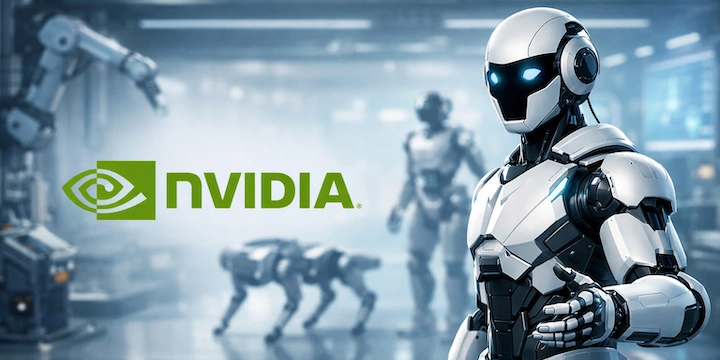
LAS VEGAS — January 2026 — NVIDIA on Monday announced the release of a new set of physical AI foundation models, marking a major step toward more capable, adaptable, and autonomous robots. The announcement coincides with CES 2026, where NVIDIA’s global partners showcased next-generation robots designed for real-world environments, from factories and warehouses to healthcare and service industries.
The new models are built to help robots perceive, reason, and act in complex physical spaces. Unlike traditional robotics software, which relies on narrowly programmed behaviors, NVIDIA’s physical AI models are designed to generalize across tasks, enabling robots to learn new skills more quickly and operate with greater autonomy.
“Physical AI is the next frontier of artificial intelligence,” NVIDIA said, describing a future where robots can understand the world around them and respond intelligently in real time.
Foundation Models for the Physical World
At the center of the announcement is a new family of AI models trained on large-scale synthetic and real-world data. These models allow robots to better interpret sensor input such as vision, depth, and motion, while planning actions safely and efficiently.
The physical AI models are designed to work with NVIDIA’s robotics platforms, including simulation and training tools that let developers teach robots in virtual environments before deploying them in the real world. This approach shortens development cycles and reduces costs while improving safety and performance.
Partners Showcase Real-World Robots
Alongside the software release, NVIDIA partners revealed robots powered by the new models. Demonstrations included humanoid robots capable of dexterous manipulation, autonomous mobile robots optimized for logistics, and industrial systems designed to work safely alongside humans.
These robots are intended to handle tasks such as material handling, inspection, assembly, and service assistance, highlighting how physical AI can scale across industries facing labor shortages and rising automation demands.
Accelerating the Robotics Ecosystem
NVIDIA said the release is part of its broader strategy to create a full-stack robotics platform, combining AI models, simulation, compute, and partner hardware. By providing foundational building blocks, the company aims to accelerate innovation while allowing manufacturers and developers to focus on specialized applications.
The announcement positions NVIDIA as a central player in the emerging physical AI landscape, as interest grows in robots that can move beyond controlled settings and operate reliably in the real world.
The new physical AI models are available to partners now, with broader adoption expected throughout 2026 as robotic systems move from pilots to large-scale deployment.
Source: NVIDIA
Join the conversation! Your thoughts help the community grow.