

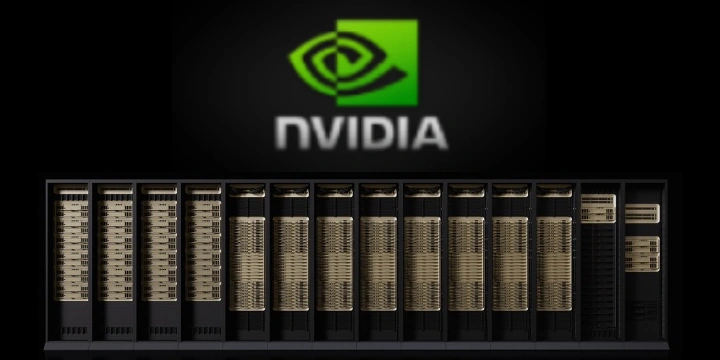
LAS VEGAS — January 2026 — NVIDIA on Monday introduced Rubin, its next-generation AI supercomputing platform, designed to dramatically increase performance for training and running large-scale artificial intelligence models. The announcement was made as part of NVIDIA’s CES 2026 presentations, signaling the company’s roadmap beyond its current Hopper and Blackwell architectures.
Named after astronomer Vera Rubin, the Rubin platform is engineered to meet the growing demands of generative AI, scientific computing, and advanced data center workloads. NVIDIA said Rubin will deliver major gains in compute density, memory bandwidth, and energy efficiency, enabling faster and more cost-effective AI development.
Built for the Next Era of AI
Rubin is designed as a full-stack platform, combining next-generation GPUs, CPUs, networking, and software. At its core is a new GPU architecture optimized for trillion-parameter models and complex reasoning workloads, paired with high-bandwidth memory to reduce bottlenecks during training and inference.
NVIDIA said Rubin-based systems will significantly outperform previous generations, supporting larger models while lowering total cost of ownership for data centers. The platform is expected to power everything from hyperscale cloud infrastructure to national AI research facilities.
Tight Integration Across the Data Center
The Rubin platform also features deep integration with NVIDIA’s networking technologies, enabling ultra-fast communication between GPUs across large clusters. This design allows thousands of accelerators to function as a single AI supercomputer, a requirement for modern foundation models and real-time AI services.
According to NVIDIA, the architecture was developed to scale efficiently as AI workloads continue to grow in size and complexity, while also addressing power and cooling constraints faced by data center operators.
Availability and Roadmap
NVIDIA said Rubin-based systems are expected to begin shipping to partners and customers in the coming years, forming the foundation of future NVIDIA DGX systems and cloud AI offerings. The company positioned Rubin as a long-term platform that will support multiple generations of products and software updates.
With the introduction of Rubin, NVIDIA reinforced its role at the center of the global AI infrastructure buildout, as demand accelerates for computing platforms capable of powering the next wave of artificial intelligence breakthroughs.
Source: NVIDIA
Join the conversation! Your thoughts help the community grow.