

YouTube has announced major updates to its AI labeling system aimed at improving transparency for both viewers and creators as AI-generated videos continue to grow rapidly across the platform.
According to YouTube, AI-generated content labels will now become much more visible across both regular videos and Shorts. Previously, AI disclosures were hidden inside the “How this content was made” section under video descriptions. With the new update, labels will appear directly below videos and as overlays inside YouTube Shorts.
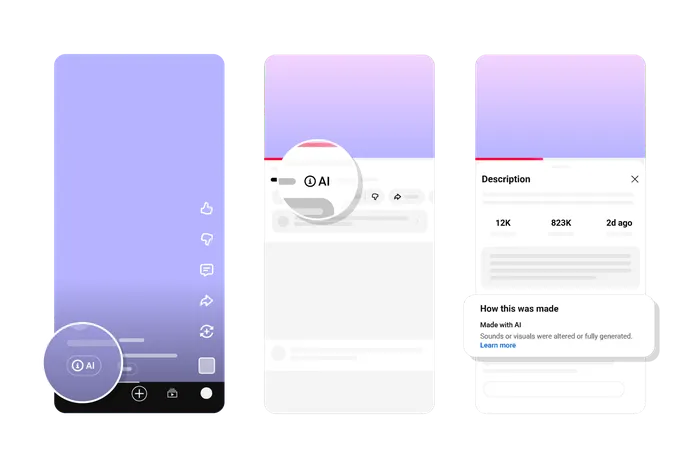
YouTube says the goal is to help viewers more easily understand when content has been significantly altered or generated using AI tools. The company is especially focused on realistic synthetic media and deepfakes.
The platform is also introducing automatic AI content detection systems. Alongside creator disclosures, YouTube will use internal AI signals, C2PA metadata, and Google SynthID technologies to automatically identify AI-generated material when possible.
Under the updated system:
AI labels will appear more prominently
Shorts will include visible AI overlays
YouTube may automatically apply labels
Labels for YouTube AI tools may become permanent
Creators can still manually disclose AI usage
The update comes as YouTube expands AI-powered creation features across the platform. During Google I/O 2026, Google introduced Gemini Omni integrations for YouTube Shorts Remix, allowing creators to transform videos using AI-generated edits, visual styles, and conversational prompts.
At the same time, YouTube is expanding protections against AI deepfakes. The company recently rolled out its likeness detection system to all users over 18, allowing people to scan YouTube for unauthorized AI-generated versions of their faces and request removals.
YouTube CEO Neal Mohan previously stated that improving AI transparency and reducing “AI slop” would become major priorities for the platform in 2026.
The broader industry trend reflects growing concerns around misinformation, deepfakes, AI-generated spam, and synthetic media authenticity across major platforms. Companies including Google, OpenAI, Meta, and Adobe are increasingly adopting watermarking, metadata tagging, and AI disclosure systems to improve transparency around generated content.
YouTube says the updated labeling system will roll out gradually across web, mobile, Shorts, and connected TV experiences over the coming weeks.
Join the conversation! Your thoughts help the community grow.