

This article explains how to send asynchronous mail using a SmtpClient.SendCompleted Event and a SmtpClient.SendAsyncCancel Method in ASP.NET 4.5 for sending the specified message to an SMTP server for delivery as an asynchronous operation.
So, let's proceed with the following procedure:
- Create an Asynchronous Page ASP.NET web page
- Create a SmtpClient.SendCompleted Event and SmtpClient.SendAsyncCancel Method
Creating an Asynchronous Page
Create a new project using "File" -> "New" -> "Project..." then select web "ASP.NET Web Forms Application". Name it "SendMailAsync".
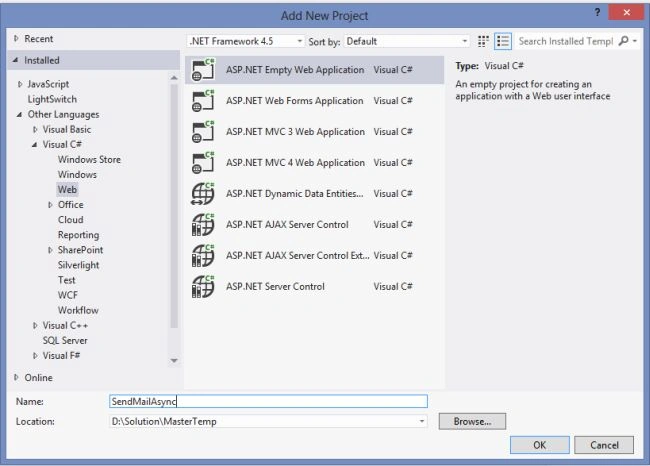
Next, create the code-behind as follows: The first step is to build an asynchronous page and setting the Async attribute in the Page directive to true, as shown here:
<%@ Page Language="C#" Async="true" %>

Now, in the code behind file SendMail.aspx use the following code.
SendMail.aspx
- <%@ Page Title="SendMailAsync|SendAsyncCancel" Async="true" Language="C#" MasterPageFile="~/Site.Master" AutoEventWireup="true" CodeBehind="SendMail.aspx.cs" Inherits="SendMailAsync.SendMail" %>
- <asp:Content ID="Content1" ContentPlaceHolderID="titleContent" runat="server">
- Send Email Asynchronously
- </asp:Content>
- <asp:Content ID="Content2" ContentPlaceHolderID="head" runat="server">
- <script type="text/javascript">
- function validationCheck() {
- var summary = "";
- summary += isvalidName();
- summary += isvalidEmail();
- summary += isvalidSubject();
- summary += isvalidMessage();
- if (summary != "") {
- alert(summary);
- return false;
- }
- else {
- return true;
- }
- }
- function isvalidName() {
- var id;
- var temp = document.getElementById("<%=txtName.ClientID %>");
- id = temp.value;
- if (id == "") {
- return ("Please enter Name" + "\n");
- }
- else {
- return "";
- }
- }
- function isvalidEmail() {
- var id;
- var temp = document.getElementById("<%=txtEmail.ClientID %>");
- id = temp.value;
- var re = /\w+([-+.']\w+)*@\w+([-.]\w+)*\.\w+([-.]\w+)*/;
- if (id == "") {
- return ("Please Enter Email" + "\n");
- }
- else if (re.test(id)) {
- return "";
- }
- else {
- return ("Email should be in the form [email protected]" + "\n");
- }
- }
- function isvalidSubject() {
- var id;
- var temp = document.getElementById("<%=txtSubject.ClientID %>");
- id = temp.value;
- if (id == "") {
- return ("Please enter Subject" + "\n");
- }
- else {
- return "";
- }
- }
- function isvalidMessage() {
- var id;
- var temp = document.getElementById("<%=txtMessage.ClientID %>");
- id = temp.value;
- if (id == "") {
- return ("Please enter Message" + "\n");
- }
- else {
- return "";
- }
- }
- </script>
- </asp:Content>
- <asp:Content ID="Content3" ContentPlaceHolderID="MainContent" runat="server">
- <table style="width: 100%;">
- <tr>
- <td>Name:</td>
- <td>
- <asp:TextBox ID="txtName" runat="server" CssClass="txt"></asp:TextBox></td>
- <td> </td>
- </tr>
- <tr>
- <td>Email ID:</td>
- <td>
- <asp:TextBox ID="txtEmail" runat="server" CssClass="txt"></asp:TextBox></td>
- <td> </td>
- </tr>
- <tr>
- <td>Subject:</td>
- <td>
- <asp:TextBox ID="txtSubject" runat="server" CssClass="txt"></asp:TextBox></td>
- <td> </td>
- </tr>
- <tr>
- <td>Message:</td>
- <td>
- <asp:TextBox ID="txtMessage" runat="server" Height="100px" Width="200px" CssClass="textarea" TextMode="MultiLine"></asp:TextBox>
- </td>
- <td> </td>
- </tr>
- <tr>
- <td></td>
- <td>
- <asp:Button ID="btnSendMail" runat="server" Text="Send Mail" CssClass="button" OnClick="btnSendMail_Click" /></td>
- </tr>
- </table>
- </asp:Content>
Create a SmtpClient.SendCompleted Event and SmtpClient.SendAsyncCancel Method
Now, in the code behind file “SendMail.aspx.cs “ use the following code.
SendMail.aspx.cs
- using System;
- using System.Collections.Generic;
- using System.Linq;
- using System.Web;
- using System.Web.UI;
- using System.Web.UI.WebControls;
- //Using namespaces
- using System.IO;
- using System.Net;
- using System.Net.Mail;
- using System.Net.Mime;
- using System.Threading;
- using System.ComponentModel;
- using System.Text;
- using System.Web.Util;
- namespace SendMailAsync
- {
- public partial class SendMail : System.Web.UI.Page
- {
- protected void Page_Load(object sender, EventArgs e)
- {
- try
- {
- if (!Page.IsPostBack)
- {
- btnSendMail.Attributes.Add("onclick", "javascript:return validationCheck()");
- }
- }
- catch (Exception ex)
- {
- ShowMessage(ex.Message);
- }
- }
- #region show message
- /// <summary>
- /// This function is used for show message.
- /// </summary>
- /// <param name="msg"></param>
- void ShowMessage(string msg)
- {
- ClientScript.RegisterStartupScript(Page.GetType(), "validation", "<script language='javascript'>alert('" + msg + "');</script>");
- }
- #endregion
- #region SendAsyncCancel
- /// <summary>
- /// this code used to SmtpClient.SendAsyncCancel Method
- /// </summary>
- // static bool mailSent = false;
- void SendCompletedCallback(object sender, AsyncCompletedEventArgs e)
- {
- if (e.Cancelled)
- {
- ShowMessage("Send canceled.");
- }
- if (e.Error != null)
- {
- ShowMessage(e.Error.ToString());
- }
- else
- {
- ShowMessage("Email sent successfully");
- }
- }
- #endregion
- #region SendMailAsync
- /// <summary>
- /// this code used to SmtpClient.SendCompleted Event
- /// </summary>
- /// <param name="sender"></param>
- /// <param name="e"></param>
- protected void btnSendMail_Click(object sender, EventArgs e)
- {
- try
- {
- MailMessage message = new MailMessage();
- message.From = new MailAddress("[email protected]");
- message.To.Add(txtEmail.Text.Trim());
- message.Subject = txtSubject.Text.Trim();
- message.Body = "<b>Hi:</b> <br/><br>Name: " +
- txtName.Text.Trim() + "<br/><br>Message: " +
- txtMessage.Text.Trim() + "<br/><br>" ;
- message.IsBodyHtml = true;
- message.Priority = MailPriority.High;
- SmtpClient smtp = new SmtpClient("smtp.gmail.com");
- smtp.Port = 587;
- smtp.Credentials = new NetworkCredential("[email protected]", "YouPassword");
- smtp.SendCompleted += new SendCompletedEventHandler(SendCompletedCallback);
- smtp.EnableSsl = true;
- smtp.SendMailAsync(message);
- }
- catch (Exception ex)
- {
- ShowMessage(ex.Message);
- }
- clear();
- }
- #endregion
- #region
- /// <summary>
- /// This Function is used TextBox Empty.
- /// </summary>
- void clear()
- {
- txtName.Text = string.Empty; txtEmail.Text = string.Empty; txtSubject.Text = string.Empty; txtMessage.Text = string.Empty;
- txtName.Focus();
- }
- #endregion
- }
- }
Now run the page, it will look like this:
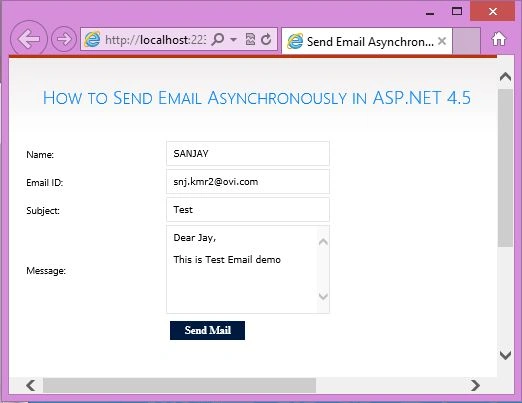
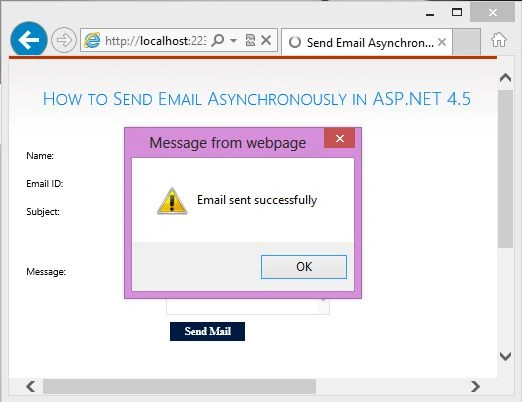
Now, show in the Message box “Email sent successfully”.
I hope this article is useful. If you have any other questions then please provide your comments in the following.
Aanchal SinghPosted Jun 16, 2020, 2:10 AM
How to implement this code in the class. this working fine for the single page. but when im implementing in the class getting error (BC30451: Name 'this' is not declared.). Please suggest
anand sutarPosted Dec 15, 2014, 5:24 AM
Uncomplit Source Code....resolved Properly System.net.Mail.SmtpClient doesn't contains the defination of SendMailAsync
anand sutarPosted Dec 15, 2014, 5:19 AM
Hello Sir, System.net.Mail.SmtpClient doesn't contains the defination of SendMailAsync
Raja ShekarPosted Aug 19, 2014, 12:19 PM
thank u
Raja ShekarPosted Aug 11, 2014, 11:50 AM
smtp.SendMailAsync(message); here am getting missing reference error please help me