Blue Theme Orange Theme Green Theme Red Theme
 
6 Months Free & No Setup Fees ASP.NET Hosting!
Home | Forums | Videos | Advertise | Certifications | Downloads | Blogs | Interviews | Jobs | Beginners | Training
 | Consulting  
Submit an Article Submit a Blog 
 Jump to
Skip Navigation Links
TechnologyExpand Technology
WebsiteExpand Website
Team Foundation Server Hosting
Search :       Advanced Search »
Home » Java and .NET » A Basic .NET and J2EE Interoperability using WebSphere MQ

A Basic .NET and J2EE Interoperability using WebSphere MQ

This artile explains a Basic .NET and J2EE Interoperability using WebSphere MQ. It shows the sending of message from DotNet Application then consuming by Java application using Websphere MQ and vice versa.

Page Views : 13322
Downloads : 0
Rating :
 Rate it
Level : Beginner
   Print Read/Post comments Post a comment  Similar Articles  
   Email to a friend  Bookmark  Author's other articles  
 
DevExpress Free UI Controls
Become a Sponsor
Nevron Chart
Become a Sponsor
 Tag Cloud
 Latest Jobs
More ... 
 Latest Interview Questions
More ... 

Introduction

Interoperability is the ability for different applications to work together, even though they are running on different operating systems, on different hardware architectures, and using different application infrastructure. Programmable web sites that directly link organizations, application, and services would better meet their business needs. This direct linking of applications can be done easily using WebSphere MQ.

Creating Queue Manager, Queue and Channel

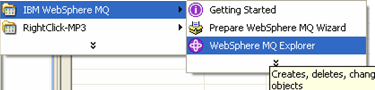
  • Open the Websphere MQ Explorer: Click start->Programs->Websphere MQ


  • Creating Queue Manager:
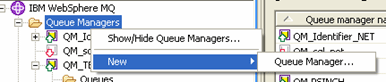
      Right click on the Queue manager option
      New->Queue manager...


  • Creating Queue:
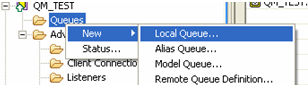
      Expand the Queue manager
      Right click on the Queue option
      New->Local Queue...


  • Creating Channel:
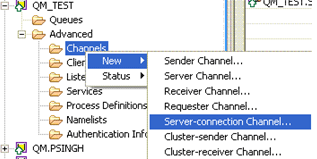
      Expand the Queue manager
      Right click on the Channels option
      New->Server-connection Channel...
The environment setup:

  1. One Queue Manager - QM_TEST (Choose a free port number in my case it is  1421)
  2. One Queue - QM_TEST.LOCAL.ONE
  3. Create a Server connection channel - QM_TEST.SVRCONN

Reading message from Java application by .NET Client.

Let us start our interoperability by sending a message from Java application and consuming it by a .NET Client.

The Java Application:

1. Create a java application MQPUT.java and past the following code.

import com.ibm.mq.*; //Include the WebSphere MQ classes for Java package


public class MQPUT {  


          private static final String qManager = "QM_TEST";

          private static final String qName = "QM_TEST.LOCAL.ONE";


          public static void main(String args[]) {

        new MQPUT().runSample();

    }


          public void runSample()

          {

                   try

                   {                                             

                             MQEnvironment.hostname    = "172.20.21.152";

                             MQEnvironment.channel       = "QM_TEST.SVRCONN";

                             MQEnvironment.port  = Integer.parseInt("1421");


                    MQQueueManager qMgr = new MQQueueManager(qManager);

                             int openOptions = MQC.MQOO_INPUT_AS_Q_DEF | MQC.MQOO_OUTPUT;

                             MQQueue queue = qMgr.accessQueue(qName, openOptions);

                             MQMessage msg = new MQMessage();


                             //msg.writeUTF("TESTING MESSAGE");

                             msg.writeString("TESTING MESSAGE");

                             MQPutMessageOptions pmo = new MQPutMessageOptions();


                             // Put the message to the queue                      

                             queue.put(msg, pmo);                           

                             queue.close();


                             // Disconnect from the QueueManager                         

                             qMgr.disconnect();

                             System.out.println("Message Sent!");

                   }

                   catch (MQException ex)

                   {

                             System.out.println("An Error occured : Completion Code "

                                      + ex.completionCode + " Reason Code " + ex.reasonCode);

                   }

                   catch (java.io.IOException ex)

                   {

                             System.out.println("Exception Occured:"    + ex);

                   }

          }

}

2. Now compile and run the application.
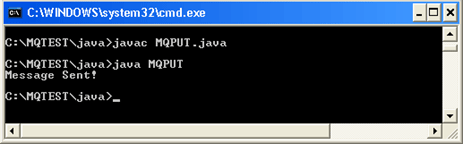
The .NET Client:

1. Create a csharp MQGET.cs file and past the following codes.

using System;

using IBM.WMQ;


namespace MQGET

{       

          class MQGET

          {                 

                   [STAThread]

                   static int Main(String[] args)

                   {

                             MQQueueManager      mqQMgr;        

                             MQQueue             mqQueue;        

                             MQMessage           queueMessage;  

                             MQGetMessageOptions mqGetMsgOpts;   


                             String qManager = "QM_TEST";

                             String qName = "QM_TEST.LOCAL.ONE";

                             String channelName = "QM_TEST.SVRCONN";

                             String connectionName = "psingh(1421)";                     


                             try

                             {                                    

                                      mqQMgr = new MQQueueManager( qManager, channelName,   

                           connectionName );                                 

                                      mqQueue = mqQMgr.AccessQueue( qName,

                           MQC.MQOO_INPUT_AS_Q_DEF

                           + MQC.MQOO_FAIL_IF_QUIESCING );


                                      queueMessage = new MQMessage();        

                                      mqGetMsgOpts = new MQGetMessageOptions();  

                                      mqGetMsgOpts.WaitInterval = 15000;  // 15 second limit

                           for waiting

                                      mqGetMsgOpts.Options |= MQC.MQGMO_WAIT;

                                      mqQueue.Get( queueMessage, mqGetMsgOpts );

                                      System.Console.WriteLine( "Get : " + 

                           queueMessage.ReadString(queueMessage.MessageLength) );                                             

                             }

                             catch (MQException mqe)

                             {                                    

                                      System.Console.WriteLine( "Process ended with " +

                           mqe.Message

                           );

                                      return( (int)mqe.Reason );

                             }

                             return (0);

                   }

          }

}

2. Now compile and run the application.
(Make sure that the amqmdnet.dll is copied in the same folder or give full path for the reference)
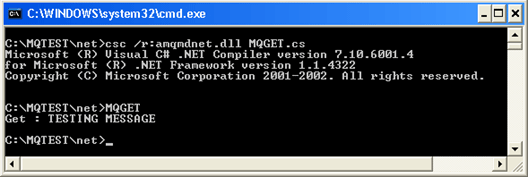
Reading message of .NET application by a java Client.

Now, in this section we are going to create a .NET Web Services and consuming it by a java Client.

The .NET Application:

1. Create a csharp MQPUT.cs file and past the following codes.

using System;

using IBM.WMQ;


namespace MQPUT

{       

          class MQPUT

          {                 

                   [STAThread]

                   static int Main(String[] args)

                   {

                             MQQueueManager      mqQMgr;         

                             MQQueue             mqQueue;        

                             MQMessage           queueMessage;  

                             MQPutMessageOptions mqPutMsgOpts;   


                             String qManager = "QM_TEST";

                             String qName = "QM_TEST.LOCAL.ONE";

                             String channelName = "QM_TEST.SVRCONN";

                             String connectionName = "psingh(1421)";

                             String message = "test message from DotNet";                       


                             try

                             {                                    

                                      mqQMgr = new MQQueueManager( qManager,

                        channelName, connectionName );                                    

                                      mqQueue = mqQMgr.AccessQueue( qName,

                        MQC.MQOO_OUTPUT + MQC.MQOO_FAIL_IF_QUIESCING );


                                      queueMessage = new MQMessage();                                     

                                      queueMessage.WriteUTF( message );

                                      queueMessage.Format = MQC.MQFMT_STRING;

                                      mqPutMsgOpts = new MQPutMessageOptions();                                

                                      mqQueue.Put( queueMessage, mqPutMsgOpts );                               

                             }

                             catch (MQException mqe)

                             {                                    

                                      System.Console.WriteLine( "Process ended with " +

                        mqe.Message );

                                      return( (int)mqe.Reason );

                             }

                             System.Console.WriteLine( "The message sent" );

                             return (0);

                   }

          }

}

2. Now compile and run the application
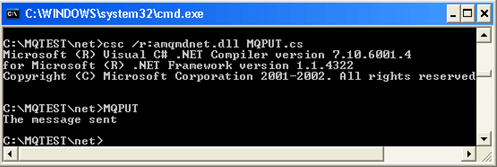
 

The java client:

1. Create a java file MQGET.java and past the following codes

import com.ibm.mq.*;


public class MQGET {         


          public static void main(String args[]) {

                   String qManager = "QM_TEST";

                   String qName = "QM_TEST.LOCAL.ONE";


        try {


            MQEnvironment.hostname  = "172.20.21.152";

               MQEnvironment.channel  = "QM_TEST.SVRCONN";

               MQEnvironment.port       = Integer.parseInt("1421");


               MQQueueManager qMgr = new MQQueueManager(qManager);          

            int openOptions = MQC.MQOO_INPUT_AS_Q_DEF | MQC.MQOO_OUTPUT;        


            MQQueue queue = qMgr.accessQueue(qName, openOptions);                              

            MQMessage rcvMessage = new MQMessage();           

            MQGetMessageOptions gmo = new MQGetMessageOptions();           


            queue.get(rcvMessage, gmo);         

            String msgText = rcvMessage.readUTF();                            

               System.out.println("The message is: " + msgText);


            queue.close();          

            qMgr.disconnect();         

        }

        catch (MQException ex) {

            System.out.println("Process ended with : " + ex.reasonCode);

        }

        catch (java.io.IOException ex) {

            System.out.println("An IOException occured while writing to the

            message buffer: " + ex);

        }

    }

}

2. Now compile and run the application
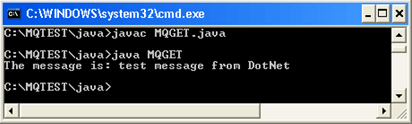
OK enjoy the Queuing !!

Comment Request!
Thank you for reading this post. Please post your feedback, question, or comments about this post Here.
Login to add your contents and source code to this article
 [Top] Rate this article
 
 About the author
 
Laishram Priyokumar
MCSD .NET and Brainbench Advance Java certified Team Leader. Working with Wesley Clover Communication Solution and well experienced in J2EE  and .NET technologies with strong RDBMS knowledge.
Looking for C# Consulting?
C# Consulting is founded in 2002 by the founders of C# Corner. Unlike a traditional consulting company, our consultants are well-known experts in .NET and many of them are MVPs, authors, and trainers. We specialize in Microsoft .NET development and utilize Agile Development and Extreme Programming practices to provide fast pace quick turnaround results. Our software development model is a mix of Agile Development, traditional SDLC, and Waterfall models.
Click here to learn more about C# Consulting.
 
Introducing MaxV - one click. infinite control. Hyper-V Hosting from MaximumASP.
Finally – a virtual platform that delivers next-generation Windows Server 2008 Hyper-V virtualization technology from a managed hosting partner you can truly depend on. Visit www.maximumasp.com/max for a FREE 30 day trial. Hurry offer ends soon. Climb aboard the MaxV platform and take advantage of High Availability, Intelligent Monitoring, Recurrent Backups, and Scalability – with no hassle or hidden fees. As a managed hosting partner focused solely on Microsoft technologies since 2000, MaximumASP is uniquely qualified to provide the superior support that our business is built on. Unparalleled expertise with Microsoft technologies lead to working directly with Microsoft as first to offer IIS 7 and SQL 2008 betas in a hosted environment; partnering in the Go Live Program for Hyper-V; and product co-launches built on WS 2008 with Hyper-V technology.
Dynamic PDF
ceTE software specializes in components for dynamic PDF generation and manipulation. The DynamicPDF™ product line allows you to dynamically generate PDF documents, merge PDF documents and new content to existing PDF documents from within your applications.
Discover the Top 5 .NET Memory Management Fundamentals
To write the best .NET code, you need to know exactly how the .NET framework really manages memory. Ricky Leeks presents the Top 5 fundamental facts of .NET memory management. Learn more.
Nevron Chart for .NET 2010.1 Now Available
The leading .NET charting control now features PDF, Flash and Silverlight export, visualization of large datasets and more. Deliver true charting functionality to your BI, Scorecard, Presentation or Scientific apps. Download evaluation now.
ASP.NET 4 Hosting
Get 2 Months Free of ASP.NET Hosting for Only $4.95/month! Receive FREE MS SQL and MySQL Databases Including ASP.NET 4/3.5, MVC 3.0, Silverlight 4, Windows 2008/IIS 7.0 Plus FREE IIS 7 Modules. Host UNLIMITED ASP.NET Web Sites – Click Here!
 
 Post a Feedback, Comment, or Question about this article
Subject:
Comment:
Discover the top 5 tips for understanding .NET Interop
Become a Sponsor
 Comments
.NET and Java Interoperability by ns_cyril On November 13, 2006
If you have both sides (.NET and Java) in MS Windows OS this approach is very heavy. The best decision is to write JNI code in any .NET language for Java modules and communicate .NET<>.NET. See my examples for .NET Framework v.2.0 at http://www.simtel.net/product.php[id]98653[SiteID]simtel.net for .NET Framework v.1.1 at http://www.simtel.net/product.php[id]95126[sekid]0[SiteID]simtel.net and http://www.simtel.net/product.php[id]98493[sekid]0[SiteID]simtel.net
Reply | Email | Modify 
How to get the list of MQ Managers and MQs on a server in ASP.Net by Sreenath On July 8, 2011
This is very nice article. But if I know the host name, is there any way that I can get MQ managers info and MQs too. Please help out
Reply | Email | Modify 

 © 2012  contents copyright of their authors. Rest everything copyright Mindcracker. All rights reserved.