

The Mediator Pattern allows objects to communicate with each other through a common instance of a mediator class. It promotes loose coupling and prevents objects from referring to each other directly.
Through a common instance of a mediator the classes subscribing to it can communicate by sending messages to this instance and it will notify the other subscribed instances.
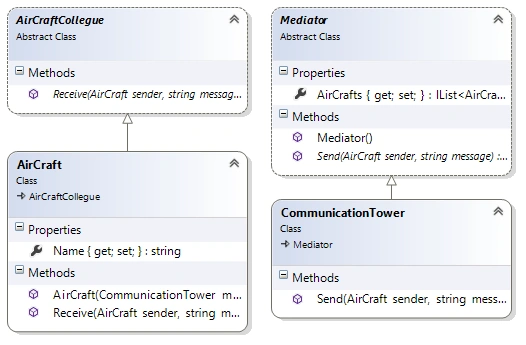
Figure 1: Subscribed instances
- public abstract class Mediator
- {
- public IList<AirCraft> AirCrafts { get; private set; }
- public Mediator()
- {
- AirCrafts = new List<AirCraft>();
- }
- public abstract void Send(AirCraft sender, string message);
- }
- public class CommunicationTower : Mediator
- {
- public override void Send(AirCraft sender, string message)
- {
- foreach (var airCraft in AirCrafts)
- {
- if (airCraft != sender)
- {
- airCraft.Receive(sender, message);
- }
- }
- }
- }
- public abstract class AirCraftCollegue
- {
- public abstract void Receive(AirCraft sender, string message);
- }
- public class AirCraft : AirCraftCollegue
- {
- public AirCraft(CommunicationTower mediator)
- {
- mediator.AirCrafts.Add(this);
- }
- public string Name { get; set; }
- public override void Receive(AirCraft sender, string message)
- {
- Console.WriteLine("{0}: Received message '{1}' from '{2}'", Name, message, sender.Name);
- }
- }
In the preceding example the mediator tells the subscribed aircrafts (except the sender) that one of them is saying something.
Example usage:
- class Program
- {
- static void Main(string[] args)
- {
- var towerMediator = new CommunicationTower();
- var airCraft1 = new AirCraft(towerMediator) { Name = "Unit #1" };
- var airCraft2 = new AirCraft(towerMediator) { Name = "Unit #2" };
- var airCraft3 = new AirCraft(towerMediator) { Name = "Unit #3" };
- var airCraft4 = new AirCraft(towerMediator) { Name = "Unit #4" };
- var airCraft5 = new AirCraft(towerMediator) { Name = "Unit #5" };
- towerMediator.Send(airCraft1, "Let's go up!");
- }
- }
Output:
- Unit #2: Received message 'Let's go up!' from 'Unit #1'
- Unit #3: Received message 'Let's go up!' from 'Unit #1'
- Unit #4: Received message 'Let's go up!' from 'Unit #1'
- Unit #5: Received message 'Let's go up!' from 'Unit #1'
One actual example is the EventAggreagator that we see in WPF. It allows the communication between view models that don't know about the existence of each other.
Santhakumar MunuswamyPosted Jul 11, 2015, 3:12 AM
Nice article! Thanks for sharing
Narasimha Reddy ChennupalliPosted Jul 10, 2015, 9:57 AM
Good One..
Nilesh JadavPosted Jul 10, 2015, 12:07 AM
Nice article sir
Sibeesh VenuPosted Jul 9, 2015, 8:12 AM
Good one.
Pranay RanaPosted Jul 9, 2015, 7:30 AM
EventAggreagator also satisfy is publisher/subscriber pattern ..i dont want to discourage you but it seems your article similar to this : http://www.codeproject.com/Articles/455228/Design-Patterns-of-Behavioral-Design-Patterns I just want to say please come with good idea means other good example...