

Introduction
This article gives an overview of MVC# -A Model-View-Presenter framework for .NET platform. It firstly explains the MVP pattern essentials and then walks through the key features of the MVC# framework which help building true MVP-based solutions.
What is Model-View-Presenter?
3-tier architecture
One of the most fundamental approaches in software engineering is the Layered architecture. It implies dividing a system into several interacting layers with certain limitations imposed on how layers may interact.s Layered architecture finds its application in various systems for example net protocols (TCP/IP layers), operating systems (three layers: core, drivers, applications) and others.
A particular case of layered architecture is the 3-tier architecture with its variations: Model-View-Controller and Model-View-Presenter. Before considering MVP (and MVC) let us discuss the general 3-tier architecture and its difference to the conventional programming style.
A straightforward (and widely used) approach in designing applications is the 2-tier architecture. According to it an application consists of a presentation layer and a domain layer. Domain layer classes represent the problem domain entities (e.g. customer, order) and are usually bound to some database access facilities. Presentation classes in 2-tier architecture have the following responsibilities:
-
receive user input
-
make necessary calls to the domain tier
-
decide what to show next to the user
-
display output
These responsibilities are rather vast and, as a system grows, may result in a bloated presentation layer. Moreover they logically can be divided into two groups: actually presentation logic (code for perceiving input and displaying output) and application logic (communication with the domain tier and application flow decisions). These responsibilities require different programming skills and should better be not mixed in a single module/class. A quite natural solution is to split this too broad presentation layer into two: presentation and application logic:
3-tier architecture is rather abstract. While it declares an existence of three layers, it says nothing about classes in these layers and their interaction. A much more precise form have two 3-tier architecture variations: Model-View-Controller and Model-View-Presenter. Let us proceed to their discussion.
MVC and MVP patterns
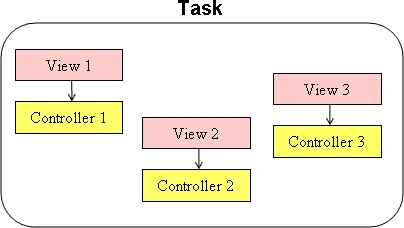
According to both MVC and MVP the presentation layer consists of view objects, and application logic consists of controller objects (we will use "controller" name instead of "presenter" in MVP). For each view object a corresponding controller exists and vice versa. And although MVC and MVP are based on a common 3-tier principle: views process only presentation needs and controllers handle application logic, these patterns have two major differences:
-
In MVC controllers receive and process user input, but in MVP views receive user input and then merely delegate processing to the corresponding controllers. That is why MVP pattern better fits modern UI environments (Windows/Web forms) where view classes themselves handle user gestures.
-
In MVC controllers affect their views by changing the intermediate presentation model, which the views are subscribed to (by observer pattern). This makes views pure observers without direct access to them. MVP on the other hand violates this "pure observer" rule by providing a direct link from a controller to its view. This makes MVP more handy as compared to MVC.


Join the conversation! Your thoughts help the community grow.