

Introduction
In this article I explain the Intval() function in PHP. The Intval() function returns the integer value of a variable. You can not use the intval() function on an object.
Syntax
|
intval($var_name,base); |
| Parameter | Description |
| Var name | Scalar value to be converted into an integer |
| Base | Base for the conversion |
The default base is ten.
Example
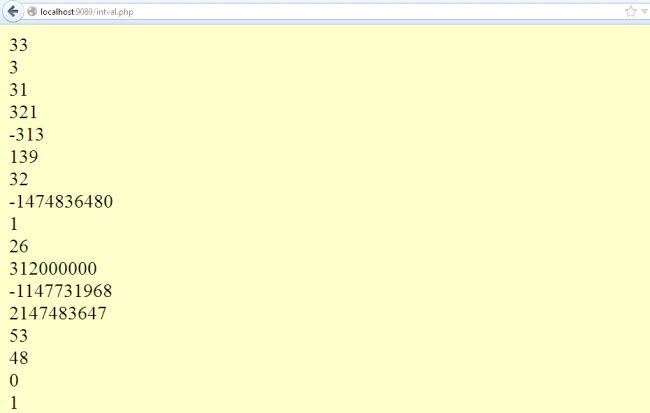
In the following example, the empty array returns the output zero and the nonempty array returns the one:
<html>
<body bgcolor="#FFFFCC">
<?php
echo intval(33)."<br>";
echo intval(3.4)."<br>";
echo intval('31')."<br>";
echo intval('+321')."<br>";
echo intval('-313')."<br>";
echo intval(0213)."<br>";
echo intval('032')."<br>";
echo intval(2e10)."<br>";
echo intval('1e10')."<br>";
echo intval(0x1A)."<br>";
echo intval(312000000)."<br>";
echo intval(3430000000000000000)."<br>";
echo intval('313000000000000000000')."<br>";
echo intval(53, 9)."<br>";
echo intval('53', 9)."<br>";
echo intval(array())."<br>";
echo intval(array('class', 'name'));
?>
</body>
</html>
The maximum value depends on the system such as 32-bit system integers are in the range -2147483648 to 2147483647 and 64-bit system integers are in the range 9223372036854775807.
The strings will most likly return zero although this depends on the leftmost characters of the string.
Output
Join the conversation! Your thoughts help the community grow.