

Servlet
It is technology to create dynamic WebPages. This is a Java program, which resides in a web server to process requests from the user and to provide a dynamic response to users.
Storing compilation and deployment of a servlet
- Store the servlet file inside the "classes" folder of the context for predefined context (root) the classes folder required to be created inside the WEB-INF folder.
- For the compilation of the servlet, files use servlet-api.jar in classpath option of javac command. This jar file contains the package used by the servlet files. This jar file can be found inside the installation folder of the tomcat/lib folder.
- Deployment: This is a process to create an URL for the servlet. The user will use the URL to access the servlet. This can be done by providing a few tags in the web.xml file. The tags are as follows:
In web.xml file present side to classes folder:
<servlet>
<servlet-name>name</servlet-name>
<servlet-class>class</servlet-class>
</servlet>
<servlet-mapping>
<servlet-name>name</servlet-name>
<url-pattern>/ url-pattern </url-pattern>
</servlet-mapping>
- import java.io.*;
- import javax.servlet.*;
- import javax.servlet.http.*;
- public class httpserv extends HttpServlet
- {
- public void doGet(HttpServletRequest req ,HttpServletResponse res)throws IOException ,ServletException
- {
- PrintWriter out = res.getWriter();
- res.setContentType("text/html");
- out.println("<html><body>");
- out.println("<h1> First servlet</h1>");
- out.println("</body></html>");
- }
- }
How to run this program
First create a folder named Servlet in any drive (here e: drive). Inside that folder create a WEB-INF folder (all letters will be capped mandatory). Copy the web.xml file from the (E:\Program Files\Apache Software Foundation\Tomcat 6.0\conf) folder. Again inside the WEB-INF folder, create a folder named classes. In the classes folder, we will store the Servlet files by their class name; here httpserv.java. Copy the servlet-api.jar (E:\Program Files\Apache Software Foundation\Tomcat 6.0\lib) file in the classes folder.
Web.xml setting:
- <?xml version="1.0" encoding="ISO-8859-1"?>
- <!--
- Licensed to the Apache Software Foundation (ASF) under one or more
- contributor license agreements. See the NOTICE file distributed with
- this work for additional information regarding copyright ownership.
- The ASF licenses this file to You under the Apache License, Version 2.0
- (the "License"); you may not use this file except in compliance with
- the License. You may obtain a copy of the License at
- http://www.apache.org/licenses/LICENSE-2.0
- Unless required by applicable law or agreed to in writing, software
- distributed under the License is distributed on an "AS IS" BASIS,
- WITHOUT WARRANTIES OR CONDITIONS OF ANY KIND, either express or implied.
- See the License for the specific language governing permissions and
- limitations under the License.
- -->
- <web-app xmlns="http://java.sun.com/xml/ns/javaee"
- xmlns:xsi="http://www.w3.org/2001/XMLSchema-instance"
- xsi:schemaLocation="http://java.sun.com/xml/ns/javaee http://java.sun.com/xml/ns/javaee/web-app_2_5.xsd"
- version="2.5">
- <servlet>
- <servlet-name>httpserv</servlet-name>
- <servlet-class>httpserv</servlet-class>
- </servlet>
- <servlet-mapping>
- <servlet-name>httpserv</servlet-name>
- <url-pattern>/httpserv</url-pattern>
- </servlet-mapping
- </web-app>
- <Context path="/javaservlet" docBase="E:\Servlet" reloadable="true" debug="0" />
- <?xml version='1.0' encoding='utf-8'?>
- <!--
- Licensed to the Apache Software Foundation (ASF) under one or more
- contributor license agreements. See the NOTICE file distributed with
- this work for additional information regarding copyright ownership.
- The ASF licenses this file to You under the Apache License, Version 2.0
- (the "License"); you may not use this file except in compliance with
- the License. You may obtain a copy of the License at
- http://www.apache.org/licenses/LICENSE-2.0
- Unless required by applicable law or agreed to in writing, software
- distributed under the License is distributed on an "AS IS" BASIS,
- WITHOUT WARRANTIES OR CONDITIONS OF ANY KIND, either express or implied.
- See the License for the specific language governing permissions and
- limitations under the License.
- -->
- <!-- Note: A "Server" is not itself a "Container", so you may not
- define subcomponents such as "Valves" at this level.
- Documentation at /docs/config/server.html
- -->
- <Server port="8005" shutdown="SHUTDOWN">
- <!--APR library loader. Documentation at /docs/apr.html -->
- <Listener className="org.apache.catalina.core.AprLifecycleListener" SSLEngine="on" />
- <!--Initialize Jasper prior to webapps are loaded. Documentation at /docs/jasper-howto.html -->
- <Listener className="org.apache.catalina.core.JasperListener" />
- <!-- JMX Support for the Tomcat server. Documentation at /docs/non-existent.html -->
- <Listener className="org.apache.catalina.mbeans.ServerLifecycleListener" />
- <Listener className="org.apache.catalina.mbeans.GlobalResourcesLifecycleListener" />
- <!-- Global JNDI resources
- Documentation at /docs/jndi-resources-howto.html
- -->
- <GlobalNamingResources>
- <!-- Editable user database that can also be used by
- UserDatabaseRealm to authenticate users
- -->
- <Resource name="UserDatabase" auth="Container"
- type="org.apache.catalina.UserDatabase"
- description="User database that can be updated and saved"
- factory="org.apache.catalina.users.MemoryUserDatabaseFactory"
- pathname="conf/tomcat-users.xml" />
- </GlobalNamingResources>
- <!-- A "Service" is a collection of one or more "Connectors" that share
- a single "Container" Note: A "Service" is not itself a "Container",
- so you may not define subcomponents such as "Valves" at this level.
- Documentation at /docs/config/service.html
- -->
- <Service name="Catalina">
- <!--The connectors can use a shared executor, you can define one or more named thread pools-->
- <!--
- <Executor name="tomcatThreadPool" namePrefix="catalina-exec-"
- maxThreads="150" minSpareThreads="4"/>
- -->
- <!-- A "Connector" represents an endpoint by which requests are received
- and responses are returned. Documentation at :
- Java HTTP Connector: /docs/config/http.html (blocking & non-blocking)
- Java AJP Connector: /docs/config/ajp.html
- APR (HTTP/AJP) Connector: /docs/apr.html
- Define a non-SSL HTTP/1.1 Connector on port 8080
- -->
- <Connector port="8081" protocol="HTTP/1.1"
- connectionTimeout="20000"
- redirectPort="8443" />
- <!-- A "Connector" using the shared thread pool-->
- <!--
- <Connector executor="tomcatThreadPool"
- port="8080" protocol="HTTP/1.1"
- connectionTimeout="20000"
- redirectPort="8443" />
- -->
- <!-- Define a SSL HTTP/1.1 Connector on port 8443
- This connector uses the JSSE configuration, when using APR, the
- connector should be using the OpenSSL style configuration
- described in the APR documentation -->
- <!--
- <Connector port="8443" protocol="HTTP/1.1" SSLEnabled="true"
- maxThreads="150" scheme="https" secure="true"
- clientAuth="false" sslProtocol="TLS" />
- -->
- <!-- Define an AJP 1.3 Connector on port 8009 -->
- <Connector port="8009" protocol="AJP/1.3" redirectPort="8443" />
- <!-- An Engine represents the entry point (within Catalina) that processes
- every request. The Engine implementation for Tomcat stand alone
- analyzes the HTTP headers included with the request, and passes them
- on to the appropriate Host (virtual host).
- Documentation at /docs/config/engine.html -->
- <!-- You should set jvmRoute to support load-balancing via AJP ie :
- <Engine name="Standalone" defaultHost="localhost" jvmRoute="jvm1">
- -->
- <Engine name="Catalina" defaultHost="localhost">
- <!--For clustering, please take a look at documentation at:
- /docs/cluster-howto.html (simple how to)
- /docs/config/cluster.html (reference documentation) -->
- <!--
- <Cluster className="org.apache.catalina.ha.tcp.SimpleTcpCluster"/>
- -->
- <!-- The request dumper valve dumps useful debugging information about
- the request and response data received and sent by Tomcat.
- Documentation at: /docs/config/valve.html -->
- <!--
- <Valve className="org.apache.catalina.valves.RequestDumperValve"/>
- -->
- <!-- This Realm uses the UserDatabase configured in the global JNDI
- resources under the key "UserDatabase". Any edits
- that are performed against this UserDatabase are immediately
- available for use by the Realm. -->
- <Realm className="org.apache.catalina.realm.UserDatabaseRealm"
- resourceName="UserDatabase"/>
- <!-- Define the default virtual host
- Note: XML Schema validation will not work with Xerces 2.2.
- -->
- <Host name="localhost" appBase="webapps"
- unpackWARs="true" autoDeploy="true"
- xmlValidation="false" xmlNamespaceAware="false">
- <!-- SingleSignOn valve, share authentication between web applications
- Documentation at: /docs/config/valve.html -->
- <!--
- <Valve className="org.apache.catalina.authenticator.SingleSignOn" />
- -->
- <!-- Access log processes all example.
- Documentation at: /docs/config/valve.html -->
- <!--
- <Valve className="org.apache.catalina.valves.AccessLogValve" directory="logs"
- prefix="localhost_access_log." suffix=".txt" pattern="common" resolveHosts="false"/>
- -->
- <Context path="/javaservlet" docBase="E:\Servlet" reloadable="true" debug="0" />
- </Host>
- </Engine>
- </Service>
- </Server>
Compiling
javac -cp servlet.jar httpserv.java (for tomcat 4.0)
javac -cp servlet-api.jar httpserv.java (for tomcat 6.0)
cp means classpath
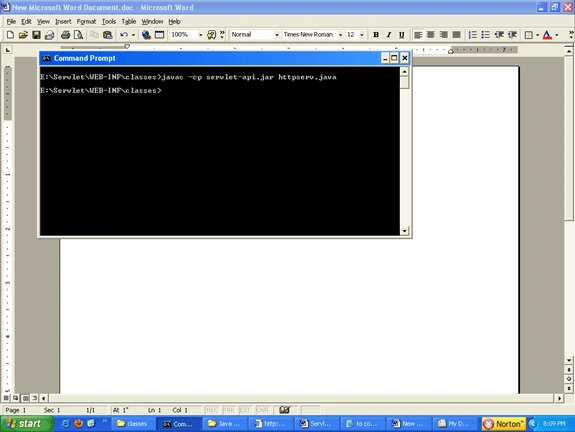
Running the servlet in a web browser
First, run the tomcat 6.0
http://localhost:8081/ javaservlet /httpserv
Sandeep SharmaPosted Jun 27, 2013, 7:03 AM
Manish sir, Tomcat is an application server or web server or servlet container developed by the Apache Software Foundation (ASF) . Most of the modern Java web frameworks are based on servlets and JavaServer Pages and can run on Apache Tomcat, for example Struts, JavaServer Faces, Spring, etcetera.
Rohatash KumarPosted Jul 28, 2011, 4:31 AM
really good post. Satyapriya
Angelina ErinPosted Jul 28, 2011, 12:04 AM
Useful Article
Manish TewatiaPosted Jul 27, 2011, 11:48 PM
Good article satyapriya. I want to ask is tomcat 6.0 is a browser for java..?
Dinesh BeniwalPosted Jul 27, 2011, 11:15 AM
Thanks for sharing, Welcome to the Mindcracker Community.