
Even though with the .NET framework we don't have to actively worry about memory management and garbage collection (GC), we still have to keep memory management and GC in mind in order to optimize the performance of our applications. Also, having a basic understanding of how memory management works will help explain the behavior of the variables we work with in every program we write. In this article we'll look into Garbage Collection (GC) and some ways to keep our applications running efficiently.
Graphing
Let's look at this from the GC's point of view. If we are responsible for "taking out the trash" we need a plan to do this effectively. Obviously, we need to determine what is garbage and what is not (this might be a bit painful for the pack-rats out there).
In order to determine what needs to be kept, we'll first make the assumption that everything not being used is trash (those piles of old papers in the corner, the box of junk in the attic, everything in the closets, etc.) Imagine we live with our two good friends: Joseph Ivan Thomas (JIT) and Cindy Lorraine Richmond (CLR). Joe and Cindy keep track of what they are using and give us a list of things they need to keep. We'll call the initial list our "root" list because we are using it as a starting point. We'll be keeping a master list to graph where everything is in the house that we want to keep. Anything that is needed to make things on our list work will be added to the graph (if we're keeping the TV we don't throw out the remote control for the TV, so it will be added to the list. If we're keeping the computer the keyboard and monitor will be added to the "keep" list).
This is how the GC determines what to keep as well. It receives a list of "root" object references to keep from just-in-time (JIT) compiler and common language runtime (CLR) (Remember Joe and Claire?) and then recursively searches object references to build a graph of what should be kept.
Roots consist of:
- Global/Static pointers. One way to make sure our objects are not garbage collected by keeping a reference to them in a static variable.
- Pointers on the stack. We don't want to throw away what our application's threads still need in order to execute.
- CPU register pointers. Anything in the managed heap that is pointed to by a memory address in the CPU should be preserved (don't throw it out).
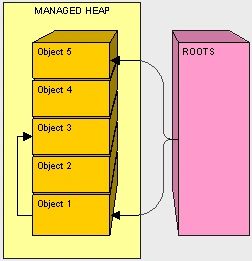
In the above diagram, objects 1, 3, and 5 in our managed heap are referenced from a root 1 and 5 are directly referenced and 3 is found during the recursive search. If we go back to our analogy and object 1 is our television, object 3 could be our remote control. After all objects are graphed we are ready to move on to the next step, compacting.
Compacting
Now that we have graphed what objects we will keep, we can just move the "keeper objects" around to pack things up.
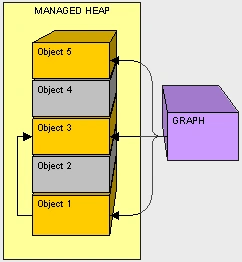
Fortunately, in our house we don't need to clean out the space before we put something else there. Since Object 2 is not needed, as the GC we'll move Object 3 down and fix the pointer in Object 1.
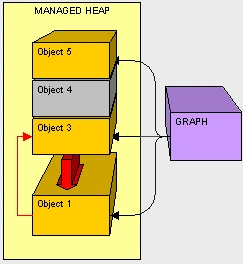
Next, as the GC, we'll copy Object 5 down
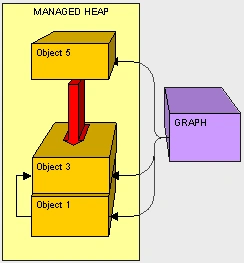
Now that everything is cleaned up we just need to write a sticky note and put it on the top of our compacted heap to let Claire know where to put new objects.
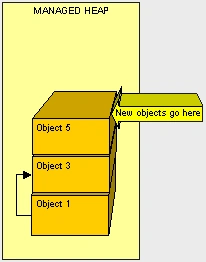
Knowing the nitty-gritty of CG helps in understanding that moving objects around can be very taxing. As you can see, it makes sense that if we can reduce the size of what we have to move, we'll improve the whole GC process because there will be less to copy.
What about things outside the managed heap?
As the person responsible for garbage collection, one problem we run into in cleaning house is how to handle objects in the car. When cleaning, we need to clean everything up. What if the laptop is in the house and the batteries are in the car?
There are situations where the GC needs to execute code to clean up non-managed resources such as files, database connections, network connections, etc. One possible way to handle this is through a finalizer.
class Sample
{
    ~Sample()
    {
        // FINALIZER: CLEAN UP HERE
    }
}
During object creation, all objects with a finalizer are added to a finalization queue. Let's say objects 1, 4, and 5 have finalizers and are on the finalization queue. Let's look at what happens when objects 2 and 4 are no longer referenced by the application and ready for garbage collection.
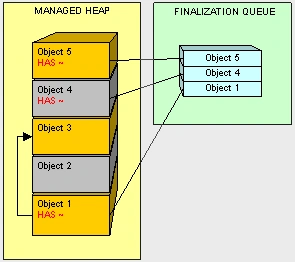
Object 2 is treated in the usual fashion. However, when we get to object 4, the GC sees that it is on the finalization queue and instead of reclaiming the memory object 4 owns, object 4 is moved and it's finalizer is added to a special queue named freachable.
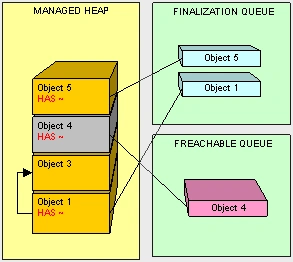
There is a dedicated thread for executing freachable queue items. Once the finalizer is executed by this thread on Object 4, it is removed from the freachable queue. Then and only then is Objet 4 ready for collection.
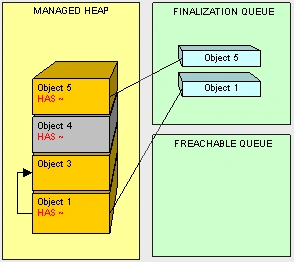
So Object 4 lives on until the next round of GC.
Because adding a finalizer to our classes creates additional work for GC it can be very expensive and adversely affect the performance garbage collection and thus our program. Only use finalizers when you are absolutely sure you need them.
A better practice is to be sure to clean up non-managed resources. As you can imagine, it is preferable to explicitly close connections and use the IDisposable interface for cleaning up instead of a finalizer where possible.
IDisposaible
Classes that implement IDisposable perform clean-up in the Dispose() method (which is the only signature of the interface). So if we have a ResouceUser class instead of using a finalizer as follows:
public class ResourceUser
{
    ~ResourceUser() // THIS IS A FINALIZER
    {
        // DO CLEANUP HERE
    }
}
We can use IDisposable as a better way to implement the same functionality:
public class ResourceUser : IDisposable
{
    #region IDisposable Members
    public void Dispose()
    {
        // CLEAN UP HERE!!!
    }
    #endregion
}
IDisposable in integrated with the using keyword. At the end of the using block Dispose() is called on the object declared in using(). The object should not be referenced after the using block because it should be essentially considered "gone" and ready to be cleaned up by the GC.
public static void DoSomething()
{
    ResourceUser rec = new ResourceUser();
    using (rec)
    {
         // DO SOMETHING
    } // DISPOSE CALLED HERE
    // DON'T ACCESS rec HERE
}
I like putting the declaration for the object in the using block because it makes more sense visabally and rec is no longer available outside of the scope of the using block. Whis this pattern is more in line with the intention of the IDisposible interface, it is not required.
public static void DoSomething()
{
    using (ResourceUser rec = new ResourceUser())
    {
        // DO SOMETHING
    } // DISPOSE CALLED HERE
}
By using using() with classes that implement IDisposible we can perform our cleanup without putting additional overhead on the GC by forcing it to finalize our objects.
Static Variables: Watch Out!
class Counter
{
    private static int s_Number = 0;
    public static int GetNextNumber()
    {
        int newNumber = s_Number;
        // DO SOME STUFF
        s_Number = newNumber + 1;
        return newNumber;
    }
}
If two threads call GetNextNumber() at the same time and both are assigned the same value for newNumber before s_Num}
If two threads call GetNextNumber() at the same time and both are assigned the same value for newNumber before s_Number is incremented they will return the same result!word is one way to ensure only one thread can access a block of code at a time. As a best practice, you should lock as little code as possible because threads have to wait in a queue to execute the code in the lock() block and it can be inefficient.
class Counter
{
    private static int s_Number = 0;
    public static int GetNextNumber()
    {
        lock (typeof(Counter))
        {
            int newNumber = s_Number;
            // DO SOME STUFF
            newNumber += 1;
            s_Number = newNumber;
            return newNumber;
        }
    }
}
Static Variables: Watch Out... Number 2!
The next thing we have to watch out for objects referenced by static variables. Remember, how anything that is referenced by a "root" is not cleaned up. Here's one of the ugliest examples I can come up with:
class Olympics
{
    public static Collection<Runner> TryoutRunners;
}
class Runner
{
    private string _fileName;
    private FileStream _fStream;
    public void GetStats()
    {
        FileInfo fInfo = new FileInfo(_fileName);
        _fStream = _fileName.OpenRead();
    }
}
Because the Runner Collection is static for the Olympics class, not only will objects in the collection will not be released for garbage collection (they are all indirectly referenced through a root), but as you probably noticed, every time we run GetStats() the stream is opened to the file. Because it is not closed and never released by GC this code is effectively a disaster waiting to happen. Imagine we have 100,000 runners trying out for the Olympics. We would end up with that many non-collectable objects each with an open resource. Ouch! Talk about poor performance!
Singleton
One trick to keep things light is to keep only one instance of a class in memory at all times. To do this we can use the GOF Singleton Pattern.
One trick to keep things light is to keep only one instance of a utility class in memory at all times. One easy way to do this we can use the GOF Singleton Pattern. Singletons should be used with caution because they are really "global variables" and cause us much headached and "strange" behavior in multi-threaded applications where different threads could be altering the state of the object. If we are using the singleton pattern (or any global variable) we should be able to justify it (in other words... don't do it without a good reason).
public">{
    private static Earth _instance = new Earth();
    private Earth() { }
    public static Earth GetInstance() { return _instance; }
}
We have a private constructor so only Earth can execute it's constructor and make an Earth. We have a static instance of Earth and a static method to get the instance. This particular implementation is thread safe because the CLR ensures thread safe creation of static variables. This is the most elegant way I have found to implement the singleton pattern in C#.
In Conclusion...
So to wrap up, some things we can do to improve GC performance are:
- Clean up. Don't leave resources open! Be sure to close all connections that are opened and clean up all non-managed objects as soon as possible. As a general rule when using non-managed objects, instantiate as late as possible and clean up as soon as possible.
- Don't overdo references. Be reasonable when using references objects. Remember, if our object is alive, all of it's referenced objects will not be collected (and so on, and so on). When we are done with something referenced by class, we can remove it by either setting the reference to null. One trick I like to do is setting unused references to a custom light weight NullObject to avoid getting null reference exceptions. The fewer references laying about when the GC kicks off, the less pressure the mapping process will be.
- Easy does it with finalizers. Finalizers are expensive during GC we should ONLY use them if we can justify it. If we can use IDisposible instead of a finalizer, it will be more efficient because our object can be cleaned up in one GC pass instead of two.
- Keep objects and their children together. It is easier on the GC to copy large chunks of memory together instead of having to essentially de-fragment the heap at each pass, so when we declare a object composed of many other objects, we should instantiate them as closely together as possible.
Next time we'll look even more closely at the GC process and look into ways to check under the hood as your program executes to discover problems that may need to be cleaned up.
Until then,
-Happy coding
Trần KhoaPosted Sep 9, 2020, 10:23 PM
(Remember Joe and Claire?) but who are they.
难得自然萌Posted Jun 28, 2020, 10:11 PM
Waiting for your next article~Fascinating
Taras ZavorotniiPosted Feb 23, 2020, 7:26 AM
It's probably worth mentioning that runners could be garbage collected once they're removed from a static collection.
Pravin KolhePosted Jul 23, 2015, 2:03 AM
Very informative and easy to understand.
A APosted Mar 26, 2013, 1:38 AM
very informative
ahmed mahmoudPosted Jan 15, 2013, 1:14 PM
Fascinating
ahmed mahmoudPosted Jan 15, 2013, 1:14 PM
Fascinating
ahmed mahmoudPosted Jan 15, 2013, 1:14 PM
Fascinating
ahmed mahmoudPosted Jan 15, 2013, 1:14 PM
Fasinating
ahmed mahmoudPosted Jan 15, 2013, 1:14 PM
Fasinating
pravesh alexPosted Oct 20, 2010, 11:12 PM
Thanks a lot for the wonderful article.
Dave BlackPosted Jul 21, 2010, 8:42 AM
You shouldn't ever call lock(typeof(Foo)) or lock(this) - it is a huge no-no. .NET Framework Design Guidelines and many other online Microsoft resources describe why (Blogs, MSDN, etc). Instead you lock on a private static readonly object variable when needing thread safety for the type and a private readonly object variable when needing thread safety for an instance of a class.
Raimo HalinenPosted Mar 11, 2010, 4:23 AM
Hi I'm teaching programming at the Polytechnic and I was looking for how tell stack and heap issues. The article series were just I needed at moment.
judah veichselfishPosted Nov 13, 2007, 2:12 AM
Hello In c# an object can be created before its class definition.for example: abc z = new abc(); class abc{} It is a kind of forward reference.I don't understand how an object can be created before its class' definition (c# compiler is a one pass compiler). Thanks in advance xyoavx my email: [email protected]
Ciaran ODonnellPosted Nov 30, 2006, 5:44 AM
You have made a mistake I'm affraid. Member functions are not copied for everyinstance. the code is held in one place in RAM and therefore you cant save memory by making member functions static. they are the same as static but are give a reference to the instance on the stack when run.
Ciaran ODonnelleditedPosted Nov 30, 2006, 5:44 AMEdited Jan 8, 2007, 11:16 AM
You have made a mistake I'm affraid. Member functions are not copied for everyinstance. the code is held in one place in RAM and therefore you cant save memory by making member functions static. they are the same as static but are give a reference to the instance on the stack when run.
ArthurPosted Jul 19, 2006, 10:52 PM
In your article you gave the example below for a Singleton class. public class Earth<?xml:namespace prefix = o ns = "urn:schemas-microsoft-com:office:office" /><o:p></o:p> {<o:p></o:p> private static Earth _instance = new Earth(); <o:p></o:p> private Earth() { } <o:p></o:p> public static Earth GetInstance() { return _instance; }<o:p></o:p> } I believe (but might be wrong) the following example is better. <o:p> public class Earth<o:p></o:p> {<o:p></o:p> public static Instance= new Earth(); <o:p></o:p> <o:p></o:p> } reasons: 1) Using it is shorter: Earth.Instance.DoThis() vs. Earth.GetInstance().DoThis() 2) When using a property or function to get the instance, this method has to be executed every time. This is not the case when refering directly to the static field. Thus faster execution. P.s. Thanx for the articel. Very usefull. </o:p>
Rajesh KumarPosted Feb 8, 2006, 6:09 AM
hello Really thanks . I am RajeshKumar.I am from India. I am a software engineer for past 2.5 year. After reading your article i got good idea on heap and stack... why can't u provide your articles in pdf format so that we can download easier any how grat thanks... We can declare a class inside the structure . In that case wt will happen Can u pleas through some light on it. I am studying design patterns. I am not getting the idea on where which pattern should be used... My personal email id is [email protected] Happy New Year Regards Rajesh Kumar.C