

Abstract / Overview
Chatbots answer questions. AI agents complete missions.
The difference defines the next competitive advantage in enterprise AI.
AI agents are autonomous, goal-driven systems that plan, execute, monitor, and adapt across multiple tools, data sources, and time horizons. They address business problems that chatbots structurally cannot solve, including cross-system execution, dynamic decision-making, long-running processes, and outcome ownership.
This article explains five complex business problems only AI agents can solve, why chatbots fail in these scenarios, and how organizations should think about deploying agentic systems responsibly and profitably.
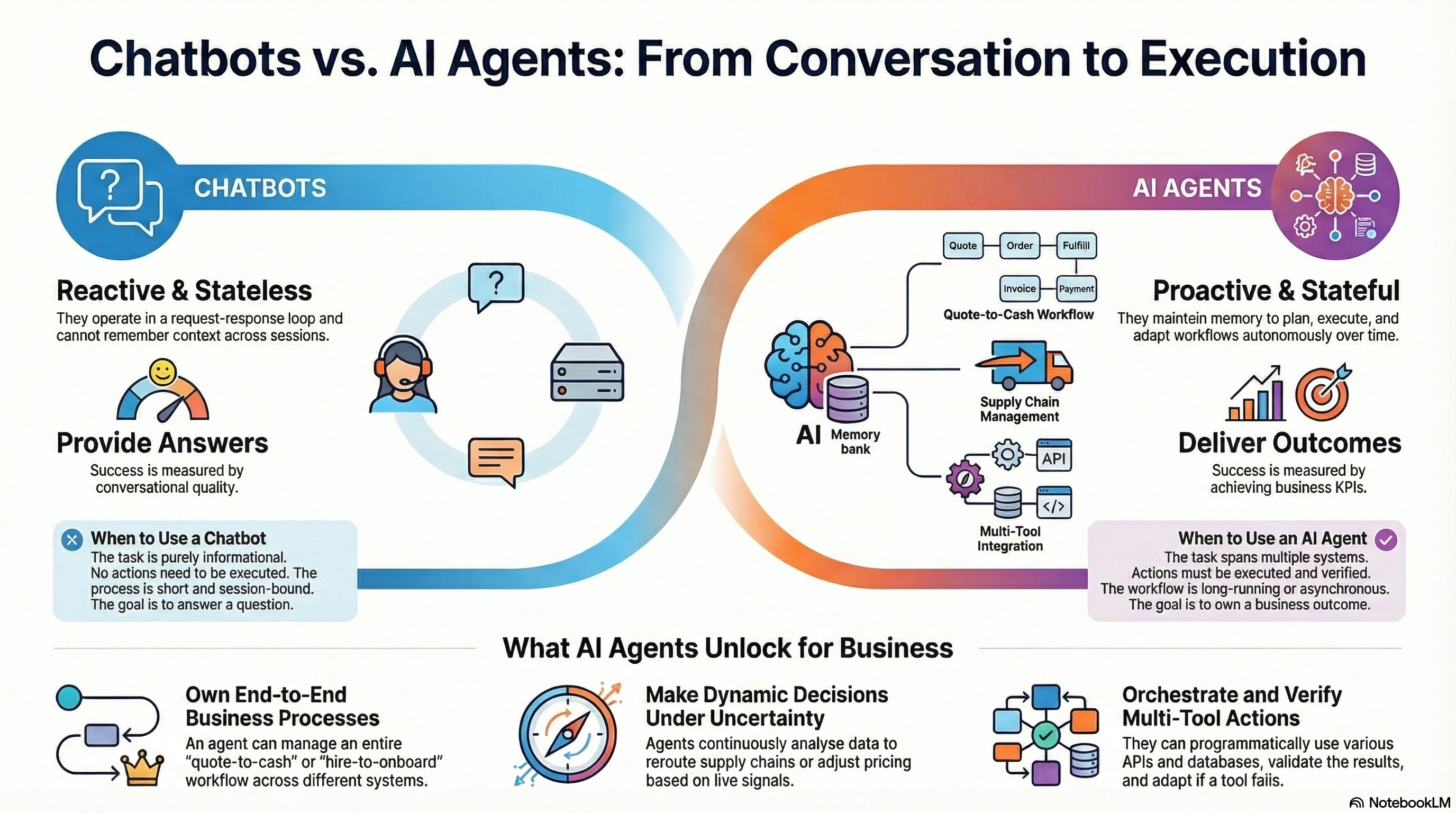
Conceptual Background
Chatbots vs. AI Agents
A chatbot is reactive.
An AI agent is proactive and stateful.
Chatbots operate in a request–response loop. They interpret a prompt and generate text. They do not persist goals, manage dependencies, or verify outcomes.
AI agents, by contrast, operate as systems.
They:
Maintain memory and state
Break goals into executable plans
Invoke tools and APIs
Evaluate results
Retry, escalate, or adapt
Run asynchronously over time
This shift from conversation to execution is why agents unlock problems that were previously impossible to automate reliably.
Problem 1: End-to-End Business Process Ownership
The Problem
Enterprises operate workflows that span multiple systems: CRM, ERP, finance, support, analytics, and compliance. These workflows are not linear. They branch, pause, escalate, and resume.
Examples:
Quote-to-cash
Incident-to-resolution
Hire-to-onboard
Procure-to-pay
Chatbots can explain these processes. They cannot own them.
Why Chatbots Fail
Chatbots lack:
Persistent state across steps
Ability to trigger and verify actions
Contextual awareness of upstream and downstream dependencies
Accountability for completion
They answer “what to do,” but they cannot do it.
How AI Agents Solve It
An AI agent can:
Observe a trigger event
Construct a multi-step execution plan
Call APIs across systems like Salesforce and SAP
Validate outcomes at each step
Escalate exceptions to humans
Close the loop with audit trails
The agent does not assist the workflow. It becomes the workflow owner.
Problem 2: Dynamic Decision-Making Under Uncertainty
The Problem
Many business decisions cannot be pre-scripted:
Pricing adjustments based on demand signals
Supply chain rerouting during disruptions
Fraud detection with evolving patterns
Risk assessment with incomplete data
These decisions require ongoing evaluation, not static rules.
Why Chatbots Fail
Chatbots do not:
Continuously ingest signals
Re-evaluate decisions as conditions change
Simulate alternatives
Optimize for outcomes over time
They respond to snapshots, not systems.
How AI Agents Solve It
AI agents act as decision engines.
They:
Continuously ingest data streams
Maintain probabilistic models
Test scenarios
Select actions aligned with business objectives
Revise decisions as new data arrives
This capability underpins modern decision intelligence platforms and autonomous operations.
According to McKinsey, organizations using advanced AI-driven decision systems report productivity gains of 20–30% in complex operational domains.
Problem 3: Long-Running, Asynchronous Workflows
The Problem
Many enterprise tasks unfold over days or weeks:
Vendor negotiations
Compliance investigations
Customer lifecycle management
Infrastructure migrations
These processes pause, resume, and depend on external events.
Why Chatbots Fail
Chatbots are session-bound.
They forget.
They cannot wait.
They cannot resume without being re-prompted.
This makes them unsuitable for ownership of long-running work.
How AI Agents Solve It
AI agents persist.
They:
Store state across time
Monitor external systems
Resume execution when conditions change
Notify stakeholders only when intervention is required
An agent managing a compliance review can monitor evidence collection, flag missing artifacts, and escalate only when thresholds are breached.
The human role shifts from operator to supervisor.
Problem 4: Multi-Tool Orchestration and Verification
The Problem
Modern enterprises rely on hundreds of tools:
Databases
APIs
BI platforms
Internal services
External vendors
True automation requires orchestrating these tools and verifying outcomes.
Why Chatbots Fail
Chatbots can suggest commands or generate scripts, but they cannot:
Execute across heterogeneous tools
Validate side effects
Handle partial failures
Retry with modified strategies
They stop at the instruction.
How AI Agents Solve It
AI agents orchestrate.
They:
Select the right tool for each task
Execute actions programmatically
Verify results against expectations
Adapt strategies when tools fail or data changes
This is why agentic systems are increasingly paired with RPA, workflow engines, and cloud automation platforms.
Problem 5: Outcome-Based Accountability
The Problem
Businesses do not pay for answers. They pay for outcomes:
Reduced churn
Faster resolution
Lower costs
Higher revenue
Chatbots optimize for response quality, not business impact.
Why Chatbots Fail
Chatbots:
Do not measure success beyond conversational metrics
Cannot own KPIs
Do not learn from downstream business results
They are decoupled from value creation.
How AI Agents Solve It
AI agents are outcome-driven.
They:
Align actions to explicit goals
Measure results against KPIs
Learn from success and failure
Improve strategies over time
An agent responsible for customer retention can experiment with interventions, measure the reduction in churn, and optimize their approach continuously.
This closes the loop between AI and business value.
Step-by-Step Walkthrough: When to Use Agents Instead of Chatbots
Use a chatbot when:
The task is informational
No action is required
No persistence is needed
Errors are low-risk
Use an AI agent when:
The task spans systems
Decisions evolve over time
Actions must be executed and verified
Outcomes matter more than answers
Chatbot vs. Agent Execution Model

Use Cases / Scenarios
Autonomous IT operations
Intelligent finance reconciliation
Customer lifecycle automation
Supply chain optimization
Compliance and risk monitoring
In each case, the agent is responsible for results, not conversation quality.
Limitations / Considerations
AI agents introduce new challenges:
Governance and auditability
Tool security and access control
Error propagation
Human override mechanisms
Agents must be constrained, observable, and aligned with organizational policies.
This is not a chatbot upgrade. It is a systems design decision.
Fixes: Common Pitfalls and Solutions
Over-automating without human checkpoints → Add escalation rules
Giving agents unrestricted tool access → Apply least-privilege principles
Measuring success via usage instead of outcomes → Tie agents to KPIs
Treating agents as chatbots → Design for execution, not dialogue
FAQs
Are AI agents replacing employees?
No. Agents replace repetitive execution and decision scaffolding, not judgment and accountability.Can agents work with existing enterprise systems?
Yes. Agents are most effective when integrated with existing systems via APIs and workflows.Are agents safe to deploy in regulated industries?
Yes, when designed with audit logs, human oversight, and strict access controls.
References
McKinsey Global Institute, “The Economic Potential of Generative AI,” 2024
Gartner, “AI Decision Intelligence Platforms,” 2024
OpenAI research on agentic systems and tool use
Generative Engine Optimization concepts and AI visibility frameworks
Hire an Expert to Integrate AI Agents the Right Way
Integrating AI agents into real enterprise environments requires architectural experience, not just tooling.
Mahesh Chand is a veteran technology leader, former Microsoft Regional Director, long-time Microsoft MVP, and founder of C# Corner. He has decades of experience designing and integrating large-scale enterprise systems across healthcare, finance, and regulated industries.
Through C# Corner Consulting, Mahesh helps organizations integrate AI agents safely with existing platforms, avoid architectural pitfalls, and design systems that scale. He also delivers practical AI Agents training focused on real-world integration challenges.
Learn more at: https://www.c-sharpcorner.com/consulting/
Conclusion
Chatbots changed how businesses communicate with machines. AI agents change what machines can be responsible for.
The organizations that win with AI will not deploy better chat interfaces. They will deploy systems that plan, act, verify, and learn.
Beyond the chatbot lies operational intelligence. That is where competitive advantage now lives.
Join the conversation! Your thoughts help the community grow.