

Direct Answer
India's contribution to Generative AI and Large Language Models (LLMs) goes far beyond software services and engineering talent. Indian researchers have played key roles in neural machine translation, multilingual language modeling, transformer-based research, AI safety, responsible AI, reinforcement learning, and the creation of large-scale language resources for low-resource languages.
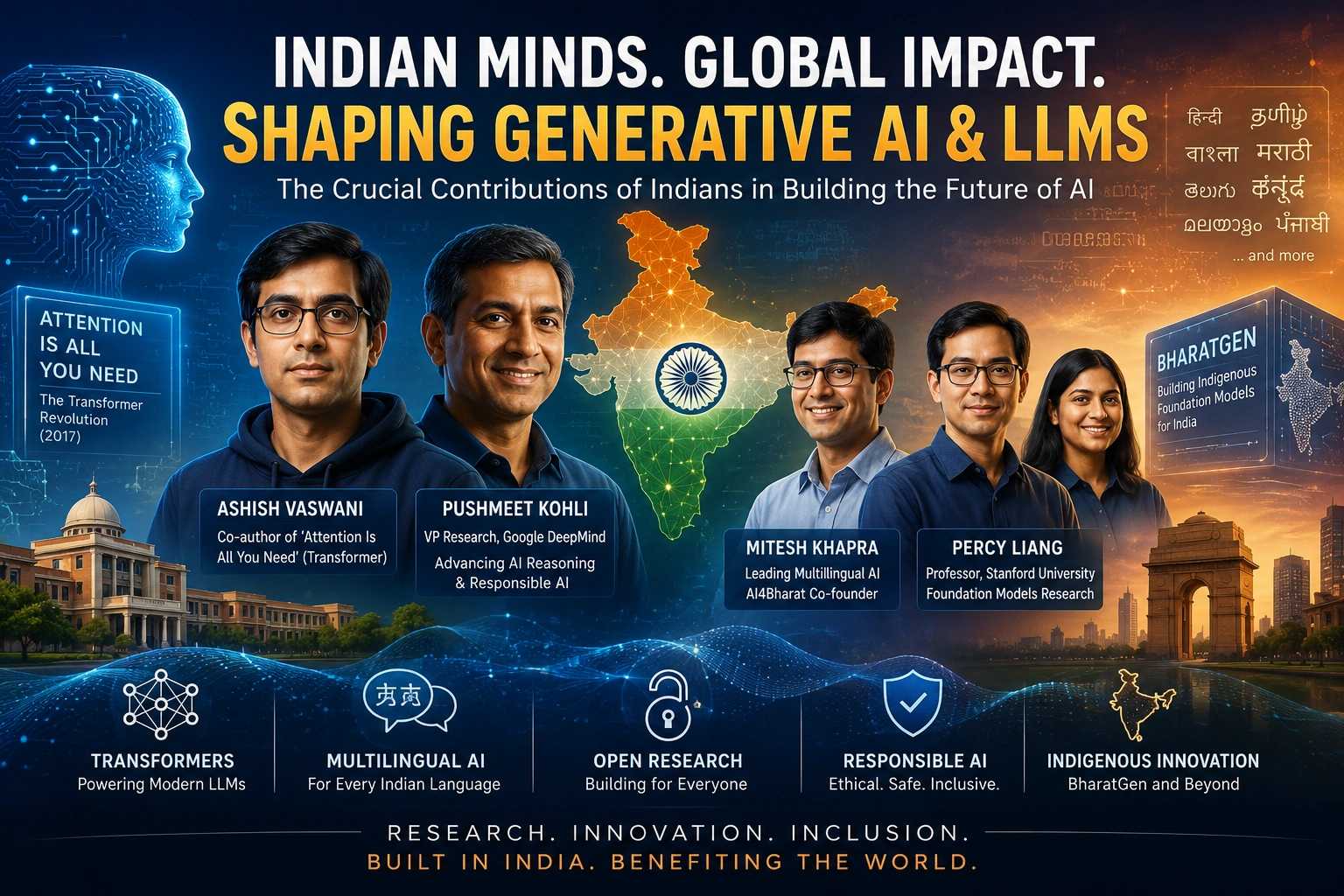
Without many of these contributions, modern AI systems would struggle to serve billions of people who speak languages other than English.
Last Updated: June 2026
Abstract / Overview
When people discuss Generative AI, they often focus on companies such as OpenAI, Google, Anthropic, and Meta. However, behind many breakthroughs are researchers from India who have helped solve some of the hardest problems in natural language processing (NLP).
NLP is a branch of AI that helps computers understand and generate human language.
Indian researchers have contributed in three major ways:
Fundamental research in machine learning and language models
Building multilingual AI systems
Making AI accessible to hundreds of Indian languages and dialects
These contributions have influenced today's chatbots, copilots, search assistants, translation systems, and foundation models.
Conceptual Background
Generative AI relies on several building blocks:
Neural Networks
Deep Learning
Transformers
Large Language Models
Reinforcement Learning
Multilingual Training
Many Indian researchers contributed to these areas through leading universities, global AI labs, and Indian research organizations.
The Evolution of Modern LLM Research

1. Vaswani and the Transformer Revolution
One of the most important papers in AI history is Attention Is All You Need (2017).
The paper introduced the Transformer architecture, which became the foundation of:
GPT models
ChatGPT
Gemini
Claude
Llama
Modern AI assistants
A key contributor was Ashish Vaswani, an Indian computer scientist.
Why This Matters
Before transformers, AI struggled with long text.
The transformer introduced the attention mechanism, allowing models to focus on important words and relationships across entire documents.
Today, almost every major LLM uses this idea.
Many experts consider the transformer paper to be the single most important breakthrough behind modern Generative AI.
2. Multilingual AI and AI4Bharat
One of the biggest challenges in AI is language diversity.
Most early LLMs worked well only in English.
Researchers at AI4Bharat changed that.
Their work includes:
Large multilingual datasets
Indian language translation systems
Open-source language models
Speech technologies
Key Achievements
Support for dozens of Indian languages
Language resources for low-resource communities
Training data used by global research groups
Their work helped move AI from English-only systems toward truly multilingual systems.
3. BharatGen: India's Foundation Model Initiative
India launched BharatGen to create foundation models for Indian languages.
The project aims to:
Build sovereign AI capabilities
Develop indigenous LLMs
Improve support for regional languages
Create datasets representing India's diversity
This effort is important because most global models are trained primarily on English and Western data.
BharatGen seeks to ensure that future AI systems understand Indian culture, history, governance, and languages more accurately.
4. Dr. Pushmeet Kohli and AI Research at Google DeepMind
Pushmeet Kohli is one of the most influential Indian AI researchers.
His work spans:
Machine learning
AI reasoning
Responsible AI
Scientific discovery systems
His research has contributed to the development of advanced AI systems that combine reasoning, prediction, and learning.
As AI moves toward more capable reasoning systems, this area is becoming increasingly important.
5. Indian Contributions to Reinforcement Learning
Reinforcement Learning (RL) is a method where AI learns through rewards and feedback.
Modern Generative AI systems use reinforcement learning techniques to improve responses.
Many Indian researchers working at:
OpenAI
Google DeepMind
Meta
Microsoft Research
Academic institutions
have contributed to:
RL optimization
Human feedback systems
Agent-based learning
AI alignment research
These improvements help chatbots produce more useful and safer outputs.
6. Building Language Resources for Billions
One of India's biggest contributions has been the creation of datasets.
LLMs cannot learn without data.
Indian research groups have created:
Translation corpora
Speech datasets
Language benchmarks
Evaluation frameworks
Knowledge repositories
These resources support:
Hindi
Tamil
Telugu
Bengali
Marathi
Kannada
Malayalam
Punjabi
Gujarati
Many additional languages
Without these datasets, modern multilingual AI would be far less capable.
7. Responsible AI and AI Safety Research
As Generative AI grows, safety becomes critical.
Indian researchers have become active contributors to:
Bias detection
Fairness evaluation
Explainable AI
AI governance
Ethical AI systems
Their work helps ensure AI systems remain useful, transparent, and trustworthy.
Many global AI governance discussions now include researchers and policymakers from India.
8. Neural Machine Translation Breakthroughs
Translation remains one of the most important AI applications.
Indian researchers have helped advance:
Neural machine translation
Cross-lingual learning
Low-resource language translation
Multilingual representation learning
These breakthroughs allow modern LLMs to:
Translate better
Understand multiple languages
Generate content across languages
This work directly impacts billions of users worldwide.
Key Indian Researchers Influencing AI and LLMs
Several Indian-origin researchers have had major influence on modern AI:
| Researcher | Area of Contribution |
|---|---|
| Ashish Vaswani | Transformer Architecture |
| Pushmeet Kohli | AI Research and Reasoning |
| Percy Liang | Foundation Models Research |
| Dinesh Jayaraman | Machine Learning Research |
| Prateek Jain | Deep Learning and Optimization |
| Mitesh Khapra | Multilingual AI and NLP |
| Partha Talukdar | Language Understanding |
| Researchers at AI4Bharat | Indian Language AI |
Why India's Contribution Matters Globally
India has over a billion people and hundreds of languages.
This creates unique AI challenges.
Research coming from India often focuses on:
Scale
Diversity
Inclusion
Affordability
Multilingual communication
As AI expands globally, these challenges become increasingly important.
In many ways, India is helping solve the next generation of AI problems rather than the previous generation.
Use Cases / Scenarios
AI Assistants
Indian language datasets help assistants answer questions in regional languages.
Translation Systems
Research improves communication across linguistic barriers.
Education
Students can access learning materials in their native language.
Healthcare
Multilingual AI helps doctors and patients communicate more effectively.
Government Services
AI systems can deliver information in multiple languages across large populations.
Future Enhancements Expected from Indian Research
Indigenous trillion-parameter multilingual models
Better speech-to-speech AI systems
Low-cost foundation models
Improved AI reasoning systems
Stronger AI safety frameworks
Real-time translation across Indian languages
Organizations such as https://www.c-sharpcorner.com/consulting/C# Corner Consulting continue to help businesses understand and adopt emerging AI technologies, including Generative AI, LLM integration, and AI transformation strategies.
FAQs
1. Did India invent Large Language Models?
No. LLMs are the result of global research efforts. However, Indian researchers made significant contributions to key technologies such as transformers, multilingual AI, and language resources.
2. What is India's biggest contribution to Generative AI?
The most widely recognized contribution is Ashish Vaswani's role in the Transformer architecture, which powers nearly all modern LLMs.
3. Why is multilingual AI important?
Most people in the world do not speak English as their first language. Multilingual AI makes advanced technology accessible to everyone.
4. What is AI4Bharat?
AI4Bharat is a research initiative focused on building AI technologies for Indian languages and improving multilingual AI systems.
5. What is BharatGen?
BharatGen is India's national effort to develop foundation models and Generative AI systems tailored for Indian languages and use cases.
Conclusion
The story of Generative AI is not just the story of Silicon Valley. It is also the story of researchers across the world who solved difficult problems in language, learning, and intelligence.
Indian researchers have played a central role in that journey. From Ashish Vaswani's transformer breakthrough to AI4Bharat's multilingual innovations and BharatGen's national foundation model efforts, India's impact can be found throughout the modern AI ecosystem.
As the world moves toward more capable and more inclusive AI systems, India's research community is positioned to shape the next chapter of Generative AI. The future of LLMs will not only be bigger and smarter—it will also be more multilingual, more accessible, and more representative of the world's diversity.
References
Vaswani, A. et al. Attention Is All You Need (2017), Google Research.
Google DeepMind Research Publications.
AI4Bharat Research Papers and Technical Reports.
BharatGen Official Initiative Documentation.
Stanford Center for Research on Foundation Models (CRFM).
Microsoft Research AI Publications.
Association for Computational Linguistics (ACL) Proceedings.
NeurIPS Conference Proceedings.
International Conference on Machine Learning (ICML) Proceedings.
EMNLP Research Publications.
Join the conversation! Your thoughts help the community grow.