

Introduction
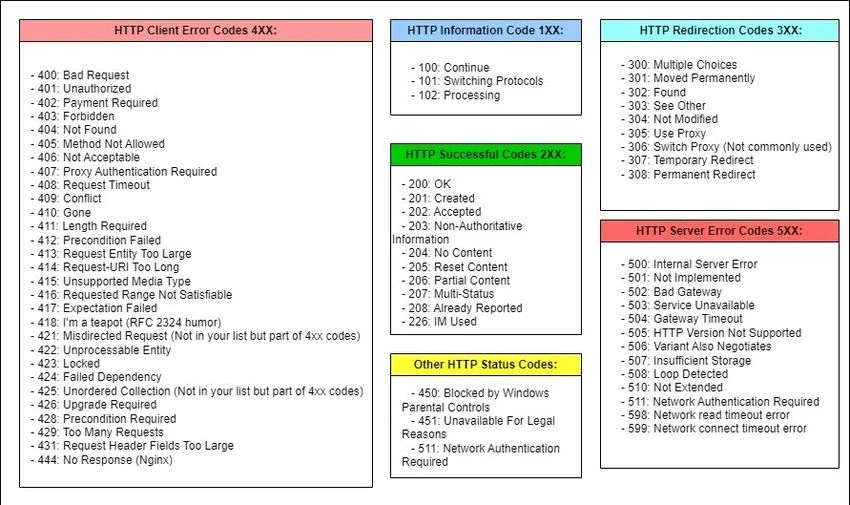
In today's digital age, the world of web development is ever-evolving, and staying ahead requires a deep understanding of the intricate details that make the internet function seamlessly. One such fundamental aspect that every web developer, whether a seasoned pro or a budding enthusiast, should be well-versed in is HTTP status codes. These three-digit numbers provide valuable insights into the status of web requests and responses, making them essential for troubleshooting and diagnosing issues in the online realm.
1. Informational Responses (1xx)
Let's kick things off with the 1xx series, which serves as a courtesy notification from the server to the client—two key status codes in this category.
- 100 Continue: Think of this as the green light for your client's request. The server has received the initial part of the request and signals that it's ready for the client to proceed.
- 101 Switching Protocols: In some cases, the client might request a switch in protocols, and this code indicates that the server is accommodating this request. A real-world analogy could be switching from HTTP to HTTPS for secure communication.
2. Successful Responses (2xx)
The 2xx series is music to a developer's ears as it signifies that the client's request was successful. Here are a few noteworthy codes.
- 200 OK: This is the golden ticket. It indicates that the client's request was received and processed successfully, and the server is returning the requested data.
- 201 Created: The server has successfully fulfilled the client's request and has created a new resource as a result.
- 202 Accepted: The client's request has been accepted, but it hasn't been fully processed yet. It's often used in asynchronous processing scenarios.
- 203 Non-Authoritative Information: This status code is similar to 200 OK, but the information may be from a third-party source, not the original server.
- 204 No Content: The server has successfully processed the client's request, but there's no content to return in the response.
- 205 Reset Content: This status code informs the client to reset the document from which the original request was sent.
- 206 Partial Content: The server is returning a partial response, indicating that the client can make additional requests to retrieve the full resource.
- 207 Multi-Status: This status is used in WebDAV to indicate multiple status codes for a single HTTP request.
- 208 Already Reported: This status code is used when the members of a WebDAV binding have already been enumerated in the response.
- 226 IM Used: The server has fulfilled the request, and the response is a representation of the result of one or more instance manipulations applied to the current instance.
3. Redirection Responses (3xx)
The 3xx series deals with redirection. When a client receives these codes, it means the requested resource is available at a different location, and the client should follow the redirection.
- 300 Multiple Choices: The server offers multiple options for the client's request, and the client can choose the most suitable one.
- 301 Moved Permanently: The resource has been permanently moved to a new location. Clients should update their bookmarks and references.
- 302 Found: The resource is temporarily at a different location. It's a common choice for temporary redirects.
- 303 See Other: The client should perform a new request to a different URI provided in the response.
- 304 Not Modified: This response informs the client that the resource hasn't changed since the last request, so the client can use the cached data.
- 307 Temporary Redirect: Similar to 302 but intended to maintain the original request method (e.g., GET or POST).
4. Client Error Responses (4xx)
The 4xx series indicates client errors, typically resulting from malformed or unauthorized requests.
- 400 Bad Request: The client's request is invalid or malformed.
- 401 Unauthorized: The client needs to provide authentication credentials to access the requested resource.
- 403 Forbidden: The server understands the request but refuses to fulfill it. The client lacks the necessary permissions.
- 404 Not Found: The requested resource does not exist on the server.
- 405 Method Not Allowed: The HTTP method used in the request (e.g., GET, POST) is not supported for this resource.
- 406 Not Acceptable: The server cannot produce a response matching the list of acceptable values defined in the request's headers.
- 407 Proxy Authentication Required: Similar to 401 but indicates that the client should authenticate with a proxy server.
- 408 Request Timeout: The server times out while waiting for the client's request.
- 409 Conflict: Indicates a conflict with the current state of the resource, and the client must resolve it before re-requesting.
- 410 Gone: The requested resource was once available, but it's now permanently removed and will not be back.
- 411 Length Required: The server requires the "Content-Length" header in the request.
- 412 Precondition Failed: The client's request failed due to preconditions specified in the request headers.
- 413 Request Entity Too Large: The client's request is too large for the server to process.
- 414 Request-URI Too Long: The URI provided in the request is too long for the server to process.
- 415 Unsupported Media Type: The server doesn't support the media type or format of the request.
- 416 Requested Range Not Satisfiable: The requested range in the "Range" header cannot be fulfilled by the server.
- 417 Expectation Failed: The server cannot meet the "Expect" request header in the client's request.
- 418 I'm a teapot: An April Fools' joke status code, not intended for serious usage.
- 421 Misdirected Request: The request was directed at a server that is not able to produce a response.
- 422: Unprocessable Entity: This status code indicates that the server understands the client's request but cannot process it due to semantic errors.
- 423: Locked: The requested resource is locked for editing, and the client should contact the server's administrator or owner to gain access.
- 424: Failed Dependency: This status code signifies that the request failed because it relied on another action that failed.
- 425: Unordered Collection (Not in your list but part of 4xx codes): This status code indicates that the client attempted to use an HTTP method not supported for an ordered collection.
- 426: Upgrade Required: The client should switch to a different protocol to access the requested resource. This can be used for security or other reasons.
- 428: Precondition Required: The server requires the client to include conditional headers (e.g., If-Match) with the request to ensure the resource's current state matches the client's expectation.
- 429: Too Many Requests: The client has made too many requests within a given time frame, and the server is limiting access to prevent abuse.
- 431: Request Header Fields Too Large: The client's request headers are too large for the server to process, and it's recommended to reduce the size of the request headers.
- 444: No Response (Nginx): This status code is specific to Nginx and indicates that the server has not returned a response, often due to issues with the client's request.
5. HTTP Server Error Codes (5XX)
The 5xx series indicates server errors, signifying issues on the server's end that prevent it from fulfilling the client's request.
- 500: Internal Server Error: This is a generic and often uninformative error message. It indicates that the server encountered an unexpected condition, which prevented it from fulfilling the request.
- 501: Not Implemented: The server does not support the functionality required to fulfill the request, or it is not configured to do so.
- 502: Bad Gateway: The server, acting as a gateway or proxy, received an invalid response from the upstream server it accessed while attempting to fulfill the client's request.
- 503: Service Unavailable: The server is currently unable to handle the request, typically due to temporary overloading or maintenance. The client can retry the request later.
- 504: Gateway Timeout: This status code is similar to 502, but it indicates that the server acting as a gateway or proxy didn't receive a timely response from the upstream server.
- 505: HTTP Version Not Supported: The server does not support the HTTP protocol version used in the client's request.
- 506: Variant Also Negotiates: This status code indicates that the server has an internal configuration error and is unable to respond to content negotiation.
- 507: Insufficient Storage: The server is unable to store the representation needed to fulfill the request.
- 508: Loop Detected: The server detected an infinite loop while processing the request, and it terminated the request to prevent further processing.
- 510: Not Extended: The server requires further extensions to fulfill the client's request.
- 511: Network Authentication Required: This status code indicates that the client must authenticate itself to access the network.
- 598: Network read timeout error: This status code typically indicates that a network read timeout occurred.
- 599: Network connect timeout error: This status code is often used when a client is unable to establish a network connection.
6. Other HTTP Status Codes
These are some other HTTP status codes that don't fit into the previous categories.
- 450: Blocked by Windows Parental Controls: This status code is used to indicate that access to the requested resource is blocked by Windows Parental Controls, typically for content filtering or access restrictions.
- 451: Unavailable For Legal Reasons: This status code is used when access to a resource is denied due to legal restrictions or legal obligations, such as censorship, court orders, or government-imposed restrictions.
- 511: Network Authentication Required: Similar to 401, this status code indicates that the client must authenticate itself to access the network or requested resource.
Conclusion
HTTP status codes are the unsung heroes of web development. They silently communicate the outcome of each request-response cycle, enabling developers to identify and address issues efficiently. For anyone venturing into the world of web development, understanding these codes is a crucial step toward mastering the art of creating seamless online experiences. So, embrace them, learn them, and let them be your guiding light in the digital realm.
Join the conversation! Your thoughts help the community grow.