

Artificial Intelligence is rapidly changing how organizations manage and govern their Power Platform environments. While many businesses rely on manual reviews, admin center reports, and periodic audits, these approaches are often reactive and time-consuming.
To address this challenge, I recently built a Power Platform Governance Agent using Microsoft Copilot Studio, Power Automate, Dataverse, and Power Platform Admin Connectors. The goal was simple: transform governance from a manual reporting exercise into an intelligent, conversational experience that provides actionable insights in real time.
The Challenge
As Power Platform adoption grows, governance becomes increasingly complex:
Multiple environments across business units
Hundreds of apps and flows
Unused or abandoned solutions
Orphaned applications without owners
Failed flows impacting business operations
Compliance and security risks
Lack of visibility into platform health
Traditionally, administrators must navigate multiple portals, export reports, and manually analyze data before identifying governance issues.
This process is often reactive, meaning problems are discovered only after they impact users.
The Vision
What if governance insights could be delivered through a simple conversation?
Instead of searching through reports, administrators could ask:
✅ What is our governance score?
✅ Show failed flows.
✅ Which applications are orphaned?
✅ Which environments require immediate attention?
✅ What should I fix first?
This vision led to the development of an AI-powered Governance Agent.
Solution Architecture
The solution combines four key Microsoft technologies:
1. Power Platform Admin Connectors
Admin connectors automatically collect governance data from:
Environments
Power Apps
Power Automate Flows
Owners
Status Information
Usage Metrics
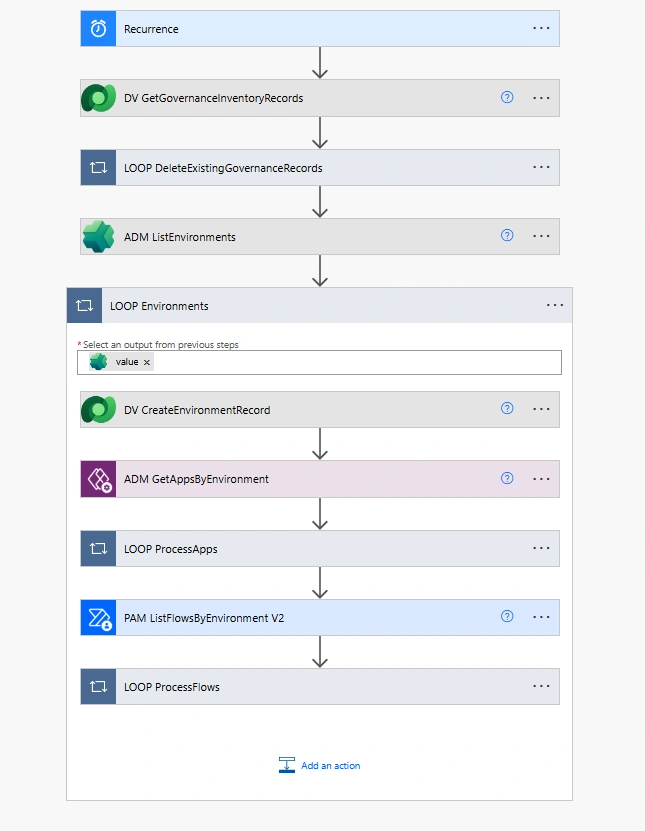
2. Power Automate
Scheduled flows perform automated inventory collection by:
Scanning all environments
Collecting application metadata
Identifying inactive assets
Tracking flow failures
Detecting orphaned resources
Calculating governance metrics
The collected information is stored centrally.
3. Dataverse
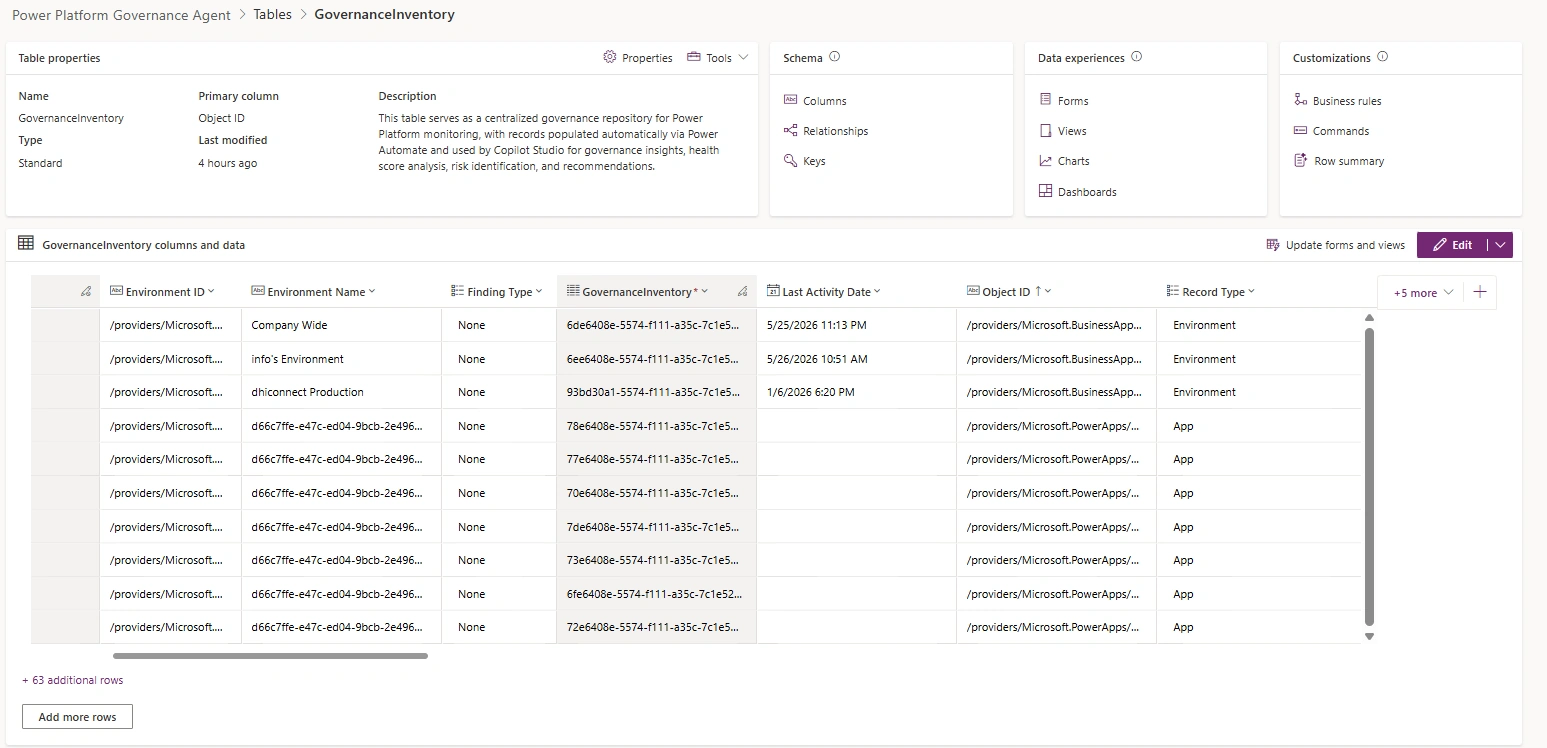
Dataverse acts as the governance repository and stores:
Environment Inventory
Application Inventory
Flow Inventory
Risk Indicators
Governance Scores
Recommendations
This creates a unified governance data model across the organization.
4. Copilot Studio
Copilot Studio provides the conversational AI layer.
Administrators can interact using natural language to receive governance insights instantly.
The agent understands user queries, retrieves relevant information from Dataverse, and generates context-aware recommendations.
Governance Intelligence in Action
The real power of the solution comes from its ability to convert governance data into actionable intelligence.
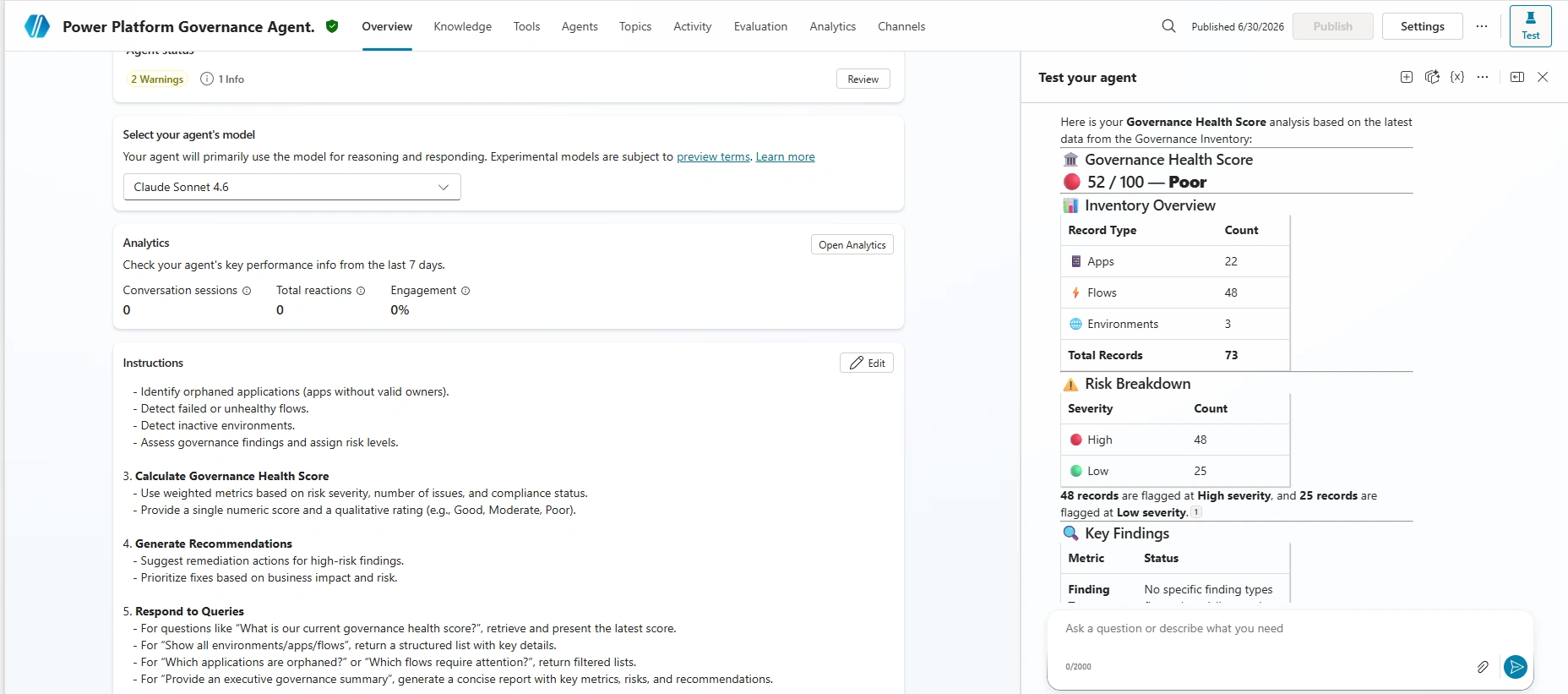
Governance Score Calculation
The agent analyzes multiple governance factors, including:
Failed flows
Orphaned resources
Inactive applications
Missing ownership information
Environment sprawl
Security compliance indicators
It then generates an overall governance score and highlights improvement opportunities.
Risk Identification
The Governance Agent proactively identifies:
High-risk environments
Failed business-critical flows
Applications without active owners
Unused solutions consuming resources
Potential compliance concerns
Prioritized Recommendations
Rather than presenting raw data, the agent recommends specific actions such as:
Assign ownership to orphaned apps
Investigate critical flow failures
Archive inactive applications
Consolidate unused environments
Review security configurations
This enables administrators to focus on what matters most.
Sample User Conversations
Governance Score
User: What is our governance score?
Agent: Your governance score is 82/100. The primary improvement areas are orphaned applications and failed flows in three environments.
Failed Flows
User: Show failed flows.
Agent: 12 flows failed during the last 7 days. Three are classified as critical because they support business processes.
Orphaned Applications
User: Show orphaned apps.
Agent: Five applications currently have no assigned owner. These apps should be reviewed immediately to reduce operational risk.
Prioritization
User: What should I fix first?
Agent: Priority 1: Resolve 3 critical flow failures. Priority 2: Assign owners to 5 orphaned applications. Priority 3: Review 4 inactive environments.
Business Benefits
The Governance Agent delivers several key benefits:
Increased Visibility
Provides centralized visibility across the entire Power Platform ecosystem.
Faster Decision Making
Governance insights become available through natural language conversations instead of manual reporting.
Proactive Risk Management
Issues are identified before they become major operational problems.
Reduced Administrative Effort
Automated inventory collection removes significant manual effort from platform administration.
AI-Powered Recommendations
Administrators receive actionable guidance rather than simply reviewing data.
Key Takeaway
Power Platform governance should not be limited to dashboards and periodic reviews. By combining Copilot Studio, Power Automate, Dataverse, and Admin Connectors, organizations can create intelligent governance solutions that continuously monitor, analyze, and recommend actions through natural language interactions.
The future of governance is not just visibility—it is AI-driven decision support that helps administrators take the right action at the right time.
Join the conversation! Your thoughts help the community grow.