

Multiple years in the computer science field, various projects, several prizes and awards and still we don't understand how much mathematics is involved in computer science. Since day one, there has been a lot of confusion and illusions in the minds of computer science students, that all they ever would have to do is, build projects, write software applications, help customers build rockets etc. and never actually have to do any mathematics... Totally, wrong concept.
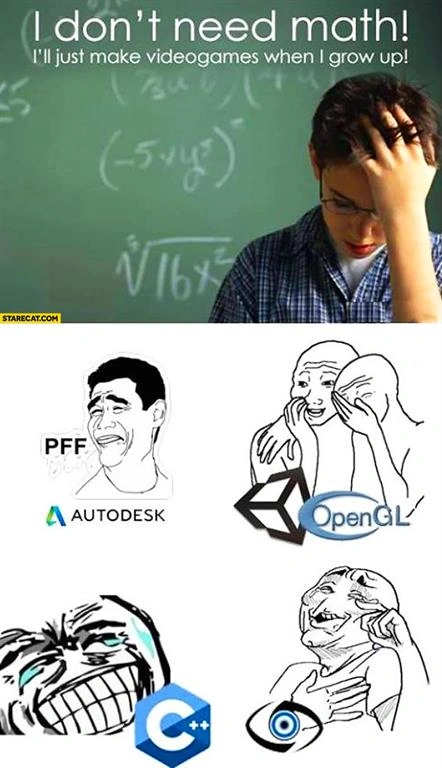
I remember, I saw this image around 3 years ago, when I myself was starting to learn programming and I also thought that maybe I don't need to learn mathematics or the concepts in mathematics, to be a good programmer. To an extent, I was right, to an extent I was wrong. And this post is entirely about the concept of why I was wrong and why I was right.
Also, before the post even starts, I want to be the "mainstream author" and start my own quote.
In software, everything is a statement, unless it is a function.
Anyway, getting back to the main theme of the post - what a function is, and how are we using it in our software engineering concepts while defining most important plans and designs of our applications.
Mathematical definition of a function
Now, that we have a computer in our reach, we have forgotten how things actually worked, and how these models that we call "computer" actually work or are expected to work. Most of the low-level details, or the algorithms, or concepts of the "computers" have been left behind and more concepts and designs have been thrown down the stream, which students have to focus on, instead of the low-level details. Before, I start to lecture you on Mathematics, I must admit I am a very poor student in Mathematics, got 33 in my BSc, and got a D grade in my Masters. But nonetheless, I try to understand as much of Mathematical concepts as I should, to better understand how to program a machine, whose sole existence depends on Mathematics and models.
The simplest of the definitions of a function, define it as a function has,
- A set of inputs, which is known as argument (or argument list).
- A value that is returned from the function.
Moreover, the function is typically defined to have a domain, and a codomain, in which it operates and doesn't break. Without going any deeper in the Mathematical details of these, I would like to give you an overview of what these two terms mean, then I will also show a code sample to clarify the meaning... Because, all of us have been tuned to understand the code more than anything else.
For a function, f(x, y) → y ÷ x,
- The domain of the function would be the set of all the possible values of x and y, where the function doesn't break—I will talk about this part in the code below.
- The codomain part of this function, is the set of possible values that the expression "y ÷ x" would return.
Keeping the above example in mind, we can define a function in C# program as following,
- double Function(int x, int y) {
- return y / x;
- }
- double Function(int x, int y) {
- if (x != 0) {
- return y / x;
- } else {
- // Properly propagate the value
- return Double.PositiveInfinity;
- }
- }
When is a Function, a Function
Now that we have understood the basic definition, we can easily define and understand what a function is more likely to be. Since the days of C, C++ and other similar procedural languages, the terminology has been intertwined enough to cause a confusion in the students. They are taught,
An object has a state and performs some functionality.
Fine, then what is the functionality when it could be much better explained as a behavior? Wouldn't it be easy to understand? But still most of the course outlines, materials do not focus on these ambiguities that, for a moment do seem to help the reader, but can be a long-term pain for the readers as they would sometime stumble upon the real usage of world and then, cringe. So, how do we then define a function?
An object has a state and performs some functionality.
Fine, then what is the functionality when it could be much better explained as a behavior? Wouldn't it be easy to understand? But still most of the course outlines, materials do not focus on these ambiguities that, for a moment do seem to help the reader, but can be a long-term pain for the readers as they would sometime stumble upon the real usage of world and then, cringe. So, how do we then define a function?
Join the conversation! Your thoughts help the community grow.