

Introduction
Every day, billions of searches happen on Google.
You type a question, hit enter — and in less than a second, Google delivers the best possible answer.
But have you ever wondered: How does Google know what exists on the internet? and how does it decide which page deserves the #1 spot?
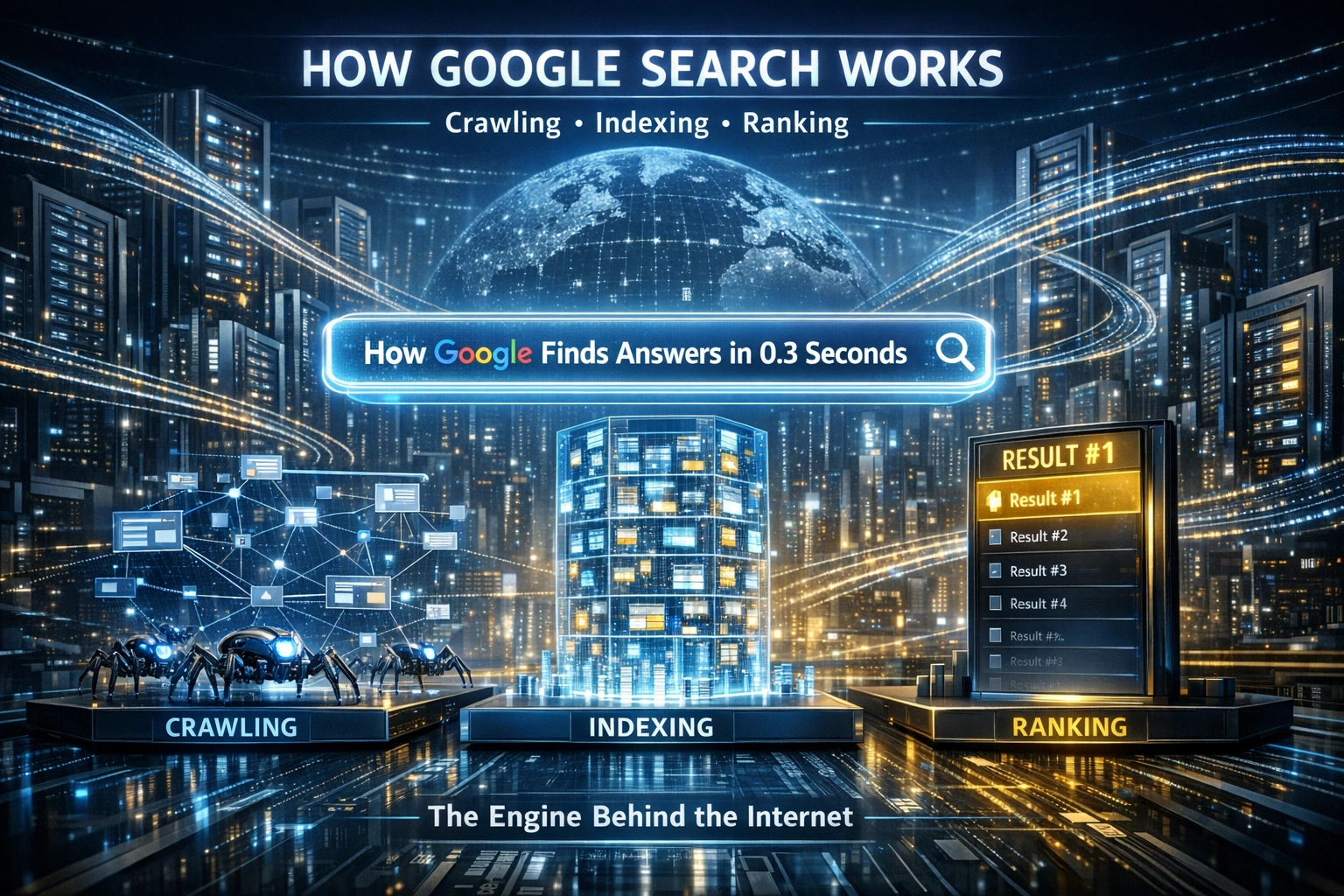
Behind every search query lies a powerful three-step system:
Crawling. Indexing. Ranking.
Understanding this process is the foundation of SEO, content creation, and digital visibility.
Let’s break it down.
The Scale of Google Search
The internet contains billions of web pages, constantly changing every second.
New websites appear. Old pages update. Some disappear.
Google’s job is to:
• Discover all these pages
• Store them efficiently
• Deliver the best answer instantly
This requires massive automation — and that’s where Google’s search infrastructure comes in.
Step 1: Crawling — Discovering the Web
The first step is Crawling. Google uses automated programs called: Google Crawlers or Spiders
These bots continuously:
• Visit websites
• Read page content
• Follow links to other pages
• Discover new or updated content
Think of crawlers as explorers mapping the entire internet.
If a page is never crawled, Google doesn’t know it exists.
And if Google doesn’t know it exists — it can never rank.
Step 2: Indexing — Storing the Internet
Once pages are discovered, Google moves to the second step: Indexing
During indexing, Google:
• Analyzes page content
• Understands text, images, structure
• Identifies keywords and topics
• Stores the page in its massive database
This database is called the Google Index.
You can imagine it like a gigantic digital library where:
• Every webpage is a book
• Every keyword is a catalog tag
If a page is not indexed, it will never appear in search results.
Step 3: Ranking — Choosing the Best Result
Now comes the most important step: Ranking
When you type a search query, Google:
• Looks into its index
• Finds relevant pages
• Decides the order of results
Ranking depends on hundreds of factors, including:
• Content quality and usefulness
• Keyword relevance
• Website authority and trust
• Page loading speed
• Mobile friendliness
• Backlinks from other websites
• User engagement signals
The page that best matches user intent earns the top position.
That’s why SEO exists — to help content align with these ranking factors.
Why Google Results Are So Fast
Google operates massive data centers around the world.
When you search:
• Your request goes to the nearest data center
• The index is queried locally
• Results are delivered in milliseconds
This global infrastructure ensures:
Fast,Reliable, Always available search.
Where SEO Fits In
SEO — Search Engine Optimization — is simply: Optimizing content so Google can crawl, index, and rank it efficiently.
Good SEO means:
• Clear and helpful content
• Proper keyword usage
• Fast-loading pages
• Mobile-friendly design
• Strong site structure
When done right, Google rewards your content with higher visibility.
Why Understanding Google Search Matters
Whether you are:
• A student
• A developer
• A blogger
• A business owner
• A digital marketer
Understanding Google Search gives you the power to:
• Make content discoverable
• Build online visibility
• Drive organic traffic
• Grow digital influence
In today’s digital world:
If Google can’t find you — your audience won’t either.
The Future of Search
Google Search is evolving rapidly:
• AI-powered ranking systems
• Natural language understanding
• Voice and visual search
• Personalized results
• Generative AI summaries
But the foundation remains the same:
Crawling. Indexing. Ranking.
Master these — and you master digital discovery.
Final Thoughts
Google doesn’t magically find answers.
It follows a precise system built on:
• Discovering content
• Understanding content
• Delivering the best result
Once you understand this process, SEO stops being confusing — and starts becoming a strategic skill.
In the internet age, visibility is power.
And Google is the gateway to visibility.
Join the conversation! Your thoughts help the community grow.