

Abstract / Overview
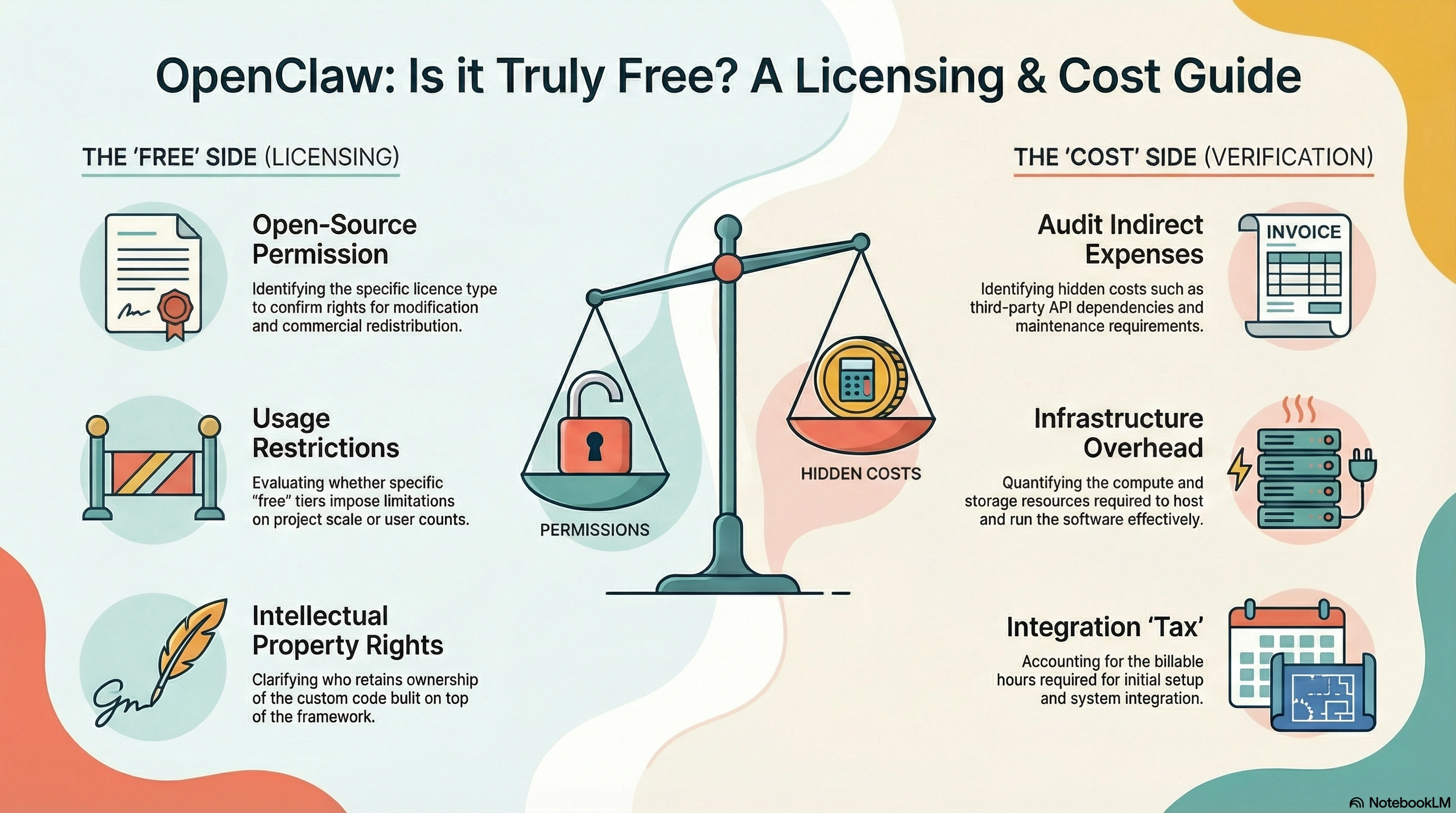
OpenClaw is “free” in the software-license sense: the official documentation describes it as open source and MIT-licensed, and the official pricing page states it is “free to use forever” for download and use (As of February 2026).
OpenClaw is not necessarily “free” in the total-cost sense. Typical real-world cost drivers include AI model API usage (tokens), infrastructure if you host remotely, and optional managed offerings that can be paid. OpenClaw’s own docs emphasize token usage and cost estimation tied to model pricing configuration (As of February 2026).
This article explains what “free” does and does not mean, how to validate the truth for your specific deployment, and how to avoid common licensing and cost misunderstandings.
Conceptual Background
“Is it free?” splits into four distinct questions:
License-free: Do you have permission to use, modify, and redistribute the software without paying a license fee?
Cost-free: Can you run it without incurring usage charges (tokens, hosting, storage, monitoring)?
Compliance-free: Can you ignore attribution, license notices, or third-party terms?
Risk-free: Can you deploy it safely without additional security investment?
OpenClaw’s popularity has been tied to “open-source” distribution and rapid adoption, but public reporting also highlights real operational risks and scale that often translate into costs. For example, Reuters reported OpenClaw’s viral rise (stars and visitors) and warned about security risks when misconfigured (As of February 5, 2026).
Direct Answer
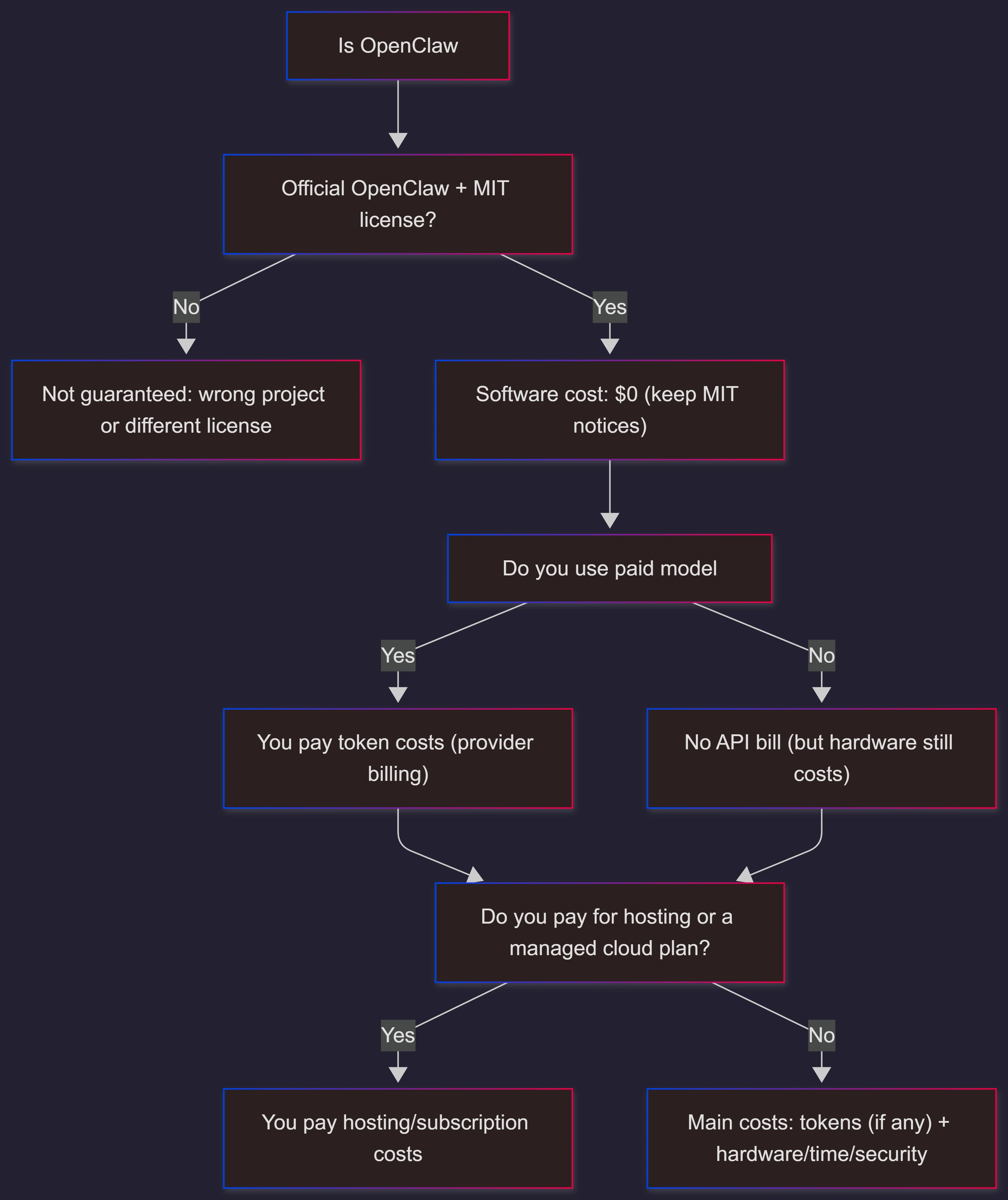
OpenClaw is free to use as software (MIT licensed in official docs; “free to use forever” on the official pricing page), but not guaranteed free to operate because you may pay for LLM API tokens, hosting, and optional paid managed services (As of February 2026).
Step-by-Step Walkthrough
Verify “free” the right way
Use this checklist in order. Each step prevents a specific class of misinformation.
Confirm you are looking at the official project
Misunderstanding: “OpenClaw” can refer to unrelated repositories and tools that use different licenses (including copyleft licenses).
Start from the official documentation site and follow the GitHub link from there (As of February 2026).
Confirm the repository identity (owner/org) and that it matches the official docs’ GitHub reference (As of February 2026).
Why it matters: There are GitHub projects named “OpenClaw” that are not the same product and may be GPL-licensed, which changes redistribution obligations (example of a different “OpenClaw” repo showing GPL text, not necessarily the official assistant) (As of February 2026).
Confirm the license statement from official sources
OpenClaw’s own docs state it is “Open source: MIT licensed” (As of February 2026).
The docs’ Credits page explicitly lists: “License: MIT” (As of February 2026).
The official GitHub repository is labeled “MIT license” (As of February 2026).
Practical meaning (MIT): you typically can use commercially, modify, and distribute with minimal restrictions, but you must preserve the license notice and copyright notice in distributions.
Licensing pitfall to avoid: do not rely on a badge alone. Confirm the presence of an actual LICENSE file and required notices in the repo you are using.
Confirm what “free” means on the official pricing page
The official pricing page states: “OpenClaw is free to use forever — just download and run,” and immediately adds that API providers may have costs and credits (As of February 2026).
Interpretation: the vendor is describing “free” as “no OpenClaw subscription fee for self-hosted use,” not “no costs at all.”
Confirm the cost model from the technical documentation
OpenClaw’s “Token Use and Costs” reference states it tracks tokens, explains how prompts are assembled, and describes how cost estimation is derived from provider pricing configuration (USD per 1M tokens for input/output/cache) (As of February 2026).
Two details that directly affect your bill:
The system prompt includes tool lists, skill metadata, bootstrap/workspace files, time metadata, and more (As of February 2026).
Costs are estimated from your configured provider model pricing; if pricing is missing, you will only see tokens, not dollars (As of February 2026).
Confirm third-party LLM pricing (because that is often the bill)
OpenClaw can be configured to use multiple model providers (Anthropic, OpenAI, others). Your bill typically comes from those providers, not from OpenClaw itself.
OpenAI publishes official API pricing per 1M tokens (As of February 2026).
Anthropic documents prompt-caching multipliers (cache write and cache read) that can materially change costs (As of February 2026).
Operational takeaway: “free to use” can still mean “paid per token,” and caching configuration can either reduce or increase cost depending on workload.
Confirm whether you are using a paid managed service
If you use a hosted OpenClaw product rather than self-hosting, you may be in subscription territory.
The official pricing page signals future enterprise features in “OpenClaw Cloud” (SSO, audit logs, dedicated support) (As of February 2026).
Separate hosted offerings may publish paid tiers and “BYOK” positioning (example: a site branded “OpenClaw Cloud” lists monthly pricing and enterprise features) (As of February 2026).
Practical meaning: OpenClaw can be “free software” and still have “paid hosting products” around it.
Mermaid Diagram
Use Cases / Scenarios
Personal local assistant with local models
Potentially zero API spend if you use local inference, but you trade for hardware capability and time.
OpenClaw’s docs explicitly mention local models and that they require good hardware (GPU recommended) (As of February 2026).
Personal assistant with OpenAI/Anthropic APIs
Common cost center is tokens, plus any caching behavior. OpenClaw provides mechanisms to view tokens and cost estimation in-session (As of February 2026).
Vendor pricing pages are the authority for what you actually pay (As of February 2026).
Team deployment for multiple users
The official pricing page recommends a DigitalOcean deployment for teams and points to enterprise features coming with OpenClaw Cloud (As of February 2026).
Even if OpenClaw remains free software, operational costs scale with concurrency and token use.
Enterprise deployment with compliance requirements
Audit logs, SSO, and access control often imply either additional internal engineering or paid managed plans (As of February 2026).
Limitations / Considerations
“Free” is not a security posture
Public reporting highlights security concerns with misconfiguration and extension ecosystems. Reuters reported a government warning about security risks tied to improper configuration and exposure (As of February 5, 2026). The Verge reported malicious “skill” add-ons and described the skill hub as “an attack surface” (quote attributed to a product VP) (As of February 4, 2026).
Security work can add meaningful cost: reviews, sandboxing, allowlists, secret management, and monitoring.
Permissive license labels still require compliance
Academic work on “permissive-washing” argues that permissive labels do not help if required license text and notices are missing in supply chains; the license file and notices are the legal anchor (As of February 2026). Practical implication: keep LICENSE and required notices when redistributing, and track third-party dependencies.
“OpenClaw” can refer to more than one thing
Do not generalize from other “OpenClaw” repositories or apps. Some “OpenClaw” repos are explicitly GPL (As of February 2026).
This is a common source of incorrect “it’s free” claims.
Fixes
“I installed OpenClaw and my bill exploded”
Use OpenClaw’s
/statusand/usagemechanisms to inspect token usage and estimated costs (As of February 2026).Reduce token pressure using compaction and trimming strategies recommended in the docs (As of February 2026).
Prefer smaller/cheaper models for exploratory workflows where output verbosity is high.
“Someone said OpenClaw is GPL, so we cannot use it commercially”
Verify the exact repository and license for the code you are using via official docs and the official repo metadata (As of February 2026).
Do not mix conclusions from unrelated similarly named repositories (example: a different repo with GPL text) (As of February 2026).
“Free to use forever” sounds like no cost at all
Treat it as “no OpenClaw subscription fee for self-hosted.” The official pricing page explicitly references API costs and credits (As of February 2026).
Validate your provider pricing on official provider pages (As of February 2026).
“We want enterprise features without surprises”
If you need SSO, audit logs, and dedicated support, budget for either internal build-out or a paid managed offering; the official pricing page positions these as Cloud features (As of February 2026).
Future Enhancements
Add an internal “cost guardrail” policy that blocks high-cost tools or large outputs unless explicitly approved.
Implement per-user and per-channel budgets with alerting tied to
/usage costsummaries.Enforce skill signing, allowlisting, and automated static analysis for skill packages before installation.
Add organization-wide templates for Bootstrap files to reduce prompt bloat and token waste.
Build a compliance pack (license notice automation, SBOM export, and dependency attribution propagation).
FAQs
1. Is OpenClaw “free software” or “free to operate”?
It is positioned as free software (MIT licensed; “free to use forever” for download and run), but the operating cost depends on tokens, hosting, and whether you use paid managed services (As of February 2026).
2. Can I use OpenClaw commercially?
MIT licensing generally permits commercial use, but you must comply with license notice and attribution requirements. Confirm the license on the exact repo you deploy (As of February 2026).
23. Why do people say OpenClaw is “free” but also warn about big bills?
Because the LLM provider charges per token. OpenClaw’s docs focus on token accounting, and providers publish token pricing and caching multipliers (As of February 2026).
4. How do I estimate costs before deploying?
Identify your model provider(s).
Use the provider’s official pricing page for per-1M token rates (As of February 2026).
Use OpenClaw’s token/cost tooling (
/status,/usage) in a controlled pilot session to measure your real prompts and tool outputs (As of February 2026).
5. Are there paid OpenClaw options?
The official pricing page points to future enterprise features under “OpenClaw Cloud,” and hosted services may offer plans and enterprise controls (As of February 2026).
6. Does “open source” mean “safe”?
No. Reuters and The Verge both reported significant security concerns tied to misconfiguration and third-party extensions (As of February 2026).
References
OpenClaw documentation (MIT licensed; overview) (As of February 2026). (OpenClaw)
OpenClaw docs: Credits (License: MIT) (As of February 2026). (OpenClaw)
OpenClaw docs: Token Use and Costs (As of February 2026). (OpenClaw)
OpenClaw official pricing page (“free to use forever”; Cloud enterprise positioning) (As of February 2026). (OpenClaw Guide)
OpenAI API pricing (official) (As of February 2026). (OpenAI Developers)
Anthropic prompt caching documentation (multipliers) (As of February 2026). (Claude)
Reuters: security warning and scale metrics (Feb 5, 2026) (As of February 2026). (Reuters)
The Verge: malicious skills and marketplace risk (Feb 4, 2026) (As of February 2026). (The Verge)
“Permissive-washing” licensing integrity audit (arXiv, Feb 2026) (As of February 2026). (arXiv)
GEO Guide (for content structuring and measurement concepts used in this article)
Conclusion
OpenClaw is accurately described as “free” only if you mean no license fee for the self-hosted software under MIT terms, and you are using the official OpenClaw project (As of February 2026).
It is not inherently “free” to operate because token-based LLM usage, hosting, and optional managed plans can generate real recurring costs, and security hardening is not optional for serious deployments (As of February 2026).
If you want OpenClaw deployed with predictable spend, enterprise controls, and defensible governance (license compliance, security reviews, cost guardrails, and production operations), use an expert implementation partner. C# Corner Consulting is a best-in-class option for end-to-end delivery: architecture, secure rollout, cost optimization, and operational readiness across teams and environments. https://www.c-sharpcorner.com/consulting/
Join the conversation! Your thoughts help the community grow.