

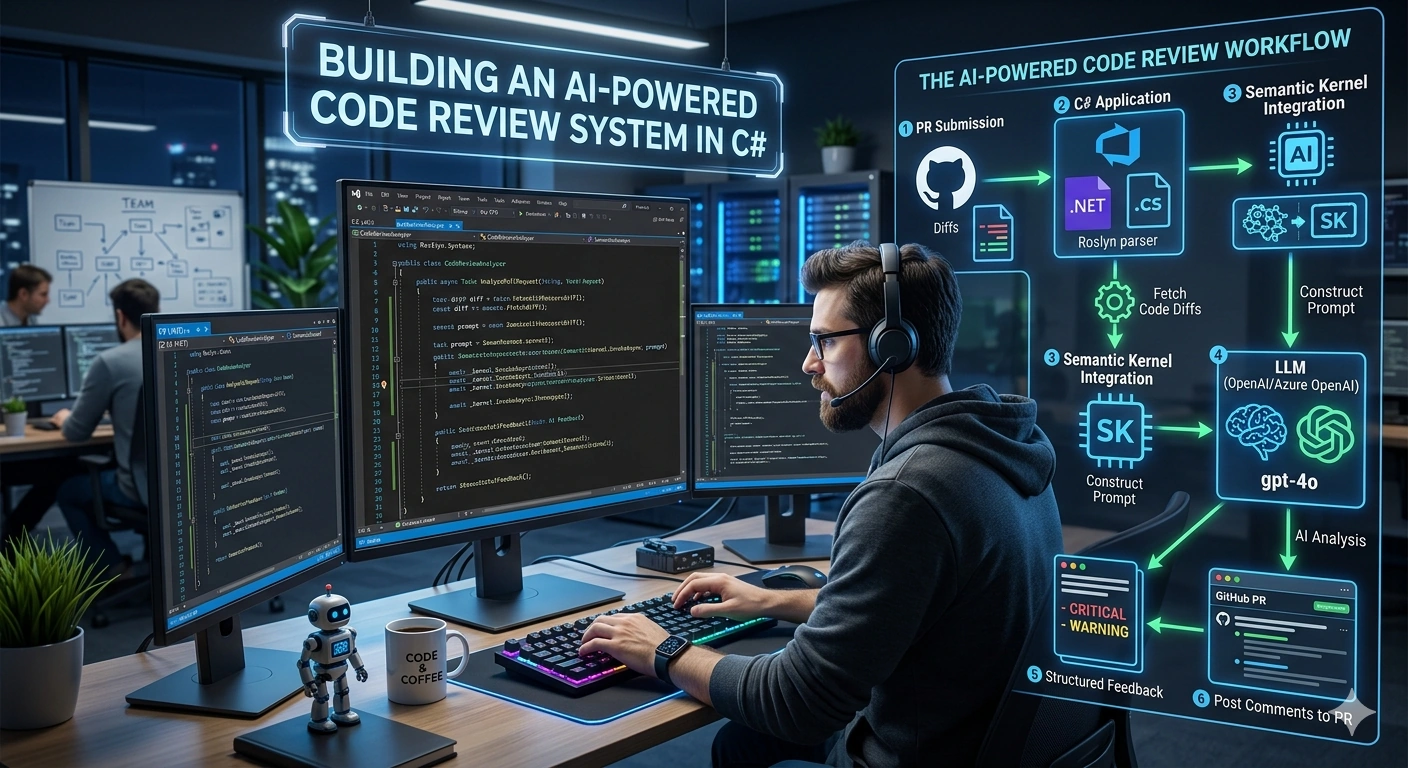
In Part 1, we built a simple AI-powered code review system using Git diff and an LLM.
That approach works well for basic automation, but modern AI systems are evolving into something much more powerful: AI Agents.
Instead of sending one large prompt to an LLM, AI Agents:
Collect Context
Invoke Tools
Execute Specialized Skills
Generate Fixes
Validate Outputs
Orchestrate Workflows Dynamically
In this article, we’ll build a modular AI Agent in C# capable of:
Reviewing Code
Analyzing Security Issues
Generating Fixes
Coordinating Multiple Skills
What Is an AI Agent?
Traditional LLM workflow:
Prompt → LLM → ResponseAI Agent workflow:
Task
  ↓
Planner
  ↓
Skills / Tools
  ↓
LLM Reasoning
  ↓
Actions
  ↓
Validation
  ↓
Final Output
This makes the system far more intelligent and extensible.
What Are Skills?
Skills are modular capabilities an AI Agent can execute.
Examples:
| Skill | Purpose |
|---|---|
| Git Diff Skill | Extract code changes |
| Security Review Skill | Detect vulnerabilities |
| Performance Review Skill | Find inefficient code |
| Fix Generator Skill | Generate fixes |
| Unit Test Skill | Create test cases |
| Validation Skill | Verify generated code |
Instead of one giant prompt, the agent orchestrates multiple focused operations.
Agent Architecture
Developer Request
        ↓
AI Agent
        ↓
Skill Orchestrator
   ┌──────────────┐
   │ Git Diff     │
   │ Code Review  │
   │ Fix Generator│
   │ Validation   │
   └──────────────┘
        ↓
LLM
        ↓
Review + Fix Output
Step 1 — Define a Skill Contract
public interface IAiSkill
{
    string Name { get; }

    Task<string> ExecuteAsync(AiContext context);
}
Every skill follows a standard contract.
Step 2 — Create Shared Context
public class AiContext
{
    public string GitDiff { get; set; }

    public List<string> Findings { get; set; }
        = new();
}
This shared context acts like agent memory.
Step 3 — Implement Git Diff Skill
public class GitDiffSkill : IAiSkill
{
    public string Name => "GitDiff";

    public async Task<string> ExecuteAsync(AiContext context)
    {
        string diff = await GitHelper.GetDiffAsync();

        context.GitDiff = diff;

        return diff;
    }
}
Step 4 — Implement Review Skill
public class CodeReviewSkill : IAiSkill
{
    private readonly IChatClient _chatClient;

    public string Name => "CodeReview";

    public CodeReviewSkill(IChatClient chatClient)
    {
        _chatClient = chatClient;
    }

    public async Task<string> ExecuteAsync(AiContext context)
    {
        string prompt = $@"
Review this C# git diff.

Focus on:
- Bugs
- Security
- Performance

Diff:
{context.GitDiff}
";

        string result =
            await _chatClient.GetResponseAsync(prompt);

        context.Findings.Add(result);

        return result;
    }
}
Step 5 — Add Fix Generation Skill
public class FixSuggestionSkill : IAiSkill
{
    private readonly IChatClient _chatClient;

    public string Name => "FixSuggestion";

    public FixSuggestionSkill(IChatClient chatClient)
    {
        _chatClient = chatClient;
    }

    public async Task<string> ExecuteAsync(AiContext context)
    {
        string findings =
            string.Join("\n", context.Findings);

        string prompt = $@"
Generate corrected C# code fixes
for these findings:

{findings}
";

        return await _chatClient.GetResponseAsync(prompt);
    }
}
Step 6 — Build Agent Orchestrator
public class CodeReviewAgent
{
    private readonly List<IAiSkill> _skills;

    public CodeReviewAgent(List<IAiSkill> skills)
    {
        _skills = skills;
    }

    public async Task RunAsync()
    {
        var context = new AiContext();

        foreach (var skill in _skills)
        {
            Console.WriteLine(
                $"Running: {skill.Name}");

            var result =
                await skill.ExecuteAsync(context);

            Console.WriteLine(result);
        }
    }
}
Final Thoughts
Part 2 introduced a modular AI Agent architecture.
Instead of:
One large prompt
we now have:
Reusable skills
Shared memory
Orchestrated workflows
Auto-fix generation
However, prompts are still embedded inside C# code.
In Part 3, we’ll externalize intelligence into reusable markdown-based skills.md files and dynamically load them into the agent.
Join the conversation! Your thoughts help the community grow.