

Introduction
Welcome to the SharePoint 2013 REST Series. In my previous article, we saw how to get the list of Features enabled for a web application using the REST API.
This article explains how to get the regional settings for a specific web application.
The SharePoint 2013 environment adds the ability for you to remotely interact with SharePoint sites using REST. So you can talk to SharePoint objects using any technology that supports standard REST capabilities. In this way, SharePoint data can be accessed anywhere and everywhere.
List of REST Access Points
The following is a list of access points that provide you entry into granular access points.
- Site
- Web
- User Profile
- Search
- Publishing
List of REST End Points
The following is a list of endpoints that are the most commonly used in a SharePoint list.
- http://server/site/_api/web/lists
- http://server/site/_api/lists/getbytitle('listname')
- http://server/site/_api/web/lists(‘guid’)
- http://server/site/_api/web/lists/getbytitle(‘Title’)
Note: The following code is tested in my SP 2013 online environment.
Step 1: Before writing your code, please ensure you have sufficient permission to access cross-domain requests. So I have given full permission to all the contents listed below
| Tenant | Full Permission |
| Site Collection | Full Permission |
| Web | Full Permission |
| List | Full Permission |
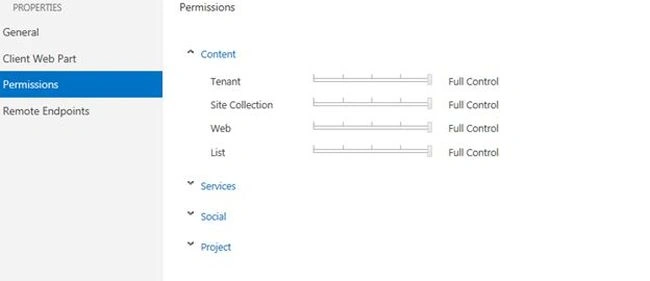
Step 2 : Navigate to the App.js file and copy the following code and paste it in.
Code
- 'use strict';
- var hostweburl;
- var appweburl;
- // This code runs when the DOM is ready and creates a context object which is
- // needed to use the SharePoint object model
- $(document).ready(function () {
- //Get the URI decoded URLs.
- hostweburl =
- decodeURIComponent(
- getQueryStringParameter("SPHostUrl"));
- appweburl =
- decodeURIComponent(
- getQueryStringParameter("SPAppWebUrl"));
- // Resources are in URLs in the form:
- // web_url/_layouts/15/resource
- var scriptbase = hostweburl + "/_layouts/15/";
- // Load the js file and continue to load the page with information about the list top level folders.
- // SP.RequestExecutor.js to make cross-domain requests
- // Load the js files and continue to the successHandler
- $.getScript(scriptbase + "SP.RequestExecutor.js", execCrossDomainRequest);
- });
- // Function to prepare and issue the request to get
- // SharePoint data
- function execCrossDomainRequest() {
- // executor: The RequestExecutor object
- // Initialize the RequestExecutor with the app web URL.
- var executor = new SP.RequestExecutor(appweburl);
- // Issue the call against the app web.
- // To get the title using REST we can hit the endpoint:
- // The response formats the data in the JSON format.
- // The functions successHandler and errorHandler attend the
- // sucess and error events respectively.
- executor.executeAsync(
- {
- url:
- appweburl +
- "/_api/SP.AppContextSite(@target)/web/ RegionalSettings?@target='" +
- hostweburl + "'",
- method: "POST",
- headers: { "Accept": "application/json; odata=verbose" },
- success: function (data) {
- alert("success: " + JSON.stringify(data));
- error: function (err) {
- alert("error: " + JSON.stringify(err));
- }
- }
- );
- }
- // This function prepares, loads, and then executes a SharePoint query to get
- // the current users information
- //Utilities
- // Retrieve a query string value.
- // For production purposes you may want to use
- // a library to handle the query string.
- function getQueryStringParameter(paramToRetrieve) {
- var params =
- document.URL.split("?")[1].split("&");
- for (var i = 0; i < params.length; i = i + 1) {
- var singleParam = params[i].split("=");
- if (singleParam[0] == paramToRetrieve)
- return singleParam[1];
- }
- }
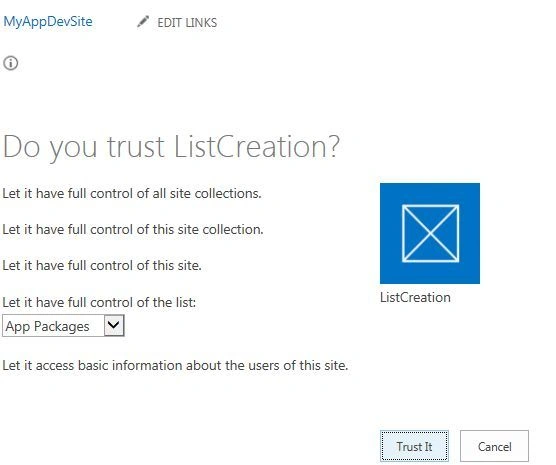
Step 3: When deploying, you will be prompted with the following screen. Press Trust it and proceed with the deployment.
Output
| WebInfo property | Description |
| Created | Gets a value that specifies when the site was created. |
| Description | Gets or sets the description for the site. |
| Id | Gets a value that specifies the site identifier. |
| Language | Gets a value that specifies the locale ID (LCID) for the language that is used |
| LastItemModifiedDate | Gets a value that specifies when an item was last modified in the site. |
| Title | Gets or sets the title for the site. |
| WebTemplateId | Gets the identifier of the site template. |
Code Walkthrough
- Post Method in REST API
IF-MATCH header
Provides a way to verify that the object being changed has not been changed since it was last retrieved. Or, lets you specify to overwrite any changes, as shown in the following example: "IF-MATCH":"*".
- Request Executor.JS
- 1. function execCrossDomainRequest() {
- 2. // executor: The RequestExecutor object
- 3. // Initialize the RequestExecutor with the app web URL.
- 4. var executor = new SP.RequestExecutor(appweburl); var metatdata = "{ '__metadata': { 'type': 'SP.Data.TestListListItem' }, 'Title': 'changelistitemtitle'}";
Summary
Join the conversation! Your thoughts help the community grow.