

View: View can be your Aspx page in your web applications or any user controls/Interface for the end user.
Model: Contains all the business logic.
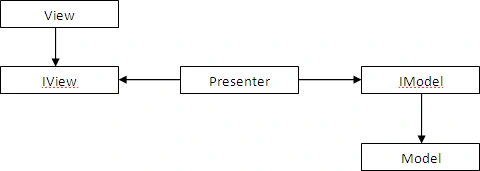
Presenter: Works as the intermediate agent for Model and View. It binds the view with the model. See the diagram below.

In the following diagram a couple of blocks are added which are interfaces through which the presenter will interact.
Let's take a simple example of how to implement it.
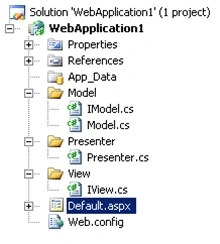
Create a web application project in your Visual Studio. Now add 3 more classes named View.cs, Presenter.cs and Model.cs and add the interfaces IView and IModel.
Start with the aspx page (View). Add a label, a button and a TextBox.
<html xmlns="http://www.w3.org/1999/xhtml" >
<head runat="server">
<title>Untitled Page</title>
</head>
<body>
<form id="form1" runat="server">
<div>
<asp:Label ID="Label1" runat="server" Text="Label"></asp:Label>
<asp:TextBox ID="TextBox1" runat="server"></asp:TextBox>
</div>
<asp:Button ID="Button1" runat="server" Text="Button" onclick="Button1_Click" />
</form>
</body>
</html>
Now we won't write anything in aspx.cs file. First write the code in IView.
namespace WebApplication1
{
public interface IView
{
String Label { get; set; }
String TextBox { get; set; }
}
}
Similarly write some code in IModel.cs
namespace WebApplication1
{
public interface IModel
{
List<String> setInfo();
}
}
Now Model.cs. Let's say we send the information about the Label and TextBox from Model.
namespace WebApplication1
{
class Model : IModel
{
public List<String> setInfo()
{
List<String> l = new List<string>();
l.Add("Enter Name:");
l.Add("Use capital letter only");
return l;
}
}
}
Now we need to write some code in the presenter so that the View and Model can communicate with each other. It'll go like this:
namespace WebApplication1
{
public class Presenter
{
IView _pView;
IModel _pModel;
public Presenter(IView PView, IModel PModel)
{
_pView = PView;
_pModel = PModel;\
}
public void BindModalView()
{
List<String> ls = _pModel.setInfo();
_pView.Label = ls[0];
_pView.TextBox = ls[1];
}
}
}
Finally go to aspx.cs and Implement the IView.
public partial class _Default : System.Web.UI.Page, IView
{
protected void Page_Load(object sender, EventArgs e)
{
}
#region IView Members
public string Label
{
get
{
return Label1.Text;
}
set
{
Label1.Text = value;
}
}
public string TextBox
{
get
{
return TextBox1.Text;
}
set
{
TextBox1.Text = value;
}
}
#endregion
Add an event for the button and write the code to get the data from Model through presenter and then bind it to the View. In the constructor of Presenter we passed "this" which means reference of the same aspx page.
protected void Button1_Click(object sender, EventArgs e)
{
Presenter p = new Presenter(this, new WebApplication1.Model());
p.BindModalView();
}
And you have implemented a small application with MVP pattern. Now I want to add a few more lines to show the advantage of adding IView and IModel interface. Using these interface your code will be more manageable and reusable. Moreover if you want to test your application you can create a TestProject and can use the IView and IModel for Mock Implementation. And unit test your application.
In the next part of this article I'll try to show you how to test this application using NUnit or any other tool like MockUp for Unit testing.
Hope this was helpful.
HariharanPosted Jul 28, 2021, 5:27 AM
Good work Amit Choudhary
hari KrishnanPosted Dec 20, 2017, 8:32 AM
Really very usefull article..smart work
Sr KarthigaPosted Feb 26, 2016, 9:12 AM
good one
Sr KarthigaPosted Feb 26, 2016, 9:12 AM
nice explanation
santosh menonPosted Jun 5, 2015, 6:39 AM
Good Work
Kopiraj YogarajahPosted Nov 20, 2013, 6:35 AM
Really very usefull article.. Thnxs Amit.. :)
karthick meiyappanPosted Jan 10, 2013, 8:05 AM
By using your above given sample i have the following erors on line 14.how to clear the errors.is anything to bind r not. Server Error in '/mvp sample project' Application. Compilation Error Description: An error occurred during the compilation of a resource required to service this request. Please review the following specific error details and modify your source code appropriately. Compiler Error Message: CS1721: Class '_Default' cannot have multiple base classes: 'System.Web.UI.Page' and 'Iview' Source Error: Line 12: using System.Xml.Linq; Line 13: Line 14: public partial class _Default : System.Web.UI.Page, Iview Line 15: { Line 16: protected void Page_Load(object sender, EventArgs e) Source File: c:\Users\mkarthik\Desktop\karthick worked projects\mvp sample project\Default.aspx.cs Line: 14 Show Detailed Compiler Output: Version Information: Microsoft .NET Framework Version:4.0.30319; ASP.NET Version:4.0.30319.272
Raju PatilPosted Aug 7, 2012, 2:44 AM
Nice article
Mohammad ArifPosted Jul 13, 2011, 12:58 AM
very good and simple example...But you should avoid to take modal on ASPX page..You can just use modal only on Presenter.only send View to presenter.
javed khanPosted Mar 10, 2011, 2:52 AM
Simple to understand..plzz come up with more on MVP.