

Why This Debate Matters Today
The AI industry is currently experiencing one of its most important architectural debates:
Should AI systems use a single powerful agent or multiple specialized agents?
Over the last two years, the market exploded with terms like:
• AI Agents
• Multi-Agent Systems
• Agentic AI
• Autonomous Workflows
• AI Employees
• AI Orchestration
• AI Native Enterprises
Every startup suddenly claims to have a “multi-agent platform.” Every framework promises autonomous intelligence. Every enterprise wants AI agents that can operate like digital employees.
But behind all the hype lies a much more important engineering question:
What architecture actually works in production?
This article explores the real-world differences between single-agent and multi-agent AI systems, where each architecture works best, the biggest technical challenges, and how AI-native companies are designing scalable systems in 2026.
What Is a Single-Agent AI System?
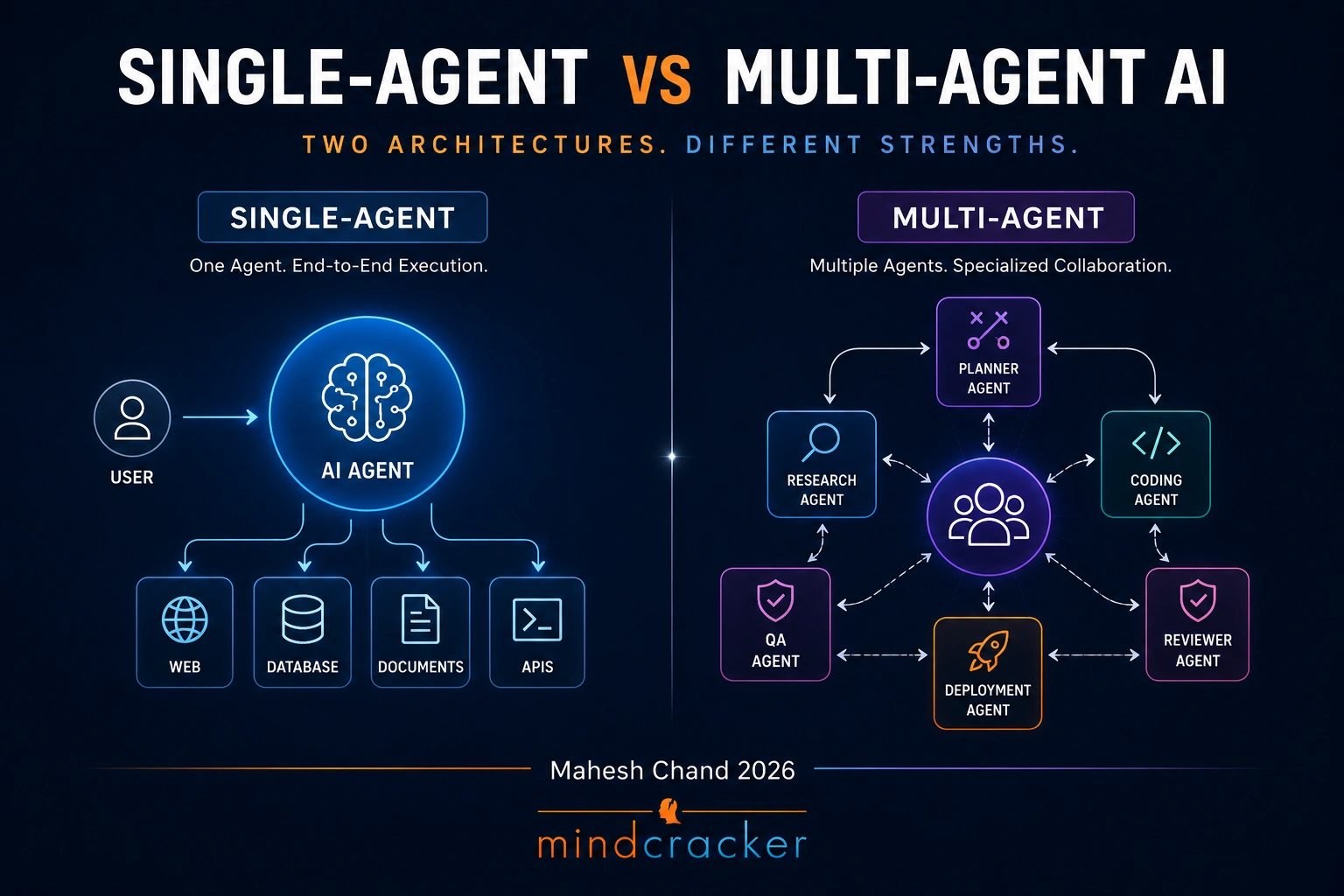
A single-agent AI system uses one central AI agent responsible for all reasoning, planning, memory management, tool usage, and execution. In simple terms, one AI brain handles everything.
The agent:
• Understands user intent
• Decides what to do
• Uses tools
• Retrieves knowledge
• Executes tasks
• Generates final outputs
Modern examples include:
• ChatGPT with tools
• Claude Code
• AI coding copilots
• AI assistants
• AI chat systems
• Internal enterprise copilots
A modern single-agent architecture often looks like this:
User → AI Agent → Tools/Memory/RAG → Response
The agent may use:
• APIs
• Databases
• Vector stores
• Browsers
• Code interpreters
• Search systems
• External applications
But the orchestration logic remains centralized. This architecture has become extremely popular because frontier AI models have become incredibly powerful. A single advanced LLM today can:
• Write production code
• Debug systems
• Analyze documents
• Generate architecture
• Create content
• Conduct research
• Call APIs
• Execute workflows
What previously required multiple systems can now often be handled by one highly capable orchestrator.
What Is a Multi-Agent AI System?
A multi-agent AI system consists of multiple specialized AI agents collaborating together. Instead of one general-purpose intelligence, the system distributes responsibilities across multiple agents.
For example:
• Planner Agent
• Research Agent
• Coding Agent
• QA Agent
• Security Agent
• Reviewer Agent
• Deployment Agent
Each agent focuses on a specialized responsibility.
A multi-agent workflow may look like this:
User Request → Planner Agent → Specialized Agents → Validation Agent → Final Output
This architecture resembles how real organizations operate. Instead of one employee handling everything, departments collaborate:
• Engineering
• Legal
• Finance
• Security
• Operations
• Compliance
This is one reason enterprises are becoming highly interested in multi-agent systems. They align naturally with organizational structures.
Why Multi-Agent AI Became Popular
The rise of multi-agent systems was driven by several trends.
1. Increasing Task Complexity
As enterprises began deploying AI into real workflows, single prompts became insufficient.
Complex tasks require:
• Research
• Planning
• Verification
• Compliance
• Validation
• Long execution chains
Splitting these responsibilities into specialized agents became attractive.
2. Specialization Improves Performance
A coding agent optimized for software development performs differently from a compliance agent optimized for legal reasoning.
Specialized agents can:
• Use different prompts
• Use different models
• Use different memory
• Use different tools
This often improves output quality.
3. Parallel Execution
Multi-agent systems can execute tasks simultaneously.
Example:
• One agent researches
• Another writes code
• Another validates security
• Another generates documentation
This creates scalability opportunities.
4. AI-Native Enterprise Vision
The long-term vision of AI-native enterprises involves digital AI workforces.
Organizations increasingly imagine:
• AI employees
• AI teams
• AI departments
• Autonomous operations
Multi-agent architecture fits naturally into this future.
Single-Agent vs Multi-Agent AI
The debate is not about which architecture is universally better.
The real question is:
Which architecture is appropriate for your level of complexity?
Here is the reality many startups learn too late:
Most AI applications do not need multi-agent systems.
This is becoming one of the biggest architectural realizations in 2026.
Single-Agent Advantages
Single-agent systems provide major benefits:
| Area | Advantage |
|---|---|
| Simplicity | Easier architecture |
| Speed | Lower latency |
| Cost | Fewer LLM calls |
| Maintenance | Easier debugging |
| Development | Faster iteration |
| Infrastructure | Simpler deployment |
| Reliability | Fewer coordination failures |
For startups and MVPs, these benefits are massive. A simple architecture usually wins early.
Multi-Agent Advantages
Multi-agent systems provide different strengths:
| Area | Advantage |
|---|---|
| Scalability | Better for large systems |
| Specialization | Expert-focused agents |
| Parallelism | Multiple tasks simultaneously |
| Governance | Easier responsibility separation |
| Enterprise Alignment | Mirrors departments |
| Modularity | Easier component replacement |
For large-scale enterprise systems, these capabilities become valuable.
Why Most Startups Should Start With Single-Agent AI
One of the biggest mistakes in modern AI engineering is premature multi-agent architecture. Startups often:
• Add too many agents
• Create unnecessary orchestration
• Increase token costs
• Slow systems down
• Make debugging impossible
Many founders are building “AI agent ecosystems” before validating whether users even need them. This creates massive technical debt. The winning approach in 2026 is:
Start simple.
A strong single-agent system with:
• Tool usage
• Memory
• RAG
• APIs
• Function calling
can solve most business problems surprisingly well.
In many cases:
One intelligent orchestrator beats five poorly coordinated agents.
The Hidden Costs of Multi-Agent AI
Multi-agent systems look impressive in demos. Production is a different story.
Token Explosion
Every agent interaction generates additional LLM calls. Costs increase rapidly:
• Agent-to-agent communication
• Validation loops
• Retry chains
• Context synchronization
A workflow that required one LLM call may suddenly require twenty.
Latency Problems
More agents usually means:
• More waiting
• More coordination
• More communication overhead
This increases response times significantly.
Debugging Complexity
Debugging multi-agent systems is extremely difficult.
Questions become hard to answer:
• Which agent failed?
• Which context was wrong?
• Which reasoning path caused hallucination?
• Which agent modified memory?
Observability becomes a major engineering challenge.
Infinite Loops
One of the most common production failures:
Agents continuously delegate work to each other.
Example:
Planner → Reviewer → Planner → Reviewer
Without strong orchestration rules, systems can spiral indefinitely.
Memory Synchronization
Different agents often maintain inconsistent views of reality.
This causes:
• Contradictory outputs
• Inconsistent reasoning
• Duplicate work
• Hallucinations
Shared memory systems become critical.
AI Workflows vs Multi-Agent AI
This is one of the most misunderstood areas in AI today. Many systems marketed as “multi-agent AI” are actually just AI workflows. These are not the same thing.
AI Workflow
An AI workflow follows predefined execution paths.
Example:
Step 1 → Step 2 → Step 3
Characteristics:
• Deterministic
• Predictable
• Easier debugging
• Lower risk
Examples:
• Lead qualification
• Document summarization
• Email automation
• Ticket routing
Multi-Agent AI
True multi-agent systems involve autonomous collaboration.
Agents:
• Make independent decisions
• Delegate tasks
• Coordinate dynamically
• Adapt execution paths
This creates much higher complexity. Understanding this distinction is critical when evaluating AI platforms.
Enterprise Use Cases for Multi-Agent AI
While many startups overuse multi-agent systems, enterprises often genuinely need them.
Healthcare AI
Healthcare workflows involve:
• Compliance
• PHI protection
• Auditability
• Clinical reasoning
• Insurance validation
Example agent architecture:
• Intake Agent
• Clinical Summary Agent
• Compliance Agent
• PHI Protection Agent
• Billing Agent
• Audit Agent
This separation improves governance and safety.
Financial Services
Financial AI systems often require:
• Risk analysis
• Fraud detection
• Regulatory compliance
• Audit logging
Multi-agent structures help isolate responsibilities.
Software Engineering
AI-native development platforms increasingly use:
• Planning agents
• Coding agents
• QA agents
• Security agents
• Deployment agents
This mirrors real engineering organizations.
Popular Multi-Agent Frameworks
The ecosystem is evolving rapidly.
LangGraph
One of the most popular enterprise frameworks.
Strengths:
• Stateful orchestration
• Graph-based workflows
• Human-in-the-loop support
• Strong observability
CrewAI
Popular for:
• Collaborative agent systems
• Simple agent role definitions
• Rapid experimentation
AutoGen
Developed for:
• Multi-agent conversations
• Research workflows
• Autonomous collaboration
OpenAI Agents SDK
OpenAI’s emerging framework focuses on:
• Agent orchestration
• Tool calling
• Memory integration
• Enterprise workflows
Semantic Kernel
Microsoft’s framework integrates:
• AI orchestration
• Plugins
• Memory
• Enterprise tooling
OpenClaw
OpenClaw focuses on:
• AI-native automation
• AI workflows
• Multi-agent orchestration
• Enterprise AI systems
The Rise of AI-Native Architecture
The future of AI systems is not simply “chatbots with APIs.” We are entering the era of AI-native architecture. AI-native systems are designed with AI as a core operating layer, not an add-on feature.
Characteristics include:
• AI-first workflows
• Autonomous orchestration
• Agent collaboration
• Continuous learning
• Human-in-the-loop governance
• Multi-model intelligence
• Adaptive execution
This changes how software itself is designed. Traditional architecture:
UI → Business Logic → Database
AI-native architecture:
Human → AI Orchestrator → Specialized Intelligence Layers → Dynamic Execution
This shift is enormous.
The Best AI Architecture Strategy in 2026
The most successful AI-native companies follow a staged evolution model.
Stage 1: Single Agent
Start with:
• One orchestrator
• Tool usage
• Prompt engineering
Goal:
Validate the use case.
Stage 2: Add Memory and RAG
Add:
• Long-term memory
• Retrieval systems
• Knowledge bases
Goal:
Increase intelligence.
Stage 3: Planner + Executor
Split responsibilities:
• Planning agent
• Execution agent
Goal:
Improve workflow reliability.
Stage 4: Specialized Agents
Introduce:
• Reviewer agents
• Security agents
• Compliance agents
Goal:
Handle scale and governance.
Stage 5: AI Ecosystem
Create:
• AI departments
• Autonomous orchestration
• AI-native enterprise systems
Goal:
Large-scale AI operations. This gradual evolution prevents overengineering.
Human-in-the-Loop Still Matters
One dangerous misconception is that multi-agent systems eliminate humans. Reality says otherwise. The most successful enterprise AI systems still rely heavily on:
• Human approvals
• Human supervision
• Human validation
• Governance layers
Especially in:
• Healthcare
• Finance
• Legal
• Government
Fully autonomous systems remain risky. Human-in-the-loop architecture is becoming a major enterprise design principle.
Security Challenges in Multi-Agent Systems
Security becomes dramatically harder with multiple agents.
Increased Attack Surface
Each agent may have:
• Tools
• APIs
• Permissions
• External access
This increases vulnerability exposure.
Prompt Injection Risks
One compromised agent can poison:
• Shared memory
• Other agents
• Workflow execution
Data Leakage
Improper context sharing can expose:
• PHI
• Financial records
• Customer data
• Intellectual property
Security isolation becomes critical.
Observability Is the Next Big Challenge
As AI systems become more autonomous, observability becomes essential.
Organizations need visibility into:
• Which agent made decisions
• Why decisions occurred
• Which prompts were used
• Which tools executed
• Which memory influenced reasoning
This is creating an entirely new category of AI infrastructure tools.
The future AI stack will include:
• AI observability
• AI governance
• AI monitoring
• Agent tracing
• Decision auditing
The Future of AI Agents
The future is bigger than chatbots.
We are moving toward:
• AI employees
• AI coworkers
• AI-native enterprises
• Autonomous digital organizations
Future enterprises may operate with:
• 100 human employees
• 10,000 AI agents
Departments may eventually include:
• AI marketing teams
• AI engineering teams
• AI support teams
• AI compliance departments
This transformation will reshape software, business operations, and the global workforce.
Final Thoughts
The future is not Single-Agent versus Multi-Agent. The future is adaptive AI architecture.
Successful systems will:
• Start simple
• Evolve gradually
• Introduce complexity only when necessary
• Balance autonomy with governance
• Combine humans and AI intelligently
The most important lesson for builders in 2026 is this:
Do not build complexity for hype. Build intelligence for outcomes.
Many companies today are building elaborate multi-agent systems nobody actually needs.
Meanwhile, some of the most successful AI-native products rely on one exceptionally capable orchestrator agent with strong tooling, memory, and retrieval. The winning strategy is not maximum agents. The winning strategy is the right architecture at the right stage of growth.
As AI-native systems mature, we will likely see:
• Hybrid architectures
• Dynamic agent spawning
• Model specialization
• AI operating systems
• Autonomous enterprise ecosystems
This is only the beginning.
The next decade will redefine how software, businesses, and organizations are built. AI agents will not simply assist applications. They will become the operating layer of the modern enterprise.
🚀 Ready to Build AI-Native Systems?
At Mindcracker Inc., we help startups and enterprises design, architect, and build AI-native platforms powered by AI agents, GenAI, LLMs, and autonomous workflows.
From single-agent copilots to enterprise-grade multi-agent ecosystems, our team helps organizations:
• Design AI-native architecture
• Build AI agents and autonomous workflows
• Develop secure enterprise AI systems
• Integrate RAG, memory, and orchestration frameworks
• Optimize LLM performance and AI infrastructure costs
• Build healthcare, fintech, and enterprise AI platforms
• Modernize existing applications into AI-native systems
Whether you're building:
• AI copilots
• AI automation platforms
• AI-native SaaS products
• Agentic enterprise systems
• Multi-agent orchestration platforms
• AI-powered developer tools
Mindcracker can help you move from idea to production faster.
💡 Explore AI-Native Consulting & Development
• Mindcracker AI Services
• C# Corner Consulting
• Contact Mindcracker
About the Author
Mahesh Chand is a technology visionary, AI Native Architect, founder of C# Corner, and advisor to startups and enterprises building next-generation AI-native systems, AI agents, and enterprise AI platforms.
Join the conversation! Your thoughts help the community grow.