

AI agents have moved from academic research into the center of modern software. They power customer service bots, research tools, coding assistants, workflow automation, and the emerging generation of autonomous digital workers. Yet most people still don’t understand what actually happens inside an AI agent. What makes it “agentic”? What gives it the ability to think, plan, and act instead of simply answering a question?
This breakdown walks through the complete internal workflow of an AI agent in a clear, human way. By the end, you’ll understand every stage of how an agent gathers information, reasons about it, decides what to do, uses tools, remembers context, and learns from outcomes.
The Foundation of Agentic Behavior 🧠
An AI agent isn’t just a large language model responding to a prompt. It is a system built around a continuous loop. That loop lets the agent move toward a goal instead of stopping after one answer.
The agentic loop can be summarized as
Observe → Think → Plan → Act → Reflect → Repeat
This cycle is what makes an AI agent capable of handling complexity, uncertainty, and multi step tasks.
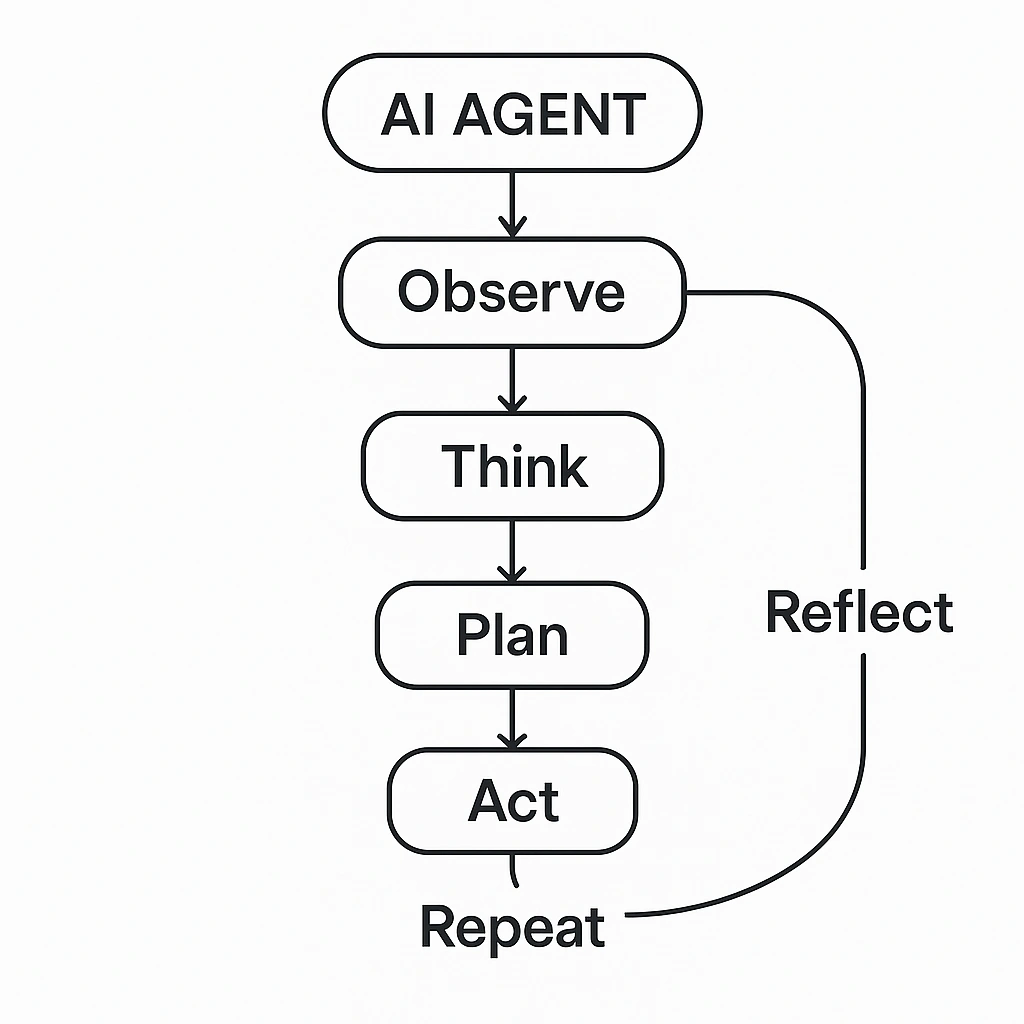
Let’s break down each stage in depth.
Observation The Agent’s Window to the World 👀
Everything starts with input. The agent must first “see” what is happening. This observation could come from a user message, a database, an API, a set of documents, sensor data, browser content, or even a multi agent environment.
A well designed agent doesn’t get flooded with unnecessary data, yet also doesn’t operate blind. The quality of observation directly impacts the quality of the agent’s decisions. If the input is incomplete, outdated, or noisy, the agent is forced to guess, and that leads to errors.
Clean context is the doorway to intelligent behavior.
Thinking How the Agent Reasons About the Situation 💡
Once the agent observes the context, it begins thinking. This is where the large language model performs reasoning, analysis, and decomposition of the task. The model evaluates constraints, weighs possibilities, interprets goals, and decides what information is missing.
Thinking isn’t random. It is structured.
The agent may reflect on previous steps, test assumptions, or retrieve knowledge from memory. This is where the power of LLM reasoning really shines. Guided correctly, the model can break down a complex challenge into solvable pieces, just like a human problem solver.
Planning The Blueprint for Action 🗺️
After the agent has reasoned through the situation, it must create a plan. This is the moment where the agent becomes “agentic.”
Instead of producing an answer, it produces a sequence of future actions.
A plan may include
Gathering more information
Running calculations
Searching documents
Calling external tools
Summarizing data
Producing a final result
Good planning allows the agent to stay organized through multi step tasks. In enterprise settings, this is where conditional logic emerges. If a search fails, switch to a fallback method. If user intent changes, update the plan. If a compliance rule is triggered, adjust the path.
Agent frameworks such as LangGraph, AutoGen, CrewAI, Semantic Kernel, and others specialize in stabilizing and structuring this planning layer.
Action Where the Agent Interacts With the Real World ⚙️
This is one of the most important stages. An agent isn’t useful unless it can take real actions.
Actions happen through tools.
A tool might be an API, a database query, a function, a browser automation step, a vector search, or a code interpreter.
Tools allow the agent to:
Fetch information
Make updates
Trigger workflows
Execute tasks
Transform data
Communicate with other systems
The agent decides which tool to call, formulates parameters, validates the output, and brings that new information back into the reasoning cycle.
This is where intelligent software becomes operational.
Memory The Agent’s Ongoing Knowledge 📚
Memory separates weak agents from powerful ones.
There are two main forms of memory
Short term memory holds the current task context.
Long term memory stores documents, conversations, facts, past actions, and personalized preferences.
A strong memory system:
Reduces hallucinations
Improves accuracy
Keeps the agent on track
Allows personalization
Supports multi day or multi week tasks
Without memory, the agent forgets everything after each turn. With memory, the agent evolves.
Reflection How the Agent Learns and Self-Corrects 🔁
An agent is not done after performing an action. It evaluates the result. Did the action move it closer to its goal? Did it generate errors? Does the plan need adjustment?
Reflection prevents runaway loops and bad decisions. More advanced systems use reflection to improve long term behavior, refine patterns, or avoid repeating mistakes.
This step is why some agents feel increasingly smarter the longer they run.
The Continuous Agent Loop 🔄
The magic happens when you connect all stages together.
The AI agent observes new information, thinks again, replans if necessary, calls more tools, updates memory, reflects on progress, and continues the cycle.
This loop can run a handful of times or hundreds of times depending on the complexity of the task. Everything from booking travel to analyzing financial documents to writing production code relies on this repeating pattern.
Why This Workflow Matters for the Future of AI 🚀
Understanding how AI agents work is no longer optional. Every major tech company is moving toward agentic systems because they mirror how real work gets done. Humans don’t stop after one instruction; they operate in loops, using tools, adapting, and learning.
Agents are now being deployed in
Customer support
Healthcare administration
Software engineering
IT operations
Finance and accounting
Legal research
Retail automation
Business analytics
The agent workflow is becoming the new execution engine for modern businesses.
Final Thoughts 🌟
AI agents aren’t magic. They follow a clear, structured, intelligent loop that mirrors human problem solving. When you understand how an agent observes, thinks, plans, uses tools, remembers, and reflects, you gain the ability to design better, safer, and more powerful systems.
The shift toward agentic AI is one of the biggest transformations in software since the rise of web and mobile apps. The organizations that master this workflow will lead the next era of automation and intelligence.
Start Building Now
Here are some of the detailed tutorials to get started with AI Agents:
Join the conversation! Your thoughts help the community grow.