


By the end of 2025, it was clear that the technology industry had crossed several quiet but meaningful thresholds. This was not a year of flashy paradigm shifts or sudden revolutions. Instead, 2025 was the year many long-running trends stopped being optional and became structural.
Artificial intelligence moved from experimentation to infrastructure. Cloud strategies matured, and in many cases, reversed. Hardware constraints reasserted themselves after a decade of abstraction. Security teams adjusted to an environment where breaches were assumed, not exceptional. And software development workflows changed in subtle but lasting ways.
This article is a technical year-in-review of 2025, aimed at engineers, architects, IT leaders, and students who want to understand what actually changed beneath the surface, how those changes affected real systems, and what they mean for the next phase of technical work.
Artificial Intelligence in 2025: From Models to Infrastructure

Foundation models stabilized, but inference became the real battleground
By 2025, foundation models themselves were no longer the primary differentiator. Large language models, multimodal models, and domain-specific fine-tuned systems reached a point of relative parity in raw capability. The industry focus shifted away from headline parameter counts toward inference efficiency, latency, and cost per request.
Teams learned quickly that model quality mattered less than how reliably and affordably that model could be served. Techniques like quantization, speculative decoding, model distillation, and caching moved from research papers into production pipelines. Running a strong model poorly was no longer acceptable.
This shift exposed a gap between teams that understood machine learning as a system and those that treated models as APIs. Organizations that invested early in inference optimization saw dramatic cost reductions and higher reliability, while others struggled with unpredictable bills and degraded performance under load.
AI infrastructure decisions became architectural, not experimental
AI infrastructure in 2025 forced hard choices. GPUs remained essential for training, but inference workloads increasingly moved to a mix of GPUs, specialized accelerators, and emerging NPUs. Cloud providers expanded their offerings, but availability constraints and pricing volatility pushed many organizations to reconsider on-prem or hybrid deployments.
Enterprises using platforms from NVIDIA, AMD, and custom accelerators from hyperscalers found that hardware selection directly influenced model architecture and deployment patterns. AI was no longer portable in practice, even if it was in theory.
As a result, AI teams began working much more closely with infrastructure and platform engineers. Decisions about memory bandwidth, interconnects, and scheduling had immediate downstream effects on application behavior.
Enterprise AI finally integrated with existing systems
The biggest AI change in 2025 was not technical novelty but integration. AI systems stopped living in isolated demos and started embedding themselves into ERP systems, customer support platforms, security tooling, and developer workflows.
This exposed long-ignored issues: data quality, access control, auditability, and failure modes. Enterprises learned that AI systems inherit the worst characteristics of the systems they sit on top of. Poor identity management, inconsistent data pipelines, and brittle APIs limited the usefulness of even the best models.
Teams that succeeded treated AI as another distributed system with strict SLOs, observability, and rollback plans. Teams that did not found themselves firefighting hallucinations, silent failures, and trust erosion from users.
Regulation forced discipline, not paralysis
2025 was also the year when AI regulation became unavoidable. Compliance requirements around data usage, explainability, and risk management forced organizations to formalize governance structures that many had delayed.
Rather than slowing innovation, this often clarified responsibilities. Security reviews, model documentation, and audit trails became standard parts of deployment. The strongest organizations used compliance as a forcing function to improve engineering rigor instead of treating it as a legal afterthought.
Cloud Computing, DevOps, and Platform Engineering
Cloud architecture patterns matured and narrowed
The cloud in 2025 was less about experimentation and more about standardization. After years of architectural sprawl, many organizations consolidated around fewer patterns that balanced flexibility with operational sanity.
Microservices remained common, but fewer teams pursued extreme service decomposition. Coarser-grained services, async messaging, and event-driven designs proved easier to operate at scale. The industry quietly acknowledged that not every system benefited from maximal modularity.
Multi-cloud strategies also became more selective. Rather than abstracting everything, teams identified which workloads truly needed portability and which benefited from provider-specific optimizations.
Platform engineering became a core function
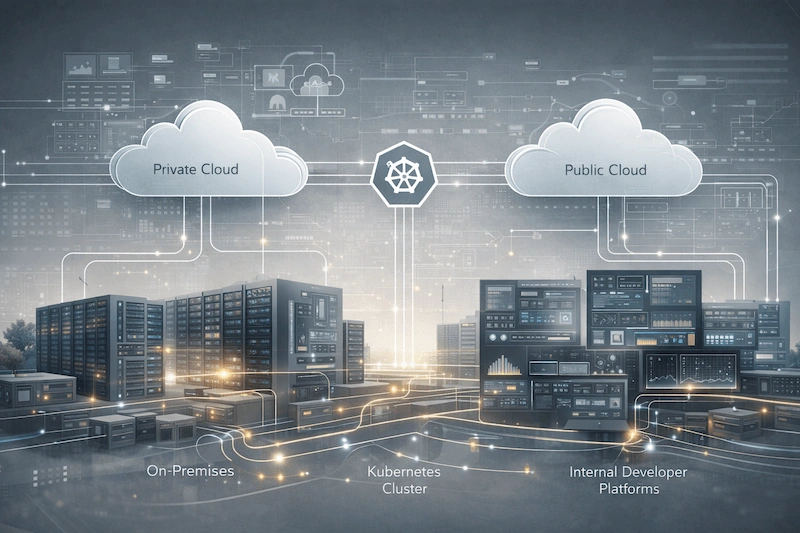
Internal developer platforms moved from trend to necessity. By 2025, organizations that lacked a clear platform strategy struggled to onboard developers, manage security, or control costs.
Kubernetes remained central, but fewer developers interacted with it directly. Platform teams provided opinionated workflows, paved roads, and self-service tooling that reduced cognitive load. The goal shifted from flexibility to throughput and reliability.
This change also reshaped DevOps culture. The idea that “everyone owns everything” gave way to clearer boundaries between product teams and platform teams, without returning to old silos.
Cost control and observability drove architectural decisions
After years of cheap capital masking inefficiencies, 2025 forced organizations to confront cloud economics. FinOps practices became embedded in design reviews, not retroactive cost reports.
Observability tooling matured beyond metrics dashboards. Teams correlated cost, performance, and reliability data to understand trade-offs in real time. Architecture decisions increasingly started with the question, “What will this cost to run at scale?”
In many cases, this led to deliberate moves away from cloud-first thinking. Latency-sensitive or predictable workloads often moved closer to users or back on-prem, while bursty or experimental systems stayed in the cloud.
Cybersecurity in 2025: Threats, Defense, and Automation

The threat landscape assumed compromise
By 2025, most security teams planned as if breaches were inevitable. Ransomware, supply chain attacks, and credential theft continued to evolve, but the biggest change was psychological. Detection and response mattered more than prevention alone.
This mindset shift led to greater emphasis on blast-radius reduction, segmentation, and recovery time. Backups, incident drills, and cross-team coordination received renewed attention.
Identity replaced the network perimeter
Zero trust architectures matured, but not as a single product or framework. Instead, identity became the primary security control across cloud, SaaS, and on-prem systems.
Strong authentication, continuous authorization, and device posture checks became table stakes. Organizations that treated identity as infrastructure rather than an IAM tool fared far better under attack.
AI-driven security tools helped, but did not replace expertise
Security vendors heavily promoted AI-powered detection and response in 2025. In practice, these tools improved signal-to-noise ratios and reduced manual triage, but they did not eliminate the need for skilled analysts.
Teams learned that automation amplified existing processes. Well-designed incident workflows benefited from AI assistance. Poorly defined processes simply failed faster.
High-impact incidents reinforced fundamentals
Several widely publicized breaches in 2025 traced back to familiar failures: exposed credentials, misconfigured storage, and unpatched dependencies. The lesson was not that defenses were inadequate, but that basics were still unevenly applied.
The most resilient organizations were not those with the most advanced tooling, but those with disciplined patching, logging, and access review practices.
Hardware and Semiconductors: Powering Modern Workloads

CPUs, GPUs, and accelerators diverged further
Hardware mattered again in 2025 because workloads demanded it. General-purpose CPUs continued to improve incrementally, but performance gains increasingly came from specialization.
GPUs dominated AI workloads, while domain-specific accelerators handled inference, networking, and storage offload. This fragmentation forced software teams to think explicitly about hardware capabilities rather than assuming uniform compute.
Edge and embedded systems gained strategic importance
Latency, bandwidth, and privacy concerns pushed more computation toward the edge. Manufacturing, healthcare, and telecom systems increasingly processed data locally, sending only aggregated results upstream.
This trend blurred the line between IT and OT. Engineers needed to understand constrained environments, real-time requirements, and long hardware lifecycles.
Energy efficiency constrained design choices
Power and cooling became first-order concerns in 2025. Data centers faced real limits, and energy efficiency influenced hardware selection and deployment density.
This reality forced trade-offs. Teams optimized for performance per watt rather than raw throughput. Software efficiency regained importance after years of hardware-driven gains.
Software Development Trends That Defined 2025

Language momentum favored stability over novelty
Programming language trends in 2025 favored mature ecosystems. Languages with strong tooling, predictable performance, and long-term support gained ground.
Rather than chasing new languages, teams focused on improving build systems, dependency management, and testing practices. The productivity gains came from consistency, not novelty.
Frameworks and runtimes emphasized observability and resilience
Application frameworks increasingly baked in metrics, tracing, and fault tolerance. Developers expected visibility into system behavior by default.
This shift reduced the gap between development and production environments. Failures were easier to reproduce, understand, and fix.
AI-assisted development changed workflows, not fundamentals
AI coding tools became widely used in 2025, but their impact was uneven. They accelerated boilerplate generation, test creation, and refactoring, but did not eliminate the need for design judgment.
The biggest productivity gains came from experienced developers who knew how to guide and validate AI output. For less experienced developers, the risk of subtle errors increased.
Teams adapted by strengthening code review practices and emphasizing architectural understanding over syntax memorization.
Testing and deployment became more continuous
CI/CD pipelines in 2025 blurred the line between development and operations. Feature flags, canary deployments, and automated rollback became standard for many teams.
This reduced release anxiety but increased the importance of monitoring and incident response. Shipping faster only helped if teams could see and react to failures quickly.
Data Engineering, Databases, and Analytics
Data platforms consolidated around fewer tools
After years of data stack sprawl, many organizations simplified in 2025. Instead of assembling dozens of specialized tools, teams chose integrated platforms that handled ingestion, transformation, storage, and analytics.
This consolidation reduced operational overhead but required clearer data ownership and governance.
Streaming and real-time analytics became default expectations
Batch processing did not disappear, but real-time data became the norm for user-facing and operational systems. Streaming pipelines fed dashboards, alerts, and AI models with minimal delay.
This increased complexity in data engineering, especially around state management and failure handling.
Governance and data quality limited AI effectiveness
Organizations learned that AI systems magnified data problems. Poor labeling, inconsistent schemas, and undocumented assumptions led to unreliable outputs.
As a result, data quality and governance received renewed investment. Clear contracts between producers and consumers became essential.
Cost management shaped data architecture
Storing and processing data at scale in 2025 was expensive. Teams actively managed retention policies, query efficiency, and storage tiers.
Data architecture decisions increasingly balanced analytical flexibility with predictable cost.
Networking, Edge Computing, and Connectivity

5G matured and early 6G research began
By 2025, 5G was no longer experimental. Its real impact came from predictable latency and higher device density rather than headline speeds.
Early 6G research focused on ultra-low latency and integrated sensing, but production impact remained years away.
Edge workloads demanded new networking models
Distributed systems spanning cloud, edge, and on-prem environments stressed traditional networking assumptions. Service discovery, traffic management, and security had to work across heterogeneous environments.
This drove adoption of software-defined networking and more programmable network infrastructure.
Enterprise networking adapted to distributed work
Hybrid work patterns persisted in 2025, forcing enterprises to rethink connectivity. Secure access to internal systems from anywhere became a baseline requirement, not an exception.
Regulation, Ethics, and Governance in Tech

AI deployment faced concrete constraints
Regulatory frameworks introduced in and before 2025 imposed real requirements on AI systems. Documentation, auditability, and human oversight were no longer optional.
Organizations that planned for these constraints early integrated them into system design. Others faced costly retrofits.
Data privacy rules influenced architecture
Cross-border data movement, retention policies, and user consent requirements affected system design at a fundamental level.
Engineering teams worked more closely with legal and compliance functions, not to slow delivery, but to avoid rework.
Governance became a technical discipline
Governance in 2025 was not just policy. It was implemented through tooling, access controls, and automated checks.
This reduced ambiguity and made compliance verifiable rather than aspirational.
What 2025 Set in Motion
Looking back, 2025 was less about breakthroughs and more about commitments. Technologies that had lingered in optional or experimental status became foundational.
AI became infrastructure, not a feature. Cloud became a set of trade-offs, not a default. Hardware constraints reshaped software design. Security assumed failure rather than perfection.
Many of these changes are permanent. The next phase of system design will emphasize efficiency, resilience, and integration over novelty.
For professionals and students, the most valuable skills are not tied to specific tools. They include systems thinking, understanding trade-offs, and the ability to work across layers, from hardware to application logic to governance.
2025 did not redefine technology overnight. It quietly reset expectations. And those expectations will shape how we build, operate, and secure systems for years to come.
Join the conversation! Your thoughts help the community grow.