

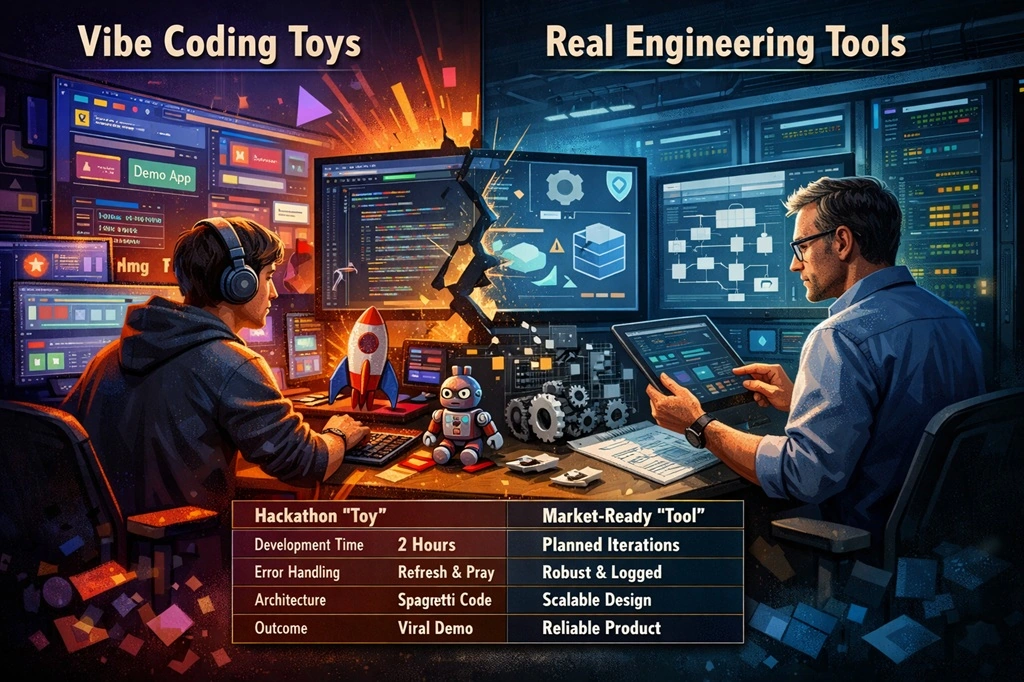
There is a seductive energy in watching a developer "vibe" a project into existence. Whether it’s a 48-hour hackathon or a viral video, the screen is a blur of AI-native IDEs, rapid UI generators, and API connectors. By the end of the session, they’ve produced a "tool" that looks like a billion-dollar startup.
It is exciting, but we need to stop being fooled. Vibe coding is not software engineering. Without professional prompt engineering and architectural literacy, you aren't building market-ready applications; you are just playing with high-fidelity toys that show potential, but lack substance.
1. The "Aesthetic Gap": Why it Looks Like a Tool but Acts Like a Toy
Modern AI-native development environments and frontend generators are masters of the Happy Path. They can generate a stunning dashboard with mock data in minutes. However, a Real-Life Application is defined by what happens when things go wrong.
The Edge Cases: How does the "vibe-coded" app handle a gateway timeout or a partial database write?
State Management: Does the UI stay in sync when multiple background tasks update the same record?
Security & Compliance: Did the AI accidentally expose a secret key because it "just wanted to make it work"?
In a hackathon, if the demo works once, it’s a success. In the market, if it fails once, you lose a customer. Without professional oversight, you aren't building a tool; you're building a mirage that breaks under the weight of its first thousand users.
2. The Tooling Trap: Accelerators are Not Architects
Modern development accelerators and AI models are power-tools, but a power-drill doesn't make you an architect.
The Vibe Coder lets the tool dictate the architecture. They accept the first folder structure the AI suggests, leading to "spaghetti-in-a-suit"—a beautiful frontend hiding a backend that is impossible to maintain, scale, or secure.
The Professional Engineer uses these tools to execute a pre-defined strategy. They enforce design patterns (like Repository or Factory patterns), mandate strict typing, and ensure the database schema is normalized for scale, not just for the next ten minutes.
"If you can’t explain the architectural trade-offs of the code your AI just wrote, you don't own the product—the model does."
3. Implementation vs. "Messing Around"
Building for the market requires Systems Thinking, which is 20% coding and 80% architecture. Vibe coding focuses entirely on the 20%. Real-world tools require:
Observability: How do you debug a "vibe" when it fails in production at 3:00 AM?
Migration Paths: Can your AI-generated database schema evolve without losing user data?
Performance: AI often writes "readable" code that might have $O(n^2)$ complexity, killing your server costs as you scale.
4. Professional Prompting is the New Compiler
To move from "messing around" to "implementing products," one must treat the prompt as the new high-level language. If you aren’t a professional prompt engineer, you are effectively "messing around" with digital Legos. Professional implementation requires:
Chain-of-Thought (CoT) structures to ensure logical consistency across the full stack.
Context Window Management: Knowing exactly what metadata to feed the model to prevent "forgetting" core requirements as the codebase grows.
Agentic Orchestration: Using multiple specialized AI agents to check each other’s work—one for business logic, one for security, and one for UI state.
Summary: Tools vs. Toys
| Feature | The Hackathon "Toy" | The Market-Ready "Tool" |
| Development Time | 2 Hours (The "Vibe") | Intentional Iterations |
| Logic | "Whatever works now" | Scalable & Decoupled Architecture |
| Error Handling | Non-existent (Refresh on crash) | Resilient and logged |
| Outcome | Viral Demo / Potential | Market-Ready Asset / Reliability |
Conclusion: Stop the Foolery
We must celebrate the potential of young developers without lying to them about the maturity of their output. Developing a "toy" in a couple of hours is a great way to learn, but it is not "implementing a product."
The market doesn't pay for "vibes"; it pays for reliability. Do not fool yourself, and do not fool them. If you want to build for the real world, trade the "vibe" for precision. Stop playing with toys and start engineering systems.
Bohdan StupakPosted Mar 25, 2026, 2:58 PM
This is an interesting take on the fact that the system requires more than just a code that "seems to work" to become really mature. However, I'd love to hear what solutions you offer, as it seems that vibe coding doesn't go nowhere, and we have somehow integrate AI generated code, to make it robust, scalable, observable etc.