

Threading with Monitor
A monitor is a mechanism for ensuring that only one thread at a time may be running a certain piece of code (critical section). A monitor has a lock, and only one thread at a time may acquire it. To run in certain blocks of code, a thread must have acquired the monitor. A monitor is always associated with a specific object and cannot be dissociated from or replaced within that object.
Monitor has the following features:
- It is associated with an object on demand.
- It is unbound, which means it can be called directly from any context.
- An instance of the Monitor class cannot be created.
The following information
is maintained for each synchronized object:
- A reference to the thread that currently holds the lock.
- A reference to a ready queue, which contains the threads that are ready to obtain the lock.
- A reference to a waiting queue, which contains the threads that are waiting for notification of a change in the state of the locked object.
Monitor Class
The Monitor Class Provides a mechanism that synchronizes access to objects. The Monitor class is a collection of static methods that provides access to the monitor associated with a particular object, which is specified through the method's first argument. the class provide following method.
- Monitor.Enter() : Acquires an exclusive lock on the specified object. This action also marks the beginning of a critical section.
- Monitor.Exit() : Releases an exclusive lock on the specified object. This action also marks the end of a critical section protected by the locked object.
- Monitor.Pules() : Notifies a thread in the waiting queue of a change in the locked object's state.
- Monitor.Wait() : Releases the lock on an object and blocks the current thread until it reacquires the lock.
- Monitor.PulesAll() : Notifies all waiting threads of a change in the object's state.
- Monitor.TryEnter() : Attempts to acquire an exclusive lock on the specified object.
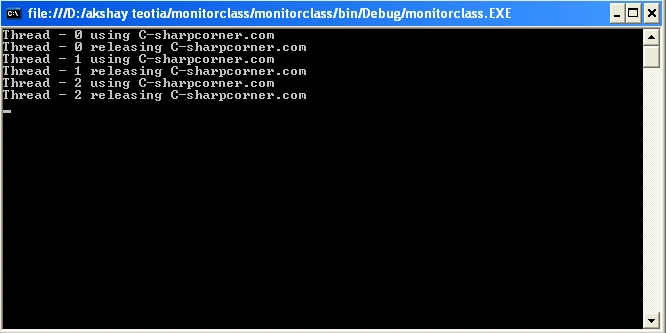
In the following example we have three threads which are trying to write a file (akshay.txt). Basically each thread will wait until the locker object gets released by the first thread that achieved a lock, before it attempts to write to our file.
using
System;
using System.IO;
using
System.Threading;
namespace
monitorclass
{
class Program
{
static object
locker = new object();
static void
ThreadMain()
{
Thread.Sleep(800); // Simulate Some work
WriteToFile(); // Access a shared resource / critical
section
}
static void
WriteToFile()
{
String ThreadName =
Thread.CurrentThread.Name;
Console.WriteLine("{0}
using C-sharpcorner.com", ThreadName);
Monitor.Enter(locker);
try
{
using (StreamWriter
sw = new
StreamWriter(@"D:\akshaydata\akshay.txt",
true))
{
sw.WriteLine(ThreadName);
}
}
catch (Exception
ex)
{
Console.WriteLine(ex.Message);
}
finally
{
Monitor.Exit(locker);
Console.WriteLine("{0}
releasing C-sharpcorner.com", ThreadName);
}
}
static void
Main(string[] args)
{
for (int
i = 0; i < 3; i++)
{
Thread thread =
new Thread(new
ThreadStart(ThreadMain));
thread.Name = String.Concat("Thread
- ", i);
thread.Start();
}
Console.Read();
}
}
}
Output
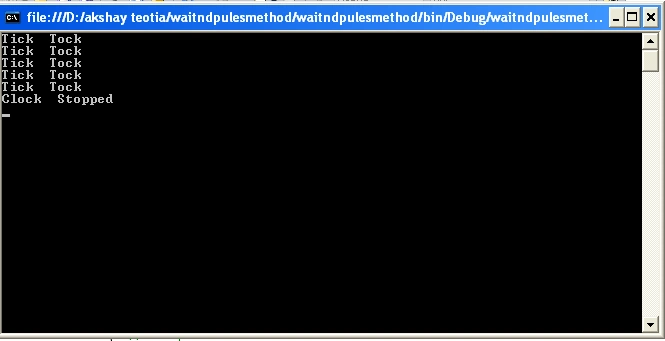
Use Wait() and Pulse() to create a ticking clock
Monitor.Wait() is used to Releases the lock on an object in order to permit other threads to lock and access the object. The calling thread waits while another thread accesses the object. Pulse signals are used to notify waiting threads about changes to an object's state.
using
System;
using
System.Threading;
namespace
waitndpulesmethod
{
class TickTock
{
public void
tick(bool running)
{
lock (this)
{
if (!running)
{ // stop the clock
Monitor.Pulse(this);
// notify any waiting threads
return;
}
Console.Write("Tick ");
Monitor.Pulse(this); // let tock() run
Monitor.Wait(this);
// wait for tock() to complete
}
}
public void
tock(bool running)
{
lock (this)
{
if (!running)
{ // stop the clock
Monitor.Pulse(this); // notify any waiting
threads |
return;
}
Console.WriteLine("Tock");
Monitor.Pulse(this); // let tick() run
Monitor.Wait(this);
// wait for tick() to complete
}
}
}
class MyThread
{
public
Thread thrd;
TickTock ttOb;
// Construct a new thread.
public MyThread(string
name, TickTock tt)
{
thrd = new
Thread(this.run);
ttOb = tt;
thrd.Name = name;
thrd.Start();
}
// Begin execution of new thread.
void run()
{
if (thrd.Name ==
"Tick")
{
for (int
i = 0; i < 5; i++) ttOb.tick(true);
ttOb.tick(false);
}
else
{
for (int
i = 0; i < 5; i++) ttOb.tock(true);
ttOb.tock(false);
}
}
}
class
TickingClock
{
public static
void Main()
{
TickTock tt =
new TickTock();
MyThread mt1 =
new MyThread("Tick",
tt);
MyThread mt2 =
new MyThread("Tock",
tt);
mt1.thrd.Join();
mt2.thrd.Join();
Console.WriteLine("Clock
Stopped");
Console.Read();
}
}
}
Output
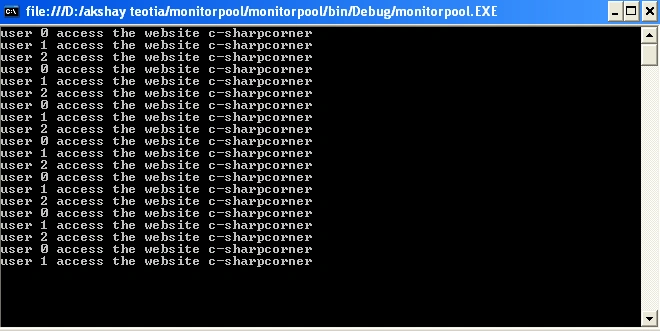
Monitor Pool
A thread pool is a collection of threads that can be used to perform a number of tasks in the background. Thread pools are often employed in server applications. Each incoming request is assigned to a thread from the thread pool. Once a thread in the pool completes its task, it is returned to a queue of waiting threads, where it can be reused. This reuse enables applications to avoid the cost of creating a new thread for each task.
using
System;
using
System.Threading;
namespace
monitorpool
{
class Akshay
{
private const
int threads = 3;
private const
int workitems = 20;
private static
Object locker = new
Object();
static void
Worker()
{
while (true)
{
lock (locker)
{
Monitor.Wait(locker);
}
System.Console.WriteLine("{0}
access the website c-sharpcorner", Thread.CurrentThread.Name);
Thread.Sleep(100);
}
}
[STAThread]
static void
Main(string[] args)
{
Thread[] t =
new Thread[threads];
for (int
k = 0; k < threads; k++)
{
t[k] = new
Thread(new
ThreadStart(Worker));
t[k].Name = "user " + k;
t[k].IsBackground = true;
t[k].Start();
}
for (int
i = 0; i < workitems; i++)
{
Thread.Sleep(1000);
lock (locker)
{
Monitor.Pulse(locker);
}
}
Console.Read();
}
}
}
Output
Bohdan StupakPosted May 2, 2020, 8:59 AM
You have a typo in a word "pulse". Also, I'd love to see a brief explanation of what is the purpose of the 3rd example