

Introduction
TypeScript, an open-source language, is a typed superset of JavaScript that compiles to plain JavaScript. It adds optional static typing and class-based object-oriented programming to the language. Some of the key features it provides are type support and code encapsulation.
Overview of the relation between TypeScript and JavaScript
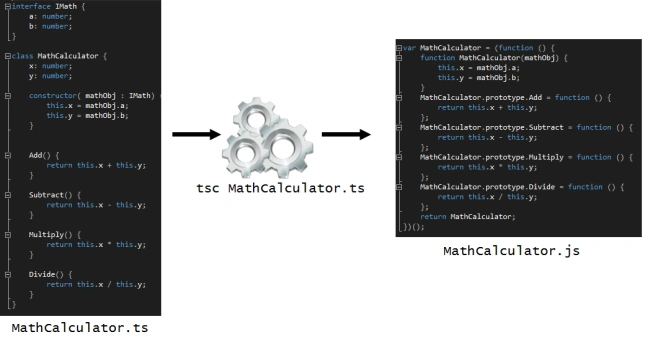
As in the above figure,
MathCalculator.ts is a TypeScript file that is compiled by tsc, the TypeScript compiler, to the MathCalculator.js file. Then one can use this MathCalculator.js
in their application.
OOPS Features of TypeScript
-
Supports Key JavaScript Features
-
Provides static typing
-
Supports constructors, properties and functions
-
Define Interfaces
-
Encapsulation through classes and modules
-
Support lambdas =>
TypeScript Annotations
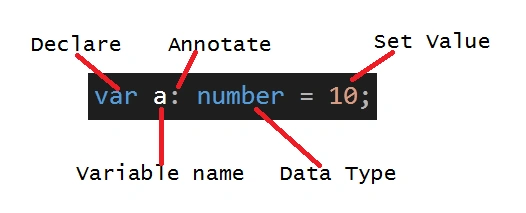
Primitive
Types
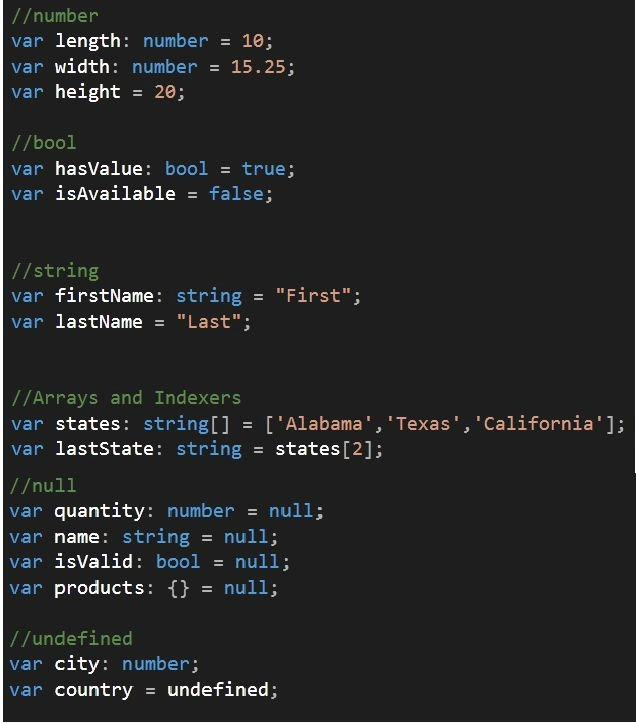
Basic primitive types
are number, bool, string, null and undefined.
Object Types
Object literals

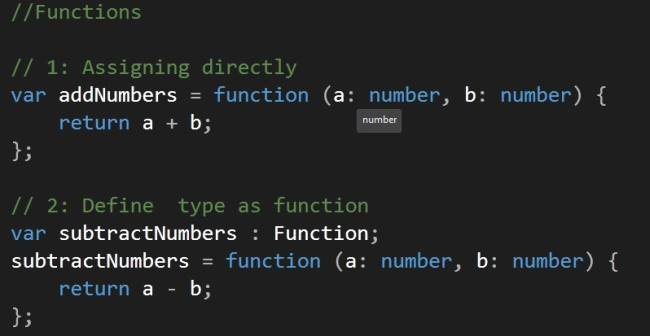
Functions
Here functions can be used in the
following two ways:
-
Assigning the function directly
-
Defining a type as a function and then assign a function
Arrow function expressions

Equivalent JavaScript code

Dynamic and Static typing
|
TypeScript
|
JavaScript
|
|
Static typing is
optional here
|
Only dynamic
typing is supported
|
|
Type safety is
checked at compile time
|
Type safety is
checked at run time
|
Summary
In this article, we have seen that
TypeScript *.ts files are compiled to *.js files by the TypeScript compiler (tsc).
Also, we have seen annotations and various object types available in TypeScript.
In future articles, we will explore classes, interfaces, and modules.
Amit KumarPosted Feb 15, 2017, 10:31 PM
Awesome!! About TypeScript
ahmed mahmoudPosted Jan 15, 2013, 1:29 PM
:)
Nitin BhardwajPosted Jan 15, 2013, 5:58 AM
Nice explanation.