

Introduction
Whenever we hear the terms Inversion of Control (IoC), Dependency Inversion Principle (DIP), and Dependency Injection (DI), they often seem similar and confusing. As developers, we use these concepts every day, but when it's time to explain the difference to someone, we suddenly find ourselves unsure.
I believe we should start from the very beginning and understand why these concepts were introduced and where each one fits. Once the foundation is clear, IoC, DIP, and Dependency Injection become much easier to understand and remember.
In this article, I'll share the approach that helped me clearly understand all three concepts. Instead of memorizing definitions, we'll first understand them conceptually and then use a simple example to see exactly where IoC, DIP, and Dependency Injection fit together.
Why Do We Get Confused?
In my experience, the confusion comes from focusing on the implementation rather than the idea behind it.
Most of us start with Dependency Injection because we use it in our code every day. We learn how to register services in the DI container and inject them into constructors, mainly to complete our tasks. However, we rarely stop to ask why we are using it or which design principle it represents.
While writing code, we rarely pause and ask ourselves questions such as:
Why am I writing the code this way?
Which design principle or pattern am I following?
What problem is this approach trying to solve?
As a result, we learn the syntax and framework features but fail to connect them with the underlying design principles. Because of this, when someone asks us to explain IoC, DIP, or Dependency Injection, we know how to write the code but struggle to explain the concepts behind it.
The Right Order to Learn These Concepts
I believe these concepts should be learned in the following sequence:
Inversion of Control (IoC)
Dependency Inversion Principle (DIP)
Dependency Injection (DI)
Looking at these three terms, you probably understand their English meanings.
But can you relate them to the way software is designed and objects are created in an application?
If not, let's use a simple example to understand each concept.
Example: A Mobile Phone and a SIM Card
Let's use a mobile phone as an example. Every mobile phone requires a SIM card to function.
We'll use this simple scenario to understand IoC, DIP, and Dependency Injection.
Understanding Inversion of Control (IoC)
Consider the following code.
public class JioSim
{
}

public class Phone
{
    private JioSim _simCard = new JioSim();
}

public class Program
{
    public static void Main()
    {
        Phone phone = new Phone();
    }
}
Who Controls Object Creation?
The Phone class creates the JioSim object itself.
The client (Main) has no control over that decision.
In other words, the Phone class owns the responsibility for creating its dependency.
What's the Problem?
Currently, the Phone class depends directly on JioSim.
Suppose tomorrow we want the phone to work with an AirtelSim.
Since the Phone class creates a JioSim directly, we must modify the Phone class every time the SIM implementation changes.
As the application grows, many parts of the system may depend on the Phone class. Every modification increases maintenance effort and testing costs.
To solve problems like this, software engineers follow design principles that make applications easier to maintain, extend, and test.
What Is Inversion of Control (IoC)?
Inversion of Control (IoC) is a design principle that states:
The responsibility for creating and managing dependencies should be transferred from the class itself to another component, such as a client, factory, or dependency injection container.
Understanding "Control"
In the first example:
The
Phoneclass controls object creation.
Understanding "Inversion"
Inversion simply means moving that control elsewhere.
Instead of the Phone class creating its own dependency, another component should create it and provide it.
Applying IoC
First, create an abstraction.
public interface ISimcard
{
    void ActivateSim();
    void DeactivateSim();
}
Now implement it.
public class JioSim : ISimcard
{
    public void ActivateSim()
    {
        Console.WriteLine("JioSim is Activated");
    }

    public void DeactivateSim()
    {
        Console.WriteLine("JioSim is Deactivated");
    }
}
Modify the Phone class.
public class Phone
{
    private readonly ISimcard _simcard;

    public Phone(ISimcard simcard)
    {
        _simcard = simcard;
    }
}
Now the client creates the dependency.
public class Program
{
    public static void Main()
    {
        ISimcard simcard = new JioSim();

        Phone phone = new Phone(simcard);
    }
}
Tomorrow, changing the implementation becomes easy.
ISimcard simcard = new AirtelSim();

Phone phone = new Phone(simcard);
What Changed?
Previously:
Phonecreated its own dependency.
Now:
The client creates the dependency.
The client decides which implementation to use.
The responsibility for object creation has moved away from the Phone class.
That transfer of responsibility is Inversion of Control (IoC).
However, one question still remains:
Why does the Phone class depend on ISimcard instead of JioSim?
The answer is the Dependency Inversion Principle.
Understanding the Dependency Inversion Principle (DIP)
The Dependency Inversion Principle (DIP) is one of the five SOLID principles.
It states:
High-level modules should not depend on low-level modules. Both should depend on abstractions.
What Is a High-Level Module?
A high-level module contains business logic.
It represents what the application is trying to achieve.
In our example:
Phoneis the high-level module.
What Is a Low-Level Module?
A low-level module contains implementation details.
In our example:
JioSimis the low-level module.
Does the First Design Follow DIP?
No.
public class Phone
{
    private JioSim _simCard = new JioSim();
}
The high-level module (Phone) depends directly on the low-level module (JioSim).
Every time the SIM implementation changes, the Phone class must also change.
This violates DIP.
Applying DIP
Instead of depending on JioSim, the Phone class depends on the abstraction.
public class Phone
{
    private readonly ISimcard _simcard;

    public Phone(ISimcard simcard)
    {
        _simcard = simcard;
    }
}
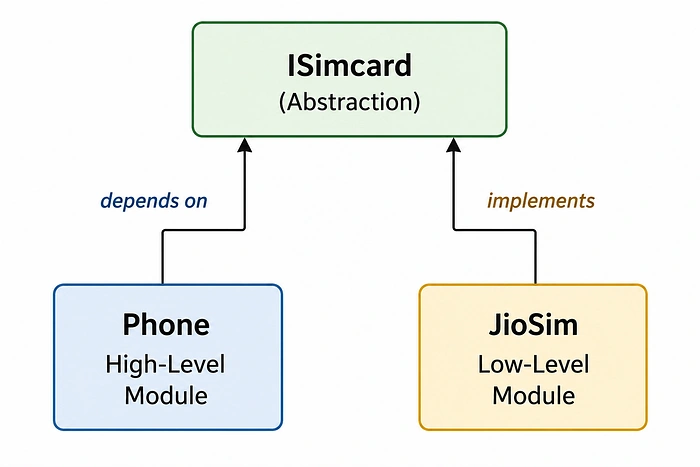
Now:
Phonedepends onISimcard.JioSimimplementsISimcard.
Therefore:
High-level module →
PhoneLow-level module →
JioSimAbstraction →
ISimcard
Both modules now depend on the same abstraction, exactly as DIP recommends.
Understanding Dependency Injection (DI)
We've learned that:
The
Phoneclass should depend onISimcard.
But another question remains:
Who creates the JioSim object?
The process of creating the dependency outside the class and supplying it to the class is called Dependency Injection (DI).
Wikipedia defines Dependency Injection as:
"Dependency injection aims to separate the concerns of constructing objects and using them, leading to loosely coupled programs."
Applying Dependency Injection
The client creates the dependency.
ISimcard simcard = new JioSim();

Phone phone = new Phone(simcard);
The Phone class simply uses it.
public Phone(ISimcard simcard)
{
    _simcard = simcard;
}
Notice the clear separation of responsibilities.
Constructing the Dependency
ISimcard simcard = new JioSim();
Injecting the Dependency
Phone phone = new Phone(simcard);
Using the Dependency
public Phone(ISimcard simcard)
{
    _simcard = simcard;
}
The Phone class:
Doesn't create the dependency.
Doesn't know how it was created.
Simply uses it.
This makes the class loosely coupled and easier to maintain and test.
Relationship Between IoC, DIP, and DI
These three concepts work together, but they answer different questions.
| Concept | Answers |
|---|---|
| IoC (Inversion of Control) | Who should control object creation? |
| DIP (Dependency Inversion Principle) | What should high-level modules depend on? |
| DI (Dependency Injection) | How is the dependency supplied to the class? |
Dependency Injection is one of the most common techniques used to implement Inversion of Control while following the Dependency Inversion Principle.
Conclusion
Although Inversion of Control (IoC), Dependency Inversion Principle (DIP), and Dependency Injection (DI) are closely related, they represent different aspects of software design.
IoC shifts the responsibility for object creation away from a class. DIP recommends that high-level modules depend on abstractions rather than concrete implementations. Dependency Injection is the practical technique used to provide those abstractions to a class from the outside.
Understanding these concepts in the correct order helps eliminate confusion and makes it easier to design applications that are loosely coupled, maintainable, extensible, and easier to test.
Join the conversation! Your thoughts help the community grow.