

A stablecoin sandwich is a payment method where money starts in regular currency, moves across a blockchain as a stablecoin, and ends again as regular currency.
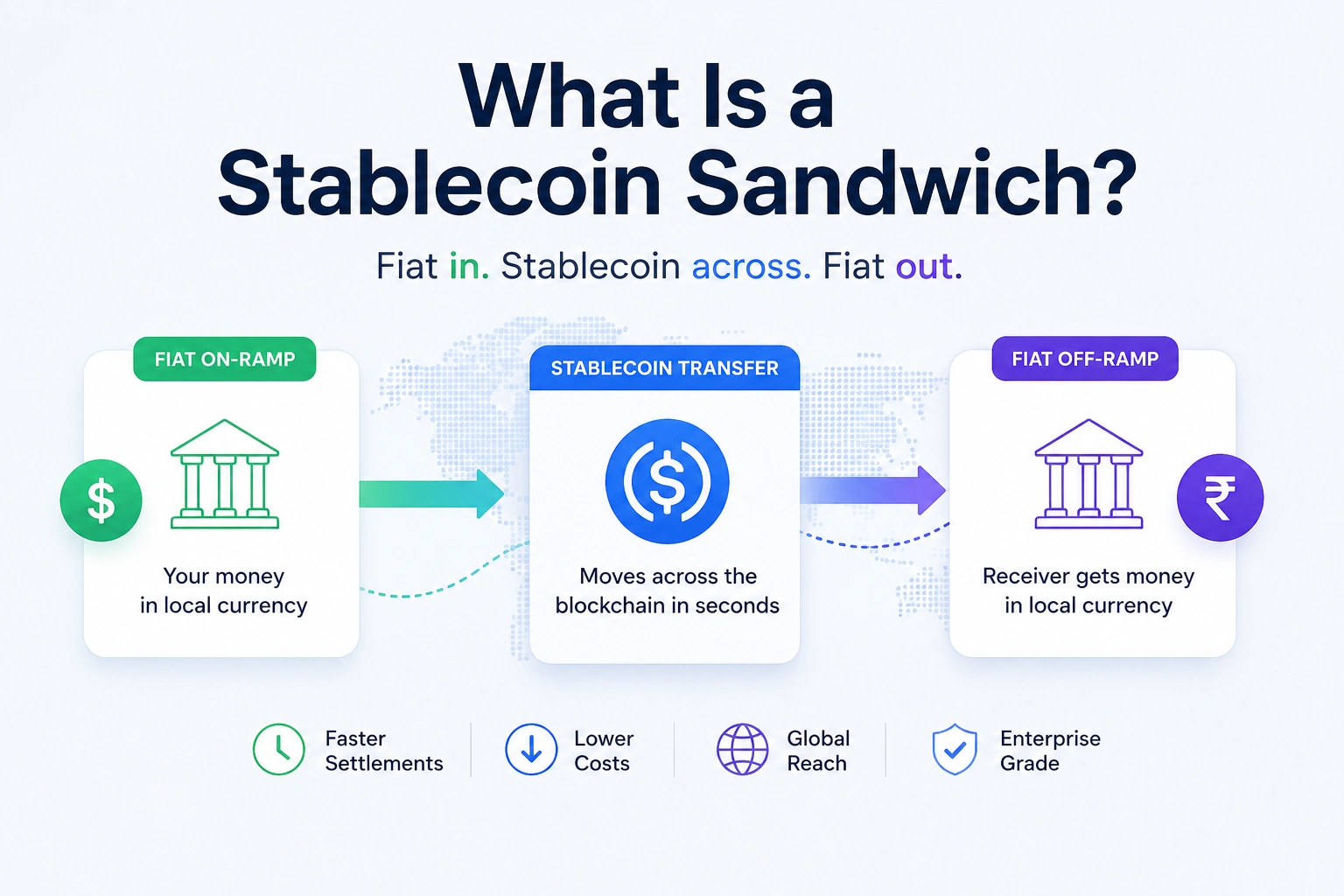
In simple words:
Fiat currency goes in
Stablecoin moves across the network
Fiat currency comes out
This model helps businesses send international payments faster and cheaper without forcing customers or suppliers to use crypto directly.
Companies like Stripe, Visa, Mastercard, and Polygon are building payment systems around this idea.
Abstract / Overview
Global payments are still slow and expensive in many countries. Traditional banking systems rely on intermediaries, banking hours, and settlement delays.
Stablecoins are changing that.
A stablecoin is a digital token linked to a stable asset like the US dollar. Popular examples include:
USDC
USDT
A stablecoin sandwich uses these digital dollars as the transport layer for payments.
The sender pays in fiat currency like USD or INR. The payment moves as a stablecoin across blockchain rails such as Polygon. The receiver gets local currency like MXN or EUR.
The stablecoin exists only in the middle layer.
This approach is becoming the standard design for enterprise stablecoin payments.
Businesses exploring blockchain payment systems can also work with https://www.c-sharpcorner.com/consulting/ C# Corner Consulting for payment architecture, fintech platforms, API integration, and blockchain modernization services.
Conceptual Background
What Is a Stablecoin?
A stablecoin is a cryptocurrency designed to maintain a stable value.
Most stablecoins are tied to fiat currencies such as:
US Dollar
Euro
British Pound
Unlike Bitcoin or Ethereum, stablecoins are built for payment stability rather than speculation.
Academic research shows stablecoins are becoming important tools for decentralized payment systems and global settlement networks.
Why Traditional Cross-Border Payments Are Slow
Traditional international payments usually involve:
Multiple banks
Correspondent banking chains
Manual compliance checks
Currency conversion delays
Banking hour limitations
This creates:
High fees
Delayed settlements
Limited transparency
A traditional wire transfer can take 1–5 business days. Stablecoin rails can reduce this to minutes or hours.
How the Stablecoin Sandwich Works
The stablecoin sandwich has three layers.

Layer 1: Fiat On-Ramp
The sender’s local currency converts into a stablecoin.
Example:
USD becomes USDC
EUR becomes USDT
This step usually includes:
KYC verification
AML checks
Compliance screening
The user still works with regular money.
Layer 2: Stablecoin Settlement
The stablecoin moves across blockchain rails.
This is the fast part.
According to Polygon, transfers on its network settle in seconds with very low fees. (Polygon Labs)
Benefits include:
24/7 settlement
No banking holidays
Lower transaction fees
Faster global transfers
Layer 3: Fiat Off-Ramp
The stablecoin converts back into local currency.
Example:
USDC converts into Mexican Peso
USDC converts into Indian Rupee
The receiver gets money directly into a bank account.
The receiver may never know stablecoins were used.
Example: USD to MXN Supplier Payment
A US company needs to pay a supplier in Mexico.
Step 1
The company sends $50,000 USD to a payment platform.
Step 2
The platform converts USD into USDC.
Step 3
USDC moves across the Polygon network.
Step 4
A Mexican payment partner converts USDC into MXN.
Step 5
The supplier receives pesos in a local bank account.
Polygon says this process can be completed within hours instead of several business days.
Why Companies Use the Stablecoin Sandwich Model
Faster Settlement
Traditional systems can take days.
Stablecoin rails settle in seconds.
Lower Costs
Blockchain settlement removes many intermediary fees.
Polygon reports transaction costs can be fractions of a cent in optimized systems.
Better Global Reach
Stablecoin systems work continuously.
There are no:
Weekend pauses
Bank holidays
Regional banking restrictions
Easier Enterprise Adoption
Most companies do not want to hold crypto on balance sheets.
The stablecoin sandwich keeps the user experience in fiat currency while using blockchain underneath.
That is why this design has become popular among enterprise payment providers.
Full Sandwich vs Open Sandwich
Full Stablecoin Sandwich
The payment starts and ends in fiat.
The stablecoin is only temporary infrastructure.
This is the most common enterprise setup.
Open Sandwich
The recipient keeps the stablecoin instead of converting immediately.
This is useful for:
Treasury management
Inflation protection
Global liquidity access
Digital-native businesses
Polygon describes this as a growing use case in international finance.
Real-World Use Cases
B2B Supplier Payments
Companies can pay international suppliers faster.
Payroll
Global payroll providers can send salaries across countries more efficiently.
Marketplace Payouts
Freelancer and creator platforms can process payouts globally.
Treasury Operations
Businesses can move liquidity across regions faster.
Remittances
Families can receive international transfers with lower fees.
Why Polygon Is Important in Stablecoin Payments
Polygon has become one of the major settlement layers for stablecoin payments.
Polygon states that trillions in stablecoin volume have moved across its network. (Polygon Labs)
Major ecosystem participants include:
Stripe
Visa
Mastercard
Revolut
Paxos
Recent reports show Polygon is investing heavily in stablecoin infrastructure and payment systems. (Reuters)
Key Risks and Challenges
Regulatory Compliance
Different countries have different crypto rules.
Payment providers must handle:
Licensing
AML compliance
KYC verification
Off-Ramp Infrastructure
The slowest part is usually the fiat conversion at the edges.
The blockchain transfer itself is already very fast.
FX Costs
Currency exchange spreads still exist during fiat conversion.
Stablecoin Risk
Not all stablecoins are equally safe.
Research shows some stablecoin designs can fail during market stress.
How Businesses Should Evaluate Stablecoin Providers
Before choosing a provider, businesses should check:
Regulatory licensing
Country coverage
Settlement speed
API quality
Compliance tooling
Stablecoin support
Blockchain reliability
The best platforms combine:
On-ramp
Settlement
Off-ramp
Compliance
into a single integration.
Companies needing help with payment modernization, blockchain architecture, or fintech integration can also explore https://www.c-sharpcorner.com/consulting/ C# Corner Consulting for enterprise-grade implementation support.
Future of Stablecoin Sandwich Payments
The market is growing quickly.
Recent industry reports show:
Stablecoin payment adoption is increasing globally
Enterprise payment providers are expanding stablecoin infrastructure
Financial firms are integrating blockchain settlement rails
Experts expect:
Faster international settlement
Lower payment costs
More regulatory clarity
Better banking integrations
over the next few years.
Future Enhancements
Possible future improvements include:
Instant fiat off-ramping
AI-driven payment routing
Multi-currency stablecoin support
CBDC integration
Real-time FX optimization
FAQs
1. What is a stablecoin sandwich?
A stablecoin sandwich is a payment model where fiat currency converts into stablecoins for blockchain settlement and then converts back into fiat currency for the receiver.
2. Why is it called a sandwich?
Fiat currency exists on both ends, while the stablecoin transfer is in the middle layer.
3. Do users need crypto wallets?
Usually no. Most enterprise systems hide the blockchain layer from end users.
4. Which stablecoins are commonly used?
USDC and USDT are the most common choices for payment systems.
5. Is the stablecoin sandwich faster than bank wires?
Yes. Many stablecoin payment systems settle in minutes or hours instead of days.
6. Which companies are using this model?
Companies like Stripe, Visa, Mastercard, Revolut, and Polygon are building payment systems around stablecoin settlement rails.
Conclusion
The stablecoin sandwich is becoming one of the most important payment models in modern fintech.
It combines:
Fiat currency usability
Blockchain settlement speed
Lower transaction costs
Global payment access
without forcing businesses or customers to become crypto experts.
The blockchain layer stays invisible while delivering faster and cheaper global settlement underneath.
As stablecoin infrastructure improves, this model could become the default architecture for international payments.
For fintech startups, banks, payment providers, and enterprise platforms, understanding the stablecoin sandwich is no longer optional. It is becoming part of the future of the money movement.
References
Polygon Blog: What Is a Stablecoin Sandwich?
https://polygon.technology/blog/what-is-a-stablecoin-sandwichPolygon Developer Documentation
https://docs.polygon.technology/stablecoins-payments/stablecoinsReuters: Polygon Targets Stablecoin Payments With Deals Worth $250 Million
https://www.reuters.com/business/polygon-targets-stablecoin-payments-with-deals-worth-250-million-2026-01-13/arXiv: What is Stablecoin?: A Survey on Its Mechanism and Potential as Decentralized Payment Systems
https://arxiv.org/abs/1906.06037arXiv: What Drives the (In)stability of a Stablecoin?
https://arxiv.org/abs/2307.11754arXiv: Understand Volatility of Algorithmic Stablecoin
https://arxiv.org/abs/2101.08423
Join the conversation! Your thoughts help the community grow.