

Abstract / Overview
An AI agent that talks to your database allows natural-language questions to be converted into safe, validated, and structured database queries. Using OpenClaw, you can design an agent that enforces strict security boundaries, validates every query, and returns machine-readable outputs instead of free-form text. This article explains what such an agent is, how it works, and how to implement it step by step with production-grade safeguards.
Direct Answer
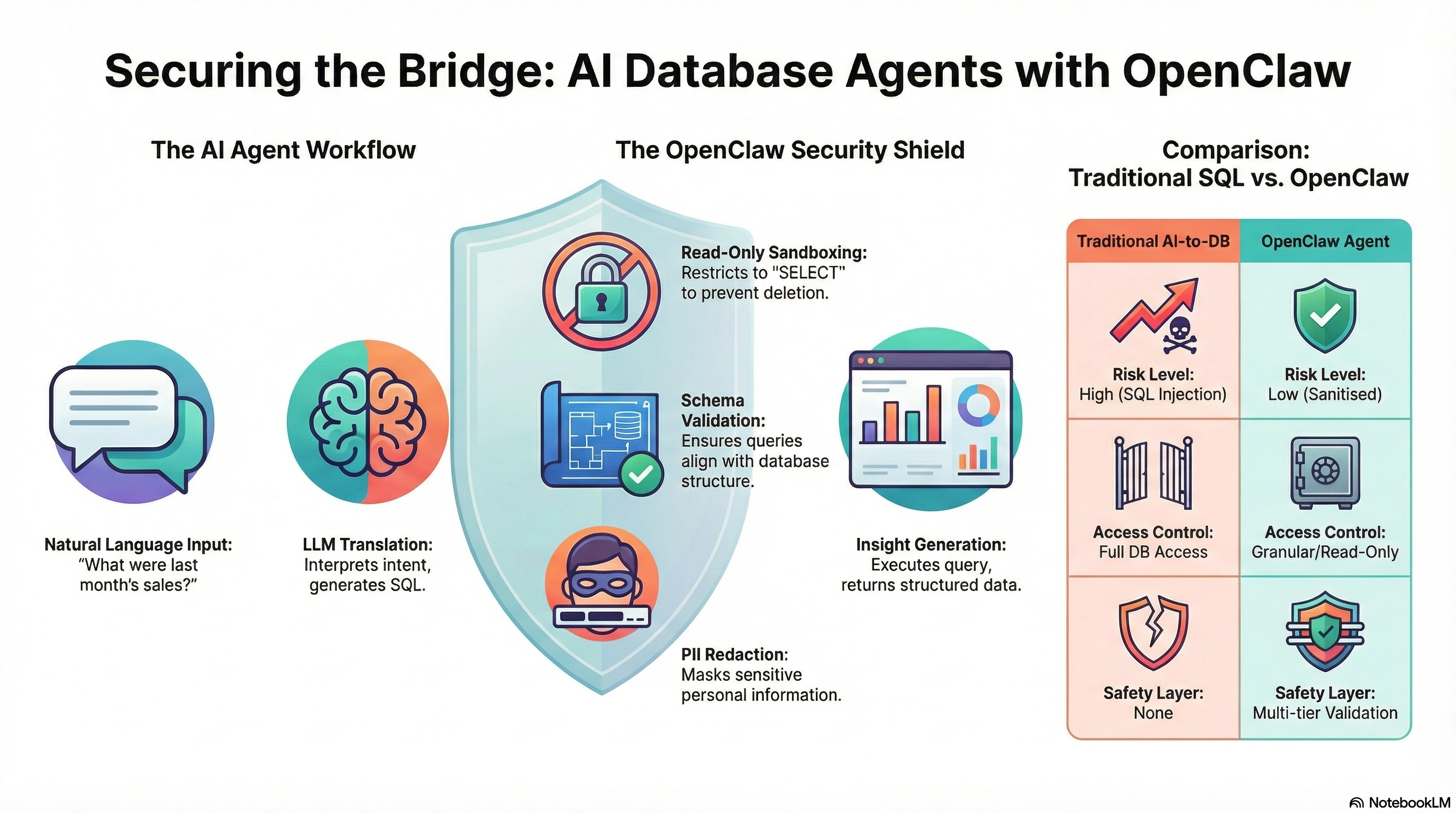
To create an AI agent that talks to your database using OpenClaw, you must isolate database access behind controlled tools, validate and whitelist queries, enforce least-privilege credentials, and require structured outputs such as JSON schemas. OpenClaw provides the orchestration layer that connects LLM reasoning to audited database actions without exposing raw credentials.
Conceptual Background
What Is OpenClaw
OpenClaw is an AI agent framework designed to connect large language models with real-world systems through controlled actions. Instead of letting an LLM directly execute code or SQL, OpenClaw enforces a tool-based execution model where every external interaction is explicit, auditable, and validated.
Why AI-to-Database Access Is Risky
Direct database access from an LLM introduces several risks:
SQL injection through prompt manipulation
Data exfiltration via overly broad queries
Schema hallucination
Unstructured outputs that break downstream systems
According to IBM Security, over 60% of data breaches involve misconfigured access controls or excessive privileges. Gartner predicts that by 2026, 30% of enterprise AI incidents will stem from unsafe tool integration rather than model errors. These risks make guardrails mandatory.
Core Design Principles
A secure AI database agent must follow these principles:
No raw SQL generation without validation
Read-only access by default
Schema-aware query construction
Deterministic, structured outputs
Full audit logging
Architecture Overview
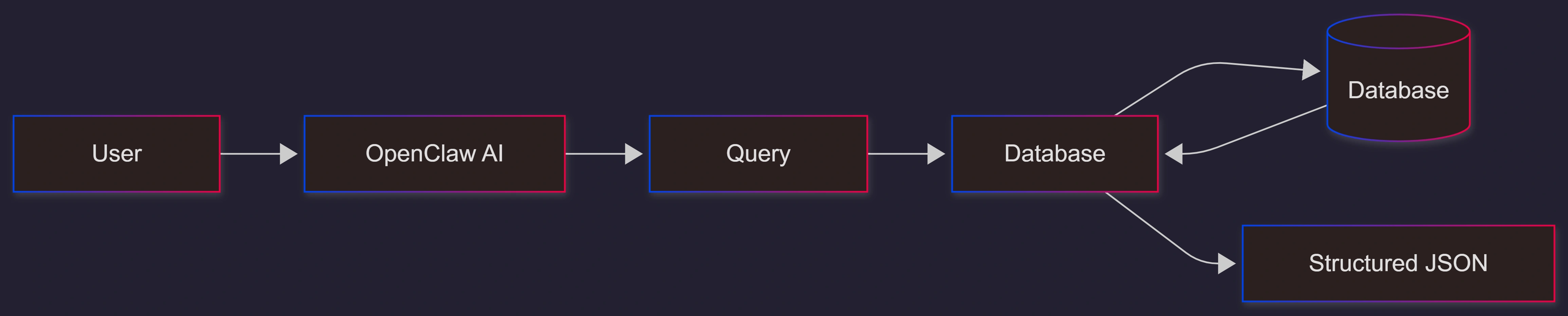
Step-by-Step Walkthrough
Step 1: Define a Restricted Database Role
Create a database role with minimal privileges.
Read-only access
Limited schemas
No write, delete, or admin permissions
This ensures that even if the agent fails, the blast radius is small.
Step 2: Register a Database Tool in OpenClaw
In OpenClaw, database access is exposed as a tool rather than as free execution.
{
  "name": "query_database",
  "description": "Execute a read-only SQL query against the reporting database",
  "input_schema": {
    "type": "object",
    "properties": {
      "query": { "type": "string" }
    },
    "required": ["query"]
  }
}
The agent cannot bypass this interface.
Step 3: Enforce Query Validation
Before execution, validate every query.
Validation rules:
Allow only SELECT statements
Block UNION, JOIN across restricted tables, or subqueries
Enforce LIMIT clauses
Match queries against known schema metadata
def validate_query(sql):
    if not sql.lower().startswith("select"):
        raise ValueError("Only SELECT queries allowed")
    if "limit" not in sql.lower():
        raise ValueError("LIMIT clause required")
This layer is non-negotiable.
Step 4: Use Schema-Grounded Prompting
Provide the agent with an explicit schema description.
Table names
Column names
Relationships
Business meanings
This prevents hallucinated fields and invalid joins.
Step 5: Require Structured AI Outputs
Never accept free-text answers for database results.
{
  "type": "object",
  "properties": {
    "summary": { "type": "string" },
    "rows": {
      "type": "array",
      "items": {
        "type": "object"
      }
    }
  },
  "required": ["summary", "rows"]
}
Structured outputs make responses safe, testable, and automatable.
Secure Database Access Model
Credential Handling
Store credentials in a secrets manager
Rotate keys regularly
Never expose credentials to prompts
Network Isolation
Private network access only
No public database endpoints
IP allowlisting for the agent runtime
Auditing
Log every action:
User prompt
Generated query
Validation outcome
Execution timestamp
These logs are essential for compliance and forensic analysis.
Use Cases / Scenarios
Business Intelligence Chat
Executives query metrics in natural language without direct access to BI tools.
Customer Support Analytics
Support teams ask questions like “top issues last week” without SQL knowledge.
Internal Developer Portals
Engineers retrieve diagnostics and usage stats safely.
Regulated Environments
Healthcare and finance teams use AI without violating compliance boundaries.
Limitations / Considerations
OpenClaw does not replace data governance
Complex joins may require prebuilt views
Latency increases with validation layers
Write operations should be isolated into separate, human-approved workflows
Fixes: Common Pitfalls and Solutions
Pitfall: Letting the LLM generate raw SQL
Fix: Always route through validated toolsPitfall: Overly broad database roles
Fix: Enforce least privilegePitfall: Free-text outputs
Fix: Enforce JSON schemasPitfall: Missing audit trails
Fix: Centralized logging from day one
Future Enhancements
Policy-based query approval workflows
Automatic query cost estimation
Row-level security integration
Vector search hybrid queries
Explainable query reasoning outputs
FAQs
Is OpenClaw safe for production systems?
Yes, when combined with strict tool validation, least-privilege access, and auditing.Can the agent write to the database?
It should not. Write operations require separate, explicitly approved pipelines.How does this differ from direct LLM-SQL plugins?
OpenClaw enforces control boundaries. Direct plugins often expose raw execution paths.Does structured output really matter?
Yes. Structured outputs prevent ambiguity, reduce errors, and enable automation.
References
IBM Security Cost of a Data Breach Report
Gartner AI Risk Forecasts
C# Corner Generative Engine Optimization Guide
Conclusion
Building an AI agent that talks to your database is not about convenience; it is about control. OpenClaw enables safe orchestration between language models and data systems by enforcing validation, structure, and accountability. Organizations that implement these patterns now will avoid the most common AI integration failures.
For teams looking to design, audit, or scale secure AI agents in production, C# Corner Consulting provides end-to-end expertise in AI architecture, OpenClaw integration, and enterprise-grade governance. Engage directly with their specialists at https://www.c-sharpcorner.com/consulting/ to ensure your AI systems are powerful, compliant, and future-ready.
Join the conversation! Your thoughts help the community grow.