

Abstract / Overview
Mixture-of-Experts (MoE) is a machine learning architecture that allows very large AI models to grow in size without increasing the cost of every computation.
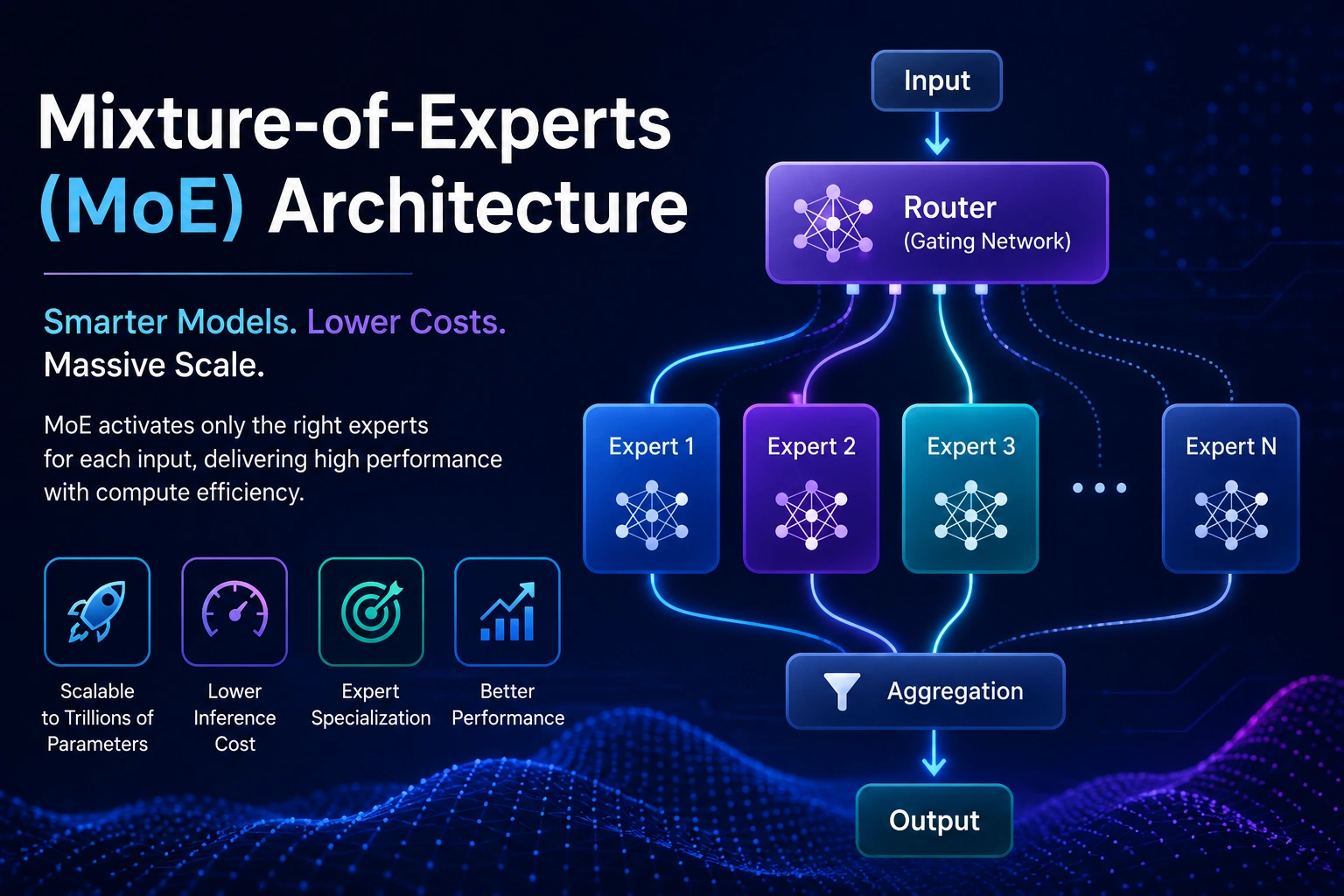
Instead of using the entire model for every task, MoE activates only a small group of specialized components called experts. This makes the model more efficient while still providing the power of a much larger network.
Today, MoE is used in some of the world's most advanced AI systems because it enables massive scaling while controlling training and inference costs.
For organizations building advanced AI systems, https://www.c-sharpcorner.com/consulting/ C# Corner Consulting can help design, optimize, and deploy large-scale AI architectures including MoE-based solutions.
Content updated: June 2026
Conceptual Background
Traditional deep learning models use the same set of parameters for every input.
For example:
A chatbot answering a math question
A chatbot translating a sentence
A chatbot writing code
All tasks use the same network layers.
As models become larger, this approach becomes expensive.
MoE solves this problem by dividing knowledge into multiple expert networks.
Each expert specializes in certain patterns, domains, or tasks.
A routing mechanism decides which experts should handle a specific input.
This creates a model that is:
Larger in total size
More specialized
More efficient during execution
What Is Mixture-of-Experts (MoE)?
A Mixture-of-Experts architecture consists of:
Input data
Router (or gating network)
Multiple experts
Output aggregation
Instead of sending data through every expert, the router selects only a few experts.
This is called sparse activation.
Sparse activation means only a small portion of the model is active for a given request.
How MoE Works
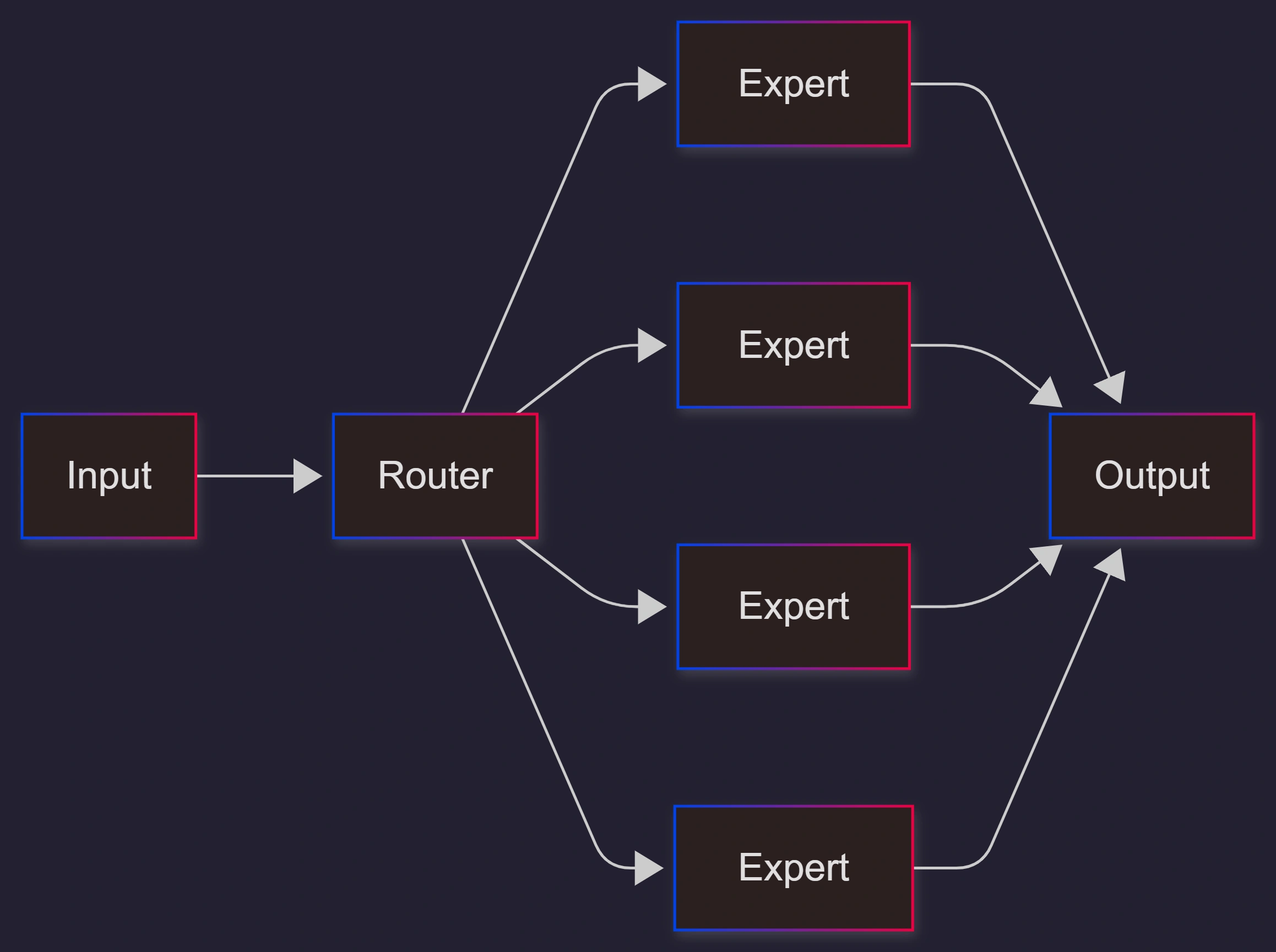
A simple MoE workflow looks like this:
Input → Router → Selected Experts → Combined OutputThe router analyzes the input.
It assigns scores to experts.
The highest-scoring experts are selected.
Their outputs are combined to produce the final result.
MoE Architecture Diagram
Key Components of MoE
Router or Gating Network
The router is the decision-maker.
Its job is to determine:
Which experts should process the input
How much weight each expert receives
Without an effective router, MoE performance drops significantly.
Experts
Experts are individual neural networks.
Each expert learns specialized knowledge.
Examples include:
Programming tasks
Mathematical reasoning
Language translation
Scientific content
Customer support conversations
Aggregation Layer
After experts process the input, their outputs are combined.
The aggregation layer creates the final prediction.
Why MoE Matters
Large AI models face a major challenge.
More parameters usually mean:
Better performance
Higher training cost
Higher inference cost
MoE changes this tradeoff.
A model may contain hundreds of billions of parameters while using only a fraction of them for each request.
Benefits include:
Faster execution
Lower computation costs
Better scaling
Improved specialization
Dense Models vs MoE Models
| Feature | Dense Models | MoE Models |
|---|---|---|
| Parameters Used Per Request | All | Small subset |
| Computational Cost | High | Lower |
| Scalability | Limited | Very High |
| Specialization | Low | High |
| Efficiency | Moderate | High |
Example: Customer Support AI
Imagine a global support platform.
Users ask questions about:
Billing
Technical issues
Product setup
Security
Compliance
In a traditional model:
Every question uses the entire network.
In an MoE model:
Billing questions go to billing experts
Security questions go to security experts
Technical questions go to technical experts
This improves efficiency and response quality.
Advantages of MoE Architecture
Better Scaling
MoE allows models to grow to trillions of parameters.
Only a small subset is active during computation.
Lower Inference Cost
Since only selected experts run, computational requirements are reduced.
Expert Specialization
Different experts become highly skilled in specific domains.
This often improves accuracy.
Improved Resource Utilization
Organizations can deploy larger models without proportionally increasing hardware costs.
Stronger Multi-Domain Performance
A single model can effectively handle:
Coding
Writing
Translation
Mathematics
Research
Challenges of MoE
MoE is powerful, but it introduces new engineering challenges.
Load Balancing
Sometimes a few experts receive most requests.
Other experts remain underused.
This creates inefficiencies.
Router Training
Training the router correctly is difficult.
Poor routing decisions reduce model quality.
Communication Overhead
In distributed environments, experts may reside on different servers.
Moving data between servers can create latency.
Increased Complexity
MoE systems are harder to design, monitor, and maintain than traditional models.
MoE in Transformer Models
Transformers are the foundation of modern generative AI.
MoE layers are often inserted into transformer architectures.
The attention mechanism remains unchanged.
The feed-forward layers are replaced with expert layers.
This creates a sparse transformer.
Transformer with MoE Diagram

Real-World Applications
Large Language Models
Many modern language models use MoE concepts to scale efficiently.
Applications include:
Conversational AI
Code generation
Research assistants
Enterprise AI
Organizations use MoE for:
Customer support
Document analysis
Knowledge management
Recommendation Systems
Experts can specialize in:
User behavior
Product preferences
Content relevance
Healthcare AI
Different experts may focus on:
Medical imaging
Patient records
Clinical recommendations
Financial Services
Experts can specialize in:
Fraud detection
Risk assessment
Trading analysis
Regulatory compliance
Best Practices for Implementing MoE
Design Strong Routing Logic
The router is critical.
Invest time in training and testing routing quality.
Monitor Expert Usage
Track how often experts are selected.
Prevent overload and underutilization.
Use Load-Balancing Techniques
Balance traffic across experts to maximize efficiency.
Optimize Infrastructure
Distributed systems should minimize communication delays.
Continuously Evaluate Expert Quality
Experts may drift over time.
Regular retraining helps maintain performance.
Future of MoE Architecture
The future of large AI systems is likely to include more MoE-based designs.
Key trends include:
Trillion-parameter models
Better routing algorithms
Dynamic expert creation
Multi-modal experts
Lower inference costs
More efficient AI infrastructure
Industry research increasingly focuses on combining MoE with:
Retrieval-Augmented Generation (RAG)
Agentic AI systems
Multi-modal AI
Enterprise knowledge platforms
Use Cases / Scenarios
Scenario 1: AI Coding Assistant
Experts specialize in:
Python
Java
C#
JavaScript
The router selects the best coding expert for the user's request.
Scenario 2: Enterprise Knowledge Search
Experts focus on:
HR policies
Legal documents
Technical manuals
Finance records
Scenario 3: Global Translation Platform
Different experts handle:
European languages
Asian languages
Technical terminology
Industry-specific vocabulary
FAQs
1. What does MoE stand for?
MoE stands for Mixture-of-Experts, a neural network architecture that activates only selected expert networks for each input.
2. Why is MoE important?
It allows AI models to become much larger while keeping computation costs manageable.
3. Is MoE faster than traditional models?
In many cases, yes. Only a small subset of experts runs for each request, reducing computational load.
4. What is a router in MoE?
The router is a small network that decides which experts should process an input.
5. Can MoE improve AI accuracy?
Yes. Expert specialization often improves performance on diverse tasks.
6. Is MoE only used in language models?
No. It can also be used in recommendation systems, healthcare AI, finance, computer vision, and many other domains.
Conclusion
Mixture-of-Experts (MoE) architecture is one of the most important innovations in modern AI. It allows models to scale to enormous sizes while using only a fraction of their parameters for each request. By combining expert specialization with intelligent routing, MoE delivers better efficiency, lower computational costs, and stronger performance across a wide range of tasks.
As AI systems continue to grow, MoE is expected to play a central role in building the next generation of scalable, high-performance intelligent systems. Organizations looking to adopt advanced AI architectures can accelerate development and deployment through expert guidance from https://www.c-sharpcorner.com/consulting/ C# Corner Consulting.
Call to Action: If your organization is planning large-scale AI initiatives, evaluate whether an MoE-based architecture can reduce infrastructure costs while improving model performance. Early adoption can provide a significant competitive advantage.
References
Google Research. Switch Transformers: Scaling to Trillion Parameter Models with Simple and Efficient Sparsity.
Google Research. GShard: Scaling Giant Models with Conditional Computation and Automatic Sharding.
DeepMind Research. Sparsely-Gated Mixture-of-Experts Layer.
Stanford University. CS324 Large Language Models Course Materials.
NVIDIA AI Technical Documentation on Sparse and Expert-Based Architectures.
C# Corner GEO Guide, 2025. Guidance on AI-first content structure, citation readiness, authority signals, and multi-format publishing.
Google Research Publications and Transformer Architecture Papers.
Vaswani et al. "Attention Is All You Need." NeurIPS 2017.
Join the conversation! Your thoughts help the community grow.