

Introduction
Today, almost every business is using cloud computing to run websites, mobile apps, databases, and digital services. Instead of storing data on local servers, companies now rely on cloud platforms like AWS, Microsoft Azure, and Google Cloud.
But here is an important shift happening in the industry — companies are no longer depending on just one cloud provider. Instead, they are adopting a strategy called Multi-Cloud.
In simple words, Multi-Cloud means using multiple cloud service providers at the same time. This approach helps businesses improve performance, reduce risks, and gain more control over their systems.
In this detailed guide, we will understand Multi-Cloud in simple language, how it works, why companies use it, its benefits, challenges, and real-world examples.
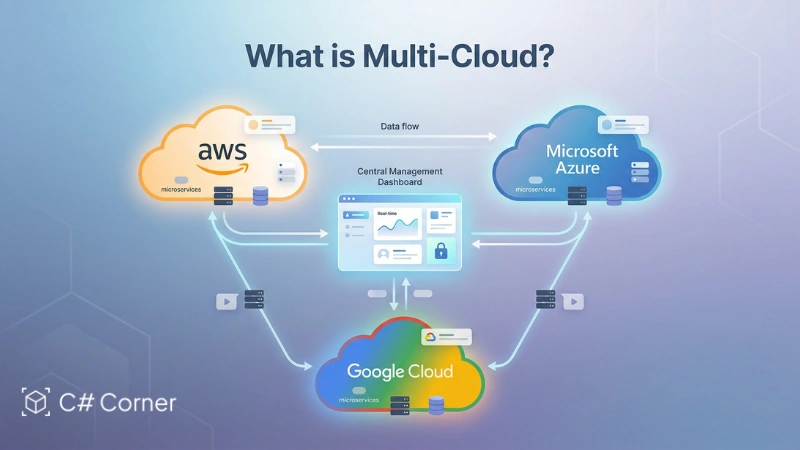
What is Multi-Cloud?
Simple Definition of Multi-Cloud
Multi-Cloud is a cloud computing strategy where a company uses two or more cloud providers instead of relying on a single one.
For example, a company might use:
AWS for hosting applications
Microsoft Azure for managing databases
Google Cloud for AI and machine learning
Instead of putting everything in one place, the company spreads its services across different cloud platforms.
Real-Life Example to Understand Multi-Cloud
Think of Multi-Cloud like using multiple apps for different purposes:
You use Google Pay for fast UPI payments
You use Paytm for wallet offers
You use PhonePe for cashback deals
You are not dependent on just one app. You use each app where it works best.
Similarly, companies use multiple cloud providers to get the best features from each.
How Multi-Cloud Works
How Systems Run Across Multiple Clouds
In a Multi-Cloud setup, different parts of a system run on different cloud platforms.
For example:
The frontend (website) runs on AWS
The database runs on Azure
The analytics system runs on Google Cloud
All these components are connected using APIs, networking, and cloud integration tools.
Behind the Scenes (In Simple Words)
Even though services are on different clouds, they communicate with each other just like different departments in a company.
For example:
When a user logs in, AWS talks to Azure to fetch user data
When a recommendation is needed, Google Cloud processes it
Everything works together as a single system, even though it is distributed.
Types of Multi-Cloud Strategy
Redundant Multi-Cloud (Backup Strategy)
In this strategy, companies use multiple cloud providers for backup and disaster recovery.
How it works:
Main application runs on one cloud (for example AWS)
Backup system is ready on another cloud (for example Azure)
If one cloud fails due to downtime or outage, the other cloud immediately takes over.
This is very important for industries like banking, healthcare, and e-commerce where downtime can cause huge losses.
Best-of-Breed Multi-Cloud
In this approach, companies choose the best service from each cloud provider.
Example:
AWS for storage because it is highly reliable
Google Cloud for AI because it has strong machine learning tools
Azure for enterprise apps because it integrates well with Microsoft products
This allows companies to get the highest performance and best results.
Cost-Optimized Multi-Cloud
Here, companies focus on saving money by choosing the most cost-effective cloud services.
For example:
Use a cheaper provider for storage
Use another provider for high-performance computing only when needed
Some companies even move workloads between clouds depending on pricing and demand.
Why Do Companies Adopt Multi-Cloud?
Avoid Vendor Lock-In
Vendor lock-in means depending completely on a single cloud provider.
Problem before Multi-Cloud:
Difficult to switch providers
High migration cost
Limited flexibility
With Multi-Cloud:
Companies can move workloads easily
They are not stuck with one provider
They can negotiate better pricing
Example:
If AWS increases its pricing, a company can shift some services to Azure or Google Cloud.
Improved Reliability and High Availability
Cloud outages can happen anytime.
Before Multi-Cloud:
If one cloud fails, the entire system goes down
After Multi-Cloud:
If one provider fails, another keeps the system running
This ensures better uptime and continuous service for users.
For example, if AWS has downtime, Azure can handle the traffic.
Better Performance and Low Latency
Different cloud providers have data centers in different locations.
Companies can use this advantage to serve users faster.
Example:
Users in India are served from AWS Mumbai region
Users in the US are served from Google Cloud US region
This reduces loading time and improves user experience.
Cost Optimization and Budget Control
Every cloud provider has different pricing models.
Companies can choose:
The cheapest storage option
The most efficient computing service
Example:
Storage may be cheaper on AWS
Compute power may be cheaper on Azure
This helps reduce overall cloud costs and improve ROI.
Access to Best Features and Tools
Each cloud provider has unique strengths.
Examples:
AWS is strong in infrastructure services
Azure is best for Microsoft-based applications
Google Cloud is powerful for AI and data analytics
With Multi-Cloud, companies can use the best tools from each platform instead of compromising.
Compliance and Data Regulations
Different countries have different rules about where data should be stored.
With Multi-Cloud:
Companies can store data in specific regions
They can follow local data laws easily
Example:
User data stored in India for compliance
Analytics processed globally
This is important for industries like finance and healthcare.
Scalability and Flexibility
Multi-Cloud makes it easy to scale applications.
During high traffic:
Companies can use multiple cloud providers together
They can handle millions of users without crashing
Example:
During a big sale (like Flipkart or Amazon sale):
Traffic is distributed across AWS and Azure
Systems remain fast and stable
Challenges of Multi-Cloud
Complexity in Management
Managing multiple cloud platforms is not easy.
Each cloud has different dashboards
Different tools and configurations
This increases complexity for developers and IT teams.
Security Risks
More cloud providers mean more entry points for potential attacks.
Companies need:
Strong security policies
Centralized monitoring
If not managed properly, security risks can increase.
Higher Operational Cost
Even though Multi-Cloud can save costs in some areas, it can also increase operational expenses.
Need skilled cloud engineers
Need monitoring and management tools
Integration Challenges
Connecting different cloud services can be complex.
APIs must be properly configured
Network latency must be managed
If integration is not done correctly, performance issues can occur.
When Should a Company Use Multi-Cloud?
Multi-Cloud is a good choice when:
The business needs high availability
The application serves global users
The company wants to avoid vendor lock-in
Different cloud services are required
It may not be suitable when:
The application is small
Budget is limited
The team lacks cloud expertise
Before vs After Multi-Cloud
Before Multi-Cloud:
Single point of failure
Limited flexibility
Dependency on one provider
After Multi-Cloud:
High availability and reliability
Better performance
More flexibility and control
Advantages and Disadvantages
Advantages
Reduced downtime risk
Better performance globally
Freedom from vendor lock-in
Cost optimization
Access to best tools
Disadvantages
Complex to manage
Higher operational effort
Security challenges
Requires skilled professionals
Real-World Example of Multi-Cloud
Let’s take an example of an e-commerce company.
AWS is used for product storage
Azure is used for payment processing
Google Cloud is used for recommendation system
During high traffic:
Workload is distributed across all clouds
System remains fast and stable
If one cloud fails:
Other clouds continue running
This ensures a smooth experience for users.
Summary
Multi-Cloud is a modern cloud computing strategy where companies use multiple cloud providers like AWS, Azure, and Google Cloud to run their applications and services. It helps businesses improve performance, reduce downtime, avoid vendor lock-in, and optimize costs. While it offers many advantages like flexibility, scalability, and better reliability, it also comes with challenges such as complexity, security risks, and higher management effort. Overall, Multi-Cloud is becoming an important approach for businesses that want to build fast, reliable, and scalable digital systems in today’s competitive world.
Join the conversation! Your thoughts help the community grow.